
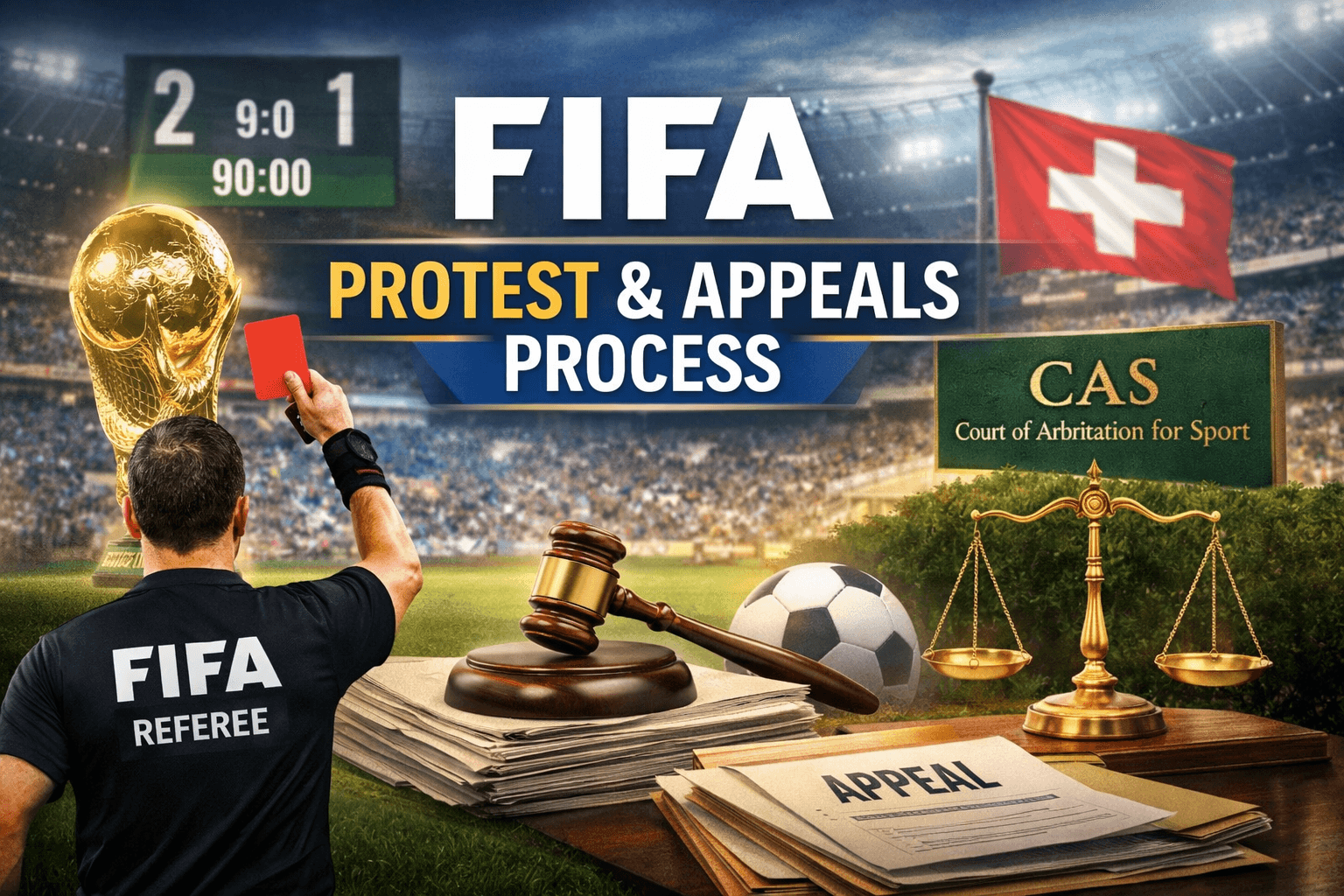
At the FIFA World Cup, any disputes are not resolved in the media or through public argument. Rather, they follow a formal procedure written in FIFA’s competition rules. When a team files a protest or a matter of discipline comes up, the case follows a normal pattern, with the system defining how the case is submitted, examined, and adjudicated.
This system is in place because of the significance of World Cup matches. These games decide who will continue and who will be eliminated, usually in front of a worldwide audience. Although decisions have to be made quickly, they must still remain consistent with the official regulations. FIFA’s procedure is intended to protect the legal rights of the parties involved while permitting the tournament to proceed without interruption.
Here is the detailed explanation of the system, from the moment a protest is filed, through the disciplinary process, and, if necessary, to the final authority responsible for deciding the case.
📌 FIFA Protest and Appeals Process — Quick Summary
Match protest deadline: Within 2 hours after the match.
Who reviews protests: FIFA Disciplinary Committee.
Can referee decisions be protested: No, referee decisions are final.
Appeal authority: FIFA internal appeals first, then Court of Arbitration for Sport (CAS).
Purpose: Ensure fair competition while keeping the World Cup on schedule.
📋 What Qualifies as a Match Protest
A match protest is a written complaint that a team submits if it feels that the problem outside the game that they are playing has influenced the match. There can be a variety of factors involved, such as questions about players eligibility, the state of the pitch, the equipment used during the game, or operational aspects related to the stadium or competition setup.
Such protests exclude refereeing errors and tactical disagreements. They are essentially about whether the competition rules and procedures were implemented correctly. The goal is to deal with instances in which there might have been a violation of FIFAs regulations.
This method provides teams with a proper channel through which they can raise such issues, at the same time allowing FIFA to examine the case within its disciplinary framework and take a decision which will be communicated on the basis of the regulations.
⏱️ Strict Deadlines for Filing Protests
Timing is essential to a World Cup protest. If a team wants to claim a wrong in the game, they should first notify the FIFA Match Director right after the match. Then the team has to submit a formal protest following the FIFA legal process within the time limit.
The reason for these strict deadlines is to make sure that disputes are settled without holding up the schedule of the tournament. When games are so close in time, FIFA cannot have unfinished matters that block the flow or the competition.
If a team is late, the chance to protest is normally lost. Therefore, teams become very alert and respond very fast whenever they think a decision or a procedure has been wrongly followed.
🚫 Referee Decisions Are Final
One of the foundations of the World Cup is the referee’s authority on the field. Decisions involving fouls, penalties, offsides, or other match incidents are final. Teams cannot file a protest simply because they disagree with how a referee interpreted a moment during the game.
This principle exists to preserve the flow and credibility of the competition. Results are meant to be decided on the pitch, not revisited later through legal disputes over routine match decisions.
That said, FIFA can still review certain disciplinary matters separately. But when it comes to factual incidents and the referee’s judgment during play, those decisions remain binding.
👨⚖️ FIFA’s Disciplinary Committee Reviews Protests
A protest which has been submitted via the official channel will be immediately taken over by FIFA’s Disciplinary Committee. This committee is tasked with reviewing the case, the evidence, and, if necessary, the relevant regulations, to establish whether a rule infringement has taken place.
Should it turn out that there has been a violation, the committee is empowered to decide on the appropriate action. It can, for example, impose disciplinary sanctions, financial penalties, suspensions, or other measures as provided under the FIFA rules.
The committee’s function is indispensable in the matter of enforcement of the competition regulations. Their rulings ensure that all teams are treated according to the same standards, thus fair play is maintained throughout the World Cup.
⚠️ Frivolous or Unfounded Protests Can Lead to Sanctions
The protest mechanism during the World Cup is meant to address authentic regulatory issues rather than tactical manoeuvres or speculative claims. Under FIFA’s rules of competition, teams are expected to file protests only if there is a clear and unmistakable basis for their claims.
Should a protest be deemed unmeritorious or the manner of its submission irresponsible, FIFA is authorised to apply disciplinary measures. These could include sanctions or other measures that are stipulated in the regulations and take into account the circumstances.
This policy prevents the misuse of the protest procedure and ensures that formal protests focus on genuine issues. It also strengthens confidence in the tournament’s disciplinary system and its ability to resolve disputes fairly.
⚖️ FIFA Controls the Appeals Process
FIFA has a legal process in place for appeals against disciplinary decisions, and these decisions cannot be bypassed by teams or disputes directly taken to courts.
The appeal has to be issued through FIFA’s system, where the matter will be examined according to the organization’s rules.
This framework is deliberately designed to ensure that decisions are handled in a uniform manner and within a single governing framework. Besides, it gives FIFA the possibility to have full control of the competition affairs instead of relinquishing them to external legal systems.
By handling appeals internally, FIFA is able to facilitate the settlement of disputes efficiently, while keeping the tournament in line with its official rules and procedures.
🌍 The Court of Arbitration for Sport Is the Final Authority
Once FIFA’s internal appeal procedure has been fully utilized, teams have the right to submit their case to the Court of Arbitration for Sport (CAS) in Switzerland. CAS is the highest independent authority for settling disputes in international sport.
A decision from CAS is binding and represents the final stage of the legal process. It provides teams with an external channel for review, separate from FIFA’s own decision-making system.
The presence of CAS adds an additional layer of oversight and accountability. While FIFA manages the competition and its disciplinary system, CAS ensures that teams have access to independent arbitration if they choose to challenge a decision beyond FIFA’s internal framework.
🏆 Why FIFA’s Protest System Is Essential to the World Cup
The World Cup operates on a quite tight schedule, with matches being played one after another and watched all over the world. Any argument is to be solved immediately, but also carefully, so that decisions are just and do not spoil the tournament.
The protest and appeals process of FIFA is made with that balance in mind. On the one hand, it allows teams to raise their issues regarding the regulations in a formal manner. On the other hand, it safeguards the authority of referees and the competition’s framework.
The idea is to sort out the issues quickly so that the attention is on the matches themselves. The system is a kind of guarantee that the results will be decided by the players and not by the drawn-out legal procedures off the field.
The main purpose of the protest system is to safeguard the competition. It ensures that the World Cup can continue smoothly by providing a structure based on clear procedures, accountability, and transparency.
This system is an important part of the regulatory framework that helps keep the tournament fair, reliable, and trusted by teams and fans worldwide.

