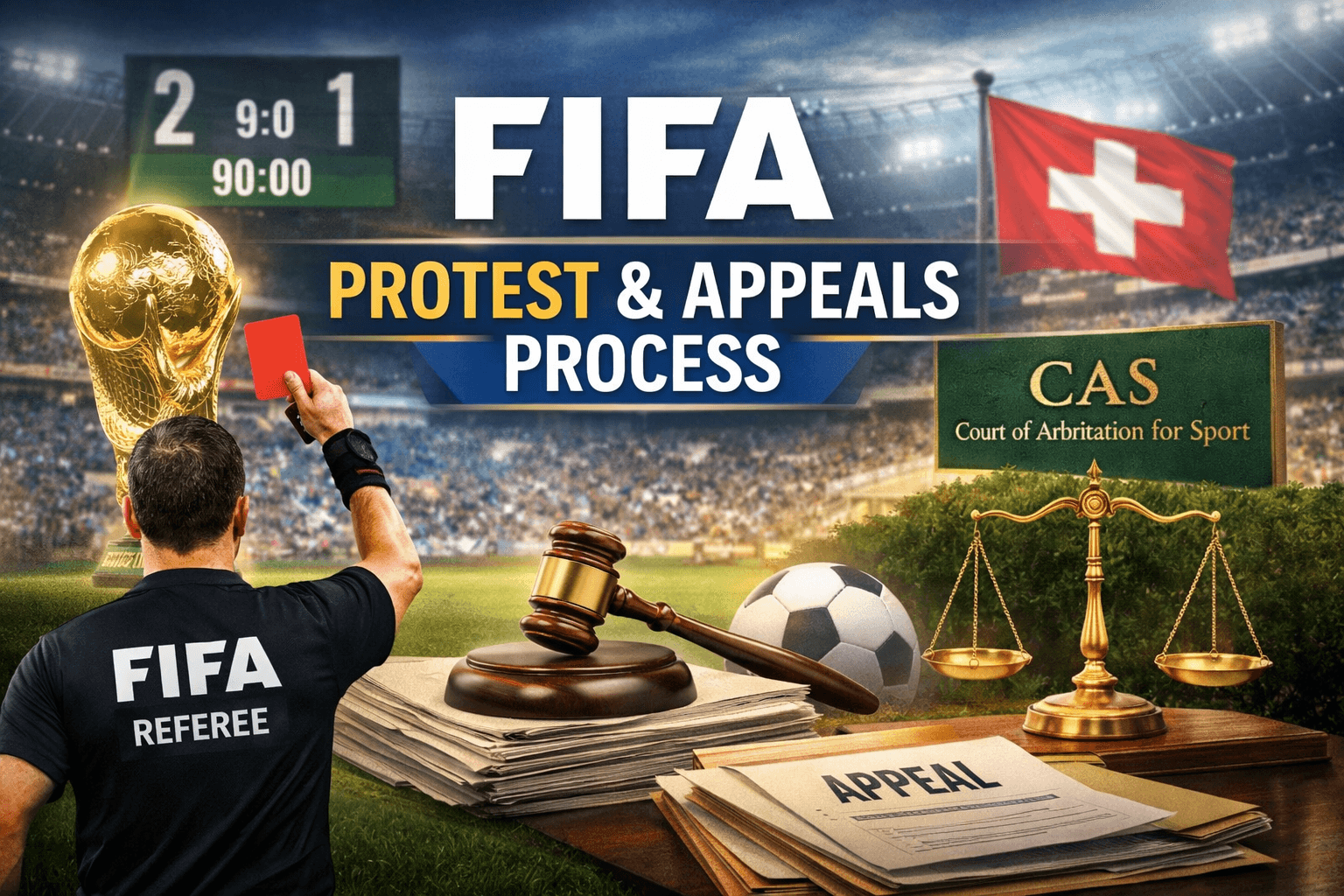
How FIFA Handles Match Protests and Appeals at the World Cup

At the FIFA World Cup, any disputes are not resolved in the media or through public argument. Rather, they follow a formal procedure written in FIFA’s competition rules. When a team files a protest or a matter of discipline comes up, the case follows a normal pattern, with the system defining how the case is submitted, examined, and adjudicated.

This system is in place because of the significance of World Cup matches. These games decide who will continue and who will be eliminated, usually in front of a worldwide audience. Although decisions have to be made quickly, they must still remain consistent with the official regulations. FIFA’s procedure is intended to protect the legal rights of the parties involved while permitting the tournament to proceed without interruption.

Here is the detailed explanation of the system, from the moment a protest is filed, through the disciplinary process, and, if necessary, to the final authority responsible for deciding the case.

๐Ÿ“Œ FIFA Protest and Appeals Process โ€” Quick Summary

Match protest deadline: Within 2 hours after the match.

Who reviews protests: FIFA Disciplinary Committee.

Can referee decisions be protested: No, referee decisions are final.

Appeal authority: FIFA internal appeals first, then Court of Arbitration for Sport (CAS).

Purpose: Ensure fair competition while keeping the World Cup on schedule.

๐Ÿ“‹ What Qualifies as a Match Protest

A match protest is a written complaint that a team submits if it feels that the problem outside the game that they are playing has influenced the match. There can be a variety of factors involved, such as questions about players eligibility, the state of the pitch, the equipment used during the game, or operational aspects related to the stadium or competition setup.

Such protests exclude refereeing errors and tactical disagreements. They are essentially about whether the competition rules and procedures were implemented correctly. The goal is to deal with instances in which there might have been a violation of FIFAs regulations.

This method provides teams with a proper channel through which they can raise such issues, at the same time allowing FIFA to examine the case within its disciplinary framework and take a decision which will be communicated on the basis of the regulations.

โฑ๏ธ Strict Deadlines for Filing Protests

Timing is essential to a World Cup protest. If a team wants to claim a wrong in the game, they should first notify the FIFA Match Director right after the match. Then the team has to submit a formal protest following the FIFA legal process within the time limit.

The reason for these strict deadlines is to make sure that disputes are settled without holding up the schedule of the tournament. When games are so close in time, FIFA cannot have unfinished matters that block the flow or the competition.

If a team is late, the chance to protest is normally lost. Therefore, teams become very alert and respond very fast whenever they think a decision or a procedure has been wrongly followed.

๐Ÿšซ Referee Decisions Are Final

One of the foundations of the World Cup is the refereeโ€™s authority on the field. Decisions involving fouls, penalties, offsides, or other match incidents are final. Teams cannot file a protest simply because they disagree with how a referee interpreted a moment during the game.

This principle exists to preserve the flow and credibility of the competition. Results are meant to be decided on the pitch, not revisited later through legal disputes over routine match decisions.

That said, FIFA can still review certain disciplinary matters separately. But when it comes to factual incidents and the refereeโ€™s judgment during play, those decisions remain binding.

๐Ÿ‘จโ€โš–๏ธ FIFAโ€™s Disciplinary Committee Reviews Protests

A protest which has been submitted via the official channel will be immediately taken over by FIFAโ€™s Disciplinary Committee. This committee is tasked with reviewing the case, the evidence, and, if necessary, the relevant regulations, to establish whether a rule infringement has taken place.

Should it turn out that there has been a violation, the committee is empowered to decide on the appropriate action. It can, for example, impose disciplinary sanctions, financial penalties, suspensions, or other measures as provided under the FIFA rules.

The committee’s function is indispensable in the matter of enforcement of the competition regulations. Their rulings ensure that all teams are treated according to the same standards, thus fair play is maintained throughout the World Cup.

โš ๏ธ Frivolous or Unfounded Protests Can Lead to Sanctions

The protest mechanism during the World Cup is meant to address authentic regulatory issues rather than tactical manoeuvres or speculative claims. Under FIFAโ€™s rules of competition, teams are expected to file protests only if there is a clear and unmistakable basis for their claims.

Should a protest be deemed unmeritorious or the manner of its submission irresponsible, FIFA is authorised to apply disciplinary measures. These could include sanctions or other measures that are stipulated in the regulations and take into account the circumstances.

This policy prevents the misuse of the protest procedure and ensures that formal protests focus on genuine issues. It also strengthens confidence in the tournamentโ€™s disciplinary system and its ability to resolve disputes fairly.

โš–๏ธ FIFA Controls the Appeals Process

FIFA has a legal process in place for appeals against disciplinary decisions, and these decisions cannot be bypassed by teams or disputes directly taken to courts.

The appeal has to be issued through FIFA’s system, where the matter will be examined according to the organization’s rules.

This framework is deliberately designed to ensure that decisions are handled in a uniform manner and within a single governing framework. Besides, it gives FIFA the possibility to have full control of the competition affairs instead of relinquishing them to external legal systems.

By handling appeals internally, FIFA is able to facilitate the settlement of disputes efficiently, while keeping the tournament in line with its official rules and procedures.

๐ŸŒ The Court of Arbitration for Sport Is the Final Authority

Once FIFA’s internal appeal procedure has been fully utilized, teams have the right to submit their case to the Court of Arbitration for Sport (CAS) in Switzerland. CAS is the highest independent authority for settling disputes in international sport.

A decision from CAS is binding and represents the final stage of the legal process. It provides teams with an external channel for review, separate from FIFA’s own decision-making system.

The presence of CAS adds an additional layer of oversight and accountability. While FIFA manages the competition and its disciplinary system, CAS ensures that teams have access to independent arbitration if they choose to challenge a decision beyond FIFA’s internal framework.

๐Ÿ† Why FIFAโ€™s Protest System Is Essential to the World Cup

The World Cup operates on a quite tight schedule, with matches being played one after another and watched all over the world. Any argument is to be solved immediately, but also carefully, so that decisions are just and do not spoil the tournament.

The protest and appeals process of FIFA is made with that balance in mind. On the one hand, it allows teams to raise their issues regarding the regulations in a formal manner. On the other hand, it safeguards the authority of referees and the competition’s framework.

The idea is to sort out the issues quickly so that the attention is on the matches themselves. The system is a kind of guarantee that the results will be decided by the players and not by the drawn-out legal procedures off the field.

The main purpose of the protest system is to safeguard the competition. It ensures that the World Cup can continue smoothly by providing a structure based on clear procedures, accountability, and transparency.

This system is an important part of the regulatory framework that helps keep the tournament fair, reliable, and trusted by teams and fans worldwide.

What Happens If Iran Withdraws from the 2026 FIFA World Cup?

Iran national team potential withdrawal from the 2026 FIFA World Cup

Iran national team potential withdrawal from the 2026 FIFA World Cup

The FIFA World Cup is often presented as footballโ€™s grand global gathering โ€” a stage where nations compete fiercely on the pitch while politics supposedly stays outside the stadium gates.

History suggests otherwise.

International sport rarely exists in isolation from world events, and the World Cup has often found itself intersecting with diplomatic tensions, security concerns and shifting geopolitical realities.

As planning continues for the 2026 FIFA World Cup โ€” which will be hosted across the United States, Mexico and Canada โ€” a new question has quietly entered the conversation: what happens if a qualified team decides not to participate?

The discussion has emerged in connection with Iran. The countryโ€™s national team has been a regular presence at the tournament over the past two decades and remains one of Asiaโ€™s strongest sides. Yet wider diplomatic tensions and security concerns have prompted speculation about how participation might unfold in a World Cup partly staged in the United States.

If such a situation were ever to arise, the consequences would extend beyond the team itself. Organisers would have to navigate the competition regulations while managing the logistical realities of staging the largest tournament the sport has ever attempted โ€” a complex challenge for FIFA as it prepares for a 48-team World Cup across North America.

๐Ÿ“Œ Iran and the 2026 World Cup โ€” Key Facts

Tournament hosts: United States, Mexico, and Canada.

Teams participating: Expanded to 48 nations for the first time.

Iranโ€™s record: One of Asiaโ€™s most consistent World Cup qualifiers.

Current debate: Whether political tensions could affect participation.

Decision authority: FIFA ultimately controls tournament regulations and disciplinary measures.

๐ŸŒ When International Politics Reaches the Pitch

Football has often found itself impacted by international politics. Diplomatic disputes, sanctions, and conflicts have at times shaped the participation of national teams.

In the case of Iran, the issue is particularly sensitive because one of the primary hosts of the 2026 tournament is the United States. Relations between the two countries have been tense for many years, and recent geopolitical developments have renewed questions about whether Iran could comfortably compete in a U.S.-hosted environment.

While football federations technically operate independently from national governments, political realities can still influence decisions surrounding travel, security, and public messaging.

Should Iran decide not to participate, it would represent a rare moment when global politics directly reshapes the lineup of teams at the World Cup.

๐Ÿ“œ FIFAโ€™s Rules on World Cup Participation

The regulations governing the World Cup make it clear that teams which qualify for the final tournament are expected to play their scheduled matches unless they are eliminated through competition.

Participation in the tournament comes with formal obligations. Once a national federation accepts its place in the World Cup, withdrawing becomes more than just a sporting choice; it becomes a regulatory issue governed by FIFAโ€™s disciplinary framework.

The governing body has the authority to impose sanctions if a qualified team fails to participate. These measures may include financial penalties, repayment of preparation funding, or additional disciplinary actions, depending on the circumstances.

Such rules exist to protect the integrity of the tournament and ensure that a competition planned years in advance can proceed without disruption.

๐Ÿ’ฐ Financial Consequences of Withdrawing

FIFA regulations outline financial penalties for any federation that withdraws from the World Cup after qualifying.

If a national federation withdraws from the tournament more than 30 days before the first match, the FIFA Disciplinary Committee may impose a minimum fine of CHF 250,000. If the withdrawal occurs within 30 days of the opening match, the minimum penalty increases to CHF 500,000.

In addition to fines, the federation involved may also be required to return funds provided by FIFA to support tournament preparation.

These measures are designed to discourage last-minute withdrawals that could disrupt the tournament schedule and affect other participating teams.

โšฝ Could Another Team Replace Iran?

If a qualified team withdraws before the tournament begins, FIFA has the authority to determine whether another national team should take its place.

In most situations, a replacement would likely come from the same confederation. In Iranโ€™s case, that would mean another team from the Asian Football Confederation.

However, the decision would depend heavily on timing. If the withdrawal occurred close to the start of the tournament, finding a suitable replacement and integrating that team into the existing schedule could become complicated.

For that reason, FIFA would weigh multiple factors before deciding whether to replace the team or adjust the tournament structure.

๐ŸŒŽ Could Iran Play Only in Canada or Mexico?

Another scenario sometimes discussed is whether Iran could still participate while avoiding matches in the United States.

Because the 2026 World Cup will be staged across three countries, FIFA technically has some flexibility when assigning match venues.

In theory, matches involving Iran could be moved to stadiums in Canada or Mexico rather than the United States. Such an arrangement might allow the team to remain in the tournament while avoiding potential diplomatic complications.

Whether such a solution would be practical would depend on scheduling logistics and agreement from tournament organizers, but the multi-nation hosting format makes venue adjustments possible if exceptional circumstances arise.

๐Ÿ“Š What It Could Mean for the Group Stage

The 2026 World Cup will feature a new format with 48 teams divided into 12 groups of four. This structure depends on each group containing the same number of teams.

If a team withdraws before the tournament begins, FIFA would most likely attempt to replace that team to maintain the format.

However, if the withdrawal occurred late in the preparation phase, the governing body might have to explore alternative solutions in order to keep the competition running smoothly.

Maintaining competitive balance while avoiding disruption would be the main priority.

โฑ๏ธ What If a Withdrawal Happens During the Tournament?

A withdrawal after the tournament has begun would create an even more complex situation.

In such cases, the governing body may decide to remove the team from the competition and adjust the standings accordingly. Matches already played could potentially be invalidated depending on the circumstances and timing.

The rules also allow tournament organizers to reschedule or relocate matches if security or operational concerns arise.

Although such situations are extremely rare, FIFAโ€™s regulations are designed to ensure that the tournament can continue even under unexpected conditions.

๐Ÿ“š Rare but Not Unprecedented in Football

Withdrawals from major international tournaments are uncommon, but history shows that political developments can sometimes affect sporting events.

One well-known example occurred at UEFA Euro 1992, when Yugoslavia was excluded from the competition due to international sanctions. Denmark, originally not qualified, took its place and went on to win the tournament.

Although the World Cup operates on a much larger scale, the episode illustrates how unexpected events can reshape a tournament.

๐Ÿ‘ฅ The Players in the Middle of the Debate

Lost in the political discussion are the players themselves. For professional footballers, appearing at the World Cup represents the peak of their international careers.

Many members of Iranโ€™s squad compete in professional leagues across Europe and Asia and have spent years working toward another opportunity to play on footballโ€™s biggest stage.

A withdrawal caused by political circumstances could deny those players a chance they may never receive again.

It is a reminder that athletes often find themselves caught between international politics and global sport.

๐Ÿ† Why the Issue Matters for the Tournament

The 2026 World Cup will feature more teams and matches than any previous edition, making it the largest tournament in football history. If even a single team were to withdraw, the impact could ripple through the event, affecting match schedules, media coverage, travel logistics and competitive balance.

Changes could follow quickly. Match timings might need adjustment, broadcasters would require new plans, and travel arrangements for teams and officials could shift. Tournament organisers would also need to examine the competition format to maintain fairness.

Situations like this highlight how international sport remains connected to global politics. While FIFA has regulations designed to manage team withdrawals, the consequences can extend well beyond those formal rules.

Ultimately, the scenario illustrates that major sporting events cannot exist entirely separate from wider global dynamics. Political pressures, diplomatic considerations and national decisions can all influence how teams approach participation in competitions of this scale.

If Iran ultimately takes part in the tournament, the debate will likely fade once the opening matches begin and attention returns to the football itself.

But if the country does withdraw, it would create one of the most unusual and politically charged situations in modern World Cup history.

Either way, the discussion serves as a reminder that the World Cup is more than just a sporting event. It is also a global stage where politics, diplomacy, and football sometimes intersect in unexpected ways.