
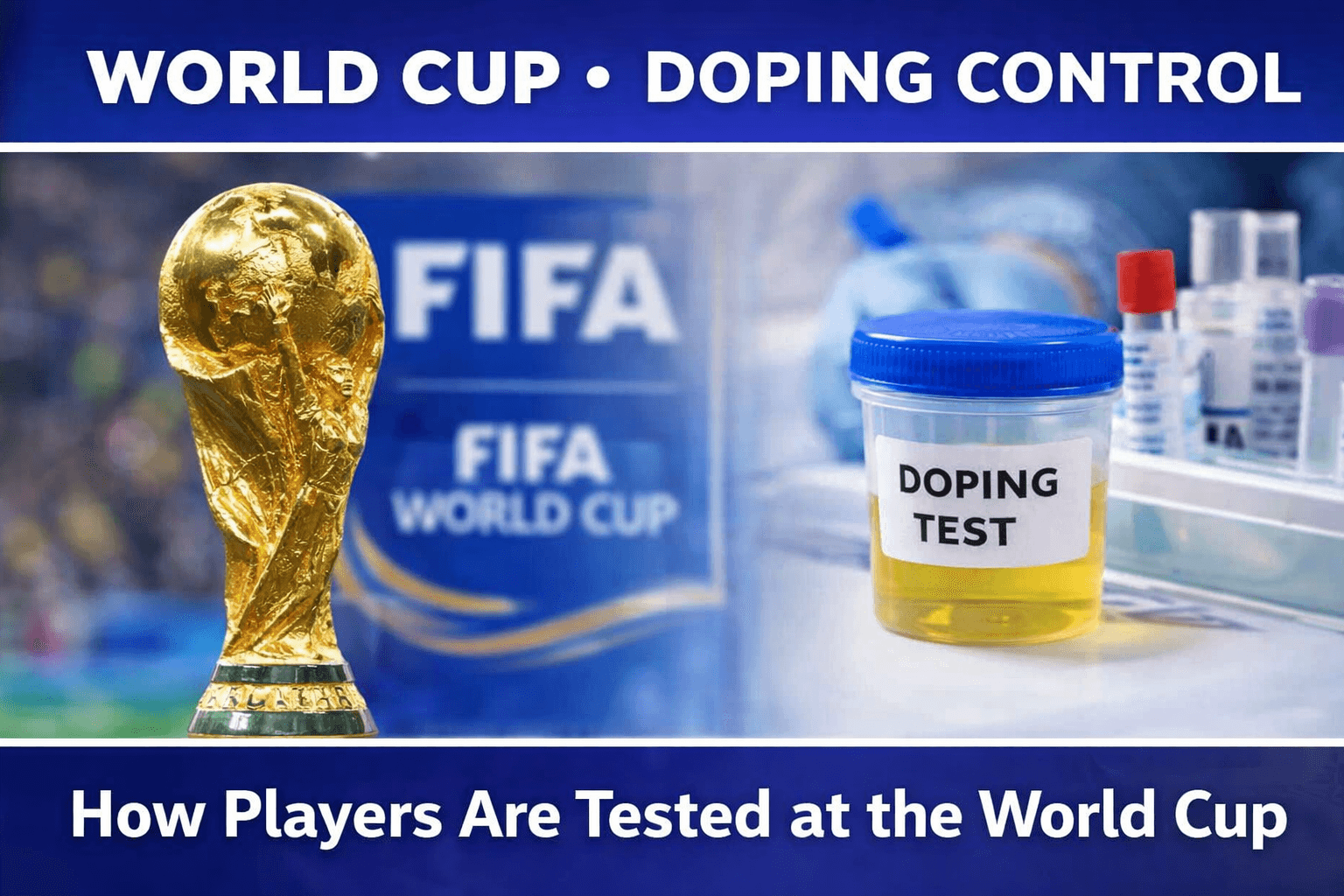

When the World Cup kicks off, the focus is obvious: goals, pressure, the noise inside packed stadiums. What stays out of view is the framework holding it all together — the regulations built to protect competitive balance.
One of those safeguards is doping control. At the 2026 FIFA World Cup, as with every modern edition, anti-doping protocols are part of the tournament’s core structure. They aren’t symbolic. They’re formal, regulated and aligned with global testing standards.
What follows is a closer look at how doping control operates during the World Cup — and why it remains one of the tournament’s most important, if least visible, layers of oversight.
📘 The Regulatory Framework Behind Doping Control
Doping control at the World Cup isn’t handled informally. It sits directly inside the tournament regulations.
Article 43 of the Regulations for the 2026 FIFA World Cup places anti-doping procedures under the competition’s medical provisions. All teams and players are subject to FIFA’s anti-doping rules for the duration of the event.
Those rules operate in line with the World Anti-Doping Agency’s World Anti-Doping Code. The tournament does not run a separate system. If there is any overlap or dispute, the World Anti-Doping Code governs.
In practice, that means the testing process is predefined. It isn’t improvised and it isn’t optional. The framework applies from the first match through the final.
🧪 When and How Players Are Tested
Testing at the World Cup is routine and structured. After matches, players are selected for mandatory testing. Typically, at least two players per team are tested per match.
Selections may be:
• Random
• Systematic
• Intelligence-based
Once notified, a player must report to the doping control station immediately. A delay is permitted only for valid reasons such as participation in official victory ceremonies, completion of post-match interviews, or with explicit approval from the doping control officer. Outside of those exceptions, the player must proceed directly to doping control in accordance with FIFA anti-doping regulations. There is no prior notice. Refusal or failure to report is treated as a violation under FIFA regulations and may result in a ban of up to 4 years.
If a player is under 18, they must be told about the test in front of an adult. The player is also allowed to have a representative stay with them during the entire sample collection process.
🔬 Inside the Testing Process
The testing procedure follows a controlled sequence. It includes:
• Verification of the player’s identity
• Supervised sample collection
• Secure labeling and sealing of samples
• Documented chain of custody
• Analysis of the “A” sample, with the “B” sample stored for potential confirmation
The structure is procedural rather than dramatic. Each step is recorded and standardized, reducing uncertainty and maintaining the integrity of the process under FIFA regulations.
⏱️ Testing Beyond Matchday
Doping control is not confined to matchdays.
Players can also be tested outside competition periods, including during training camps, rest days, or other preparation phases. These controls may be conducted without prior notice.
The requirement applies continuously. Testing obligations are in force throughout the tournament period, not only during matches, under FIFA anti-doping regulations.
⚽ Why Football’s Anti-Doping Landscape Is Unique
Football isn’t built like endurance sport. It’s a game of repeated sprints, short recoveries, and constant changes of pace rather than sustained output over hours.
At a World Cup, though, the scrutiny is different. A violation at this level doesn’t just affect a single season. It carries national weight and can cast a shadow over the tournament itself.
That visibility matters. It raises the stakes for everyone involved and, in doing so, serves as both a deterrent and a layer of protection around the competition.
🌍 Expansion, Travel and Compliance in 2026
The 2026 FIFA World Cup brings 48 teams, a packed match calendar and travel that stretches across North America.
That scale adds pressure behind the scenes. Recovery windows are tighter. Flights are longer. Medical staffs have to track treatments, supplements and paperwork with precision, not guesswork.
Therapeutic Use Exemptions, hydration planning and supplement oversight aren’t side issues in that environment. They become routine parts of tournament management, logged and reviewed alongside training loads and match minutes.
🔒 The Role of Doping Control in Tournament Integrity
World Cup games are remembered for the obvious moments — the goals, the saves, the plays that live on for years. What rarely makes the highlights are the systems working in the background.
Doping control is part of that structure. It exists to make sure performance sits within defined boundaries, not outside them.
The framework is intentionally low-profile. It isn’t built for headlines. It’s built for compliance — and for the confidence that what happens on the field stands up to scrutiny long after the final whistle.
❓ Frequently Asked Questions About World Cup Doping Tests
Are players tested after every match?
Yes. A minimum number of players are selected for testing after each match.
Can players be tested without warning?
Yes. Out-of-competition testing may occur at any time during the tournament period.
Who oversees World Cup anti-doping procedures?
FIFA administers testing in alignment with the World Anti-Doping Code and its own Anti-Doping Regulations.
The World Cup is spectacle. But spectacle without trust erodes quickly. Doping control may operate in silence, but that silence is assurance — a reminder that behind every moment of brilliance stands a framework designed to protect the game.


