How FIFA Protects Match Integrity at the World Cup: Anti-Corruption, Monitoring, and Security Systems

At the FIFA World Cup, integrity isn’t assumed. It’s enforced. The tournament runs under a framework of regulations, oversight, and operational controls designed to ensure that results are decided on the field.

The scale of the event makes that necessary. With billions watching and global betting markets tied to every match, the risk of manipulation or improper influence is something FIFA plans for, not something it reacts to. Competition regulations establish clear disciplinary authority, monitoring systems, and investigative procedures.

Below, we will have a closer look at how those safeguards work from anti-corruption protocols to match monitoring and security measures that remain in place throughout the tournament.

🛡️ FIFA’s Legal Authority to Protect Tournament Integrity

FIFA runs the World Cup. It sets the rules, oversees the matches, and handles discipline when issues arise. That responsibility includes making sure games are played properly and without outside interference.

Everyone inside the tournament falls under those same rules: players, coaches, team staff, referees, all of them. Trying to influence a result or interfere with match operations isn’t just against the spirit of the game, it carries real disciplinary consequences.

That system is there so there’s no gray area. FIFA has the authority to regulate the tournament and the ability to act if something crosses the line, keeping the focus where it belongs i.e., on the football itself.

📡 Global Betting Surveillance and Match Monitoring

One of the most important safeguards sits far from the pitch. FIFA works with specialized integrity monitoring services that track betting markets around the world in real time.

These systems watch for shifts such as unusual betting volume, sudden odds changes, or patterns that fall outside expected behavior. On their own, those signals don’t prove wrongdoing, but they can raise questions that require closer scrutiny.

When irregular activity is flagged, FIFA’s integrity teams have the authority to review the data and open formal inquiries if necessary. The aim is speed and visibility in identifying potential risks early, before they can affect the competition itself.

⚖️ Strict Oversight of Players, Officials, and Team Personnel

Integrity rules apply to everyone inside the tournament environment. Players, coaches, team staff, and officials all operate under the disciplinary framework set by FIFA, which prohibits corruption, misconduct, and any attempt to influence a match improperly.

The consequences can be significant. Sanctions range from match suspensions to removal from the tournament, and in more serious cases, long-term bans from the sport.

The structure is designed to ensure responsibility doesn’t sit in one place. Accountability applies across the competition, from the field to the technical area and beyond.

👨‍⚖️ Controlled Referee Appointments and Supervision

Referees sit at the center of match integrity, and their selection is handled directly by FIFA. Officials are appointed centrally, with assignments based on performance, experience, and neutrality rather than local involvement.

Once selected, referees operate within a controlled structure. Their match appointments are managed to avoid conflicts of interest, and their work is evaluated throughout the tournament.

That centralized system exists to maintain consistency and to shield officials from outside pressure, ensuring decisions are made within the framework of the competition rather than influenced by external factors.

🔒 Stadium Security and Restricted Access Zones

Access inside World Cup stadiums is tightly regulated. FIFA designates restricted zones around key areas, including dressing rooms, referee spaces, and match operations centers.

Entry is limited to accredited personnel only. Security staff control access points, and movement in sensitive areas is monitored throughout the event.

The goal is straightforward: limit unnecessary contact, protect officials and players, and reduce the risk of interference around match operations.

📋 Match Commissioners and Integrity Oversight

Every World Cup match has a FIFA match commissioner present. Their job isn’t to referee the game, but to make sure everything around it follows the tournament rules.

They’re there before kickoff, during the match, and afterward. They watch how procedures are handled and note anything that doesn’t follow regulations. If something needs attention, it’s reported back to FIFA through the proper channels.

It’s part of how the tournament stays consistent from one stadium to the next, with someone assigned to observe and report on each match independently.

🚫 Investigations and Disciplinary Enforcement

When questions arise around match integrity, FIFA has the authority to open formal investigations. That process can involve reviewing evidence, speaking with those involved, and working with relevant authorities where necessary.

If violations are confirmed, disciplinary action follows. Sanctions can range from match suspensions to long-term — and in some cases lifetime bans from the sport.

Those enforcement powers are part of the structure designed to deter misconduct and reinforce the credibility of the competition.

🌍 Why Integrity Protection Is Essential to the World Cup

The World Cup runs on trust. Every result has to stand on its own, accepted as fair and free from outside influence.

That’s why FIFA relies on a network of regulations, monitoring systems, security controls, and disciplinary procedures throughout the tournament. Those mechanisms exist to protect the competition at every level.

Most of it happens out of view. Fans see the matches. What they don’t see are the safeguards behind them — the systems in place to ensure the outcome reflects only what happens on the field.

At its core, the World Cup is meant to be settled by what happens on the field — preparation, execution, and performance over 90 minutes and beyond. That’s why FIFA maintains a structured integrity framework around the tournament.

Its purpose is straightforward: to protect the competition and preserve confidence among players, teams, and the global audience that follows every match.
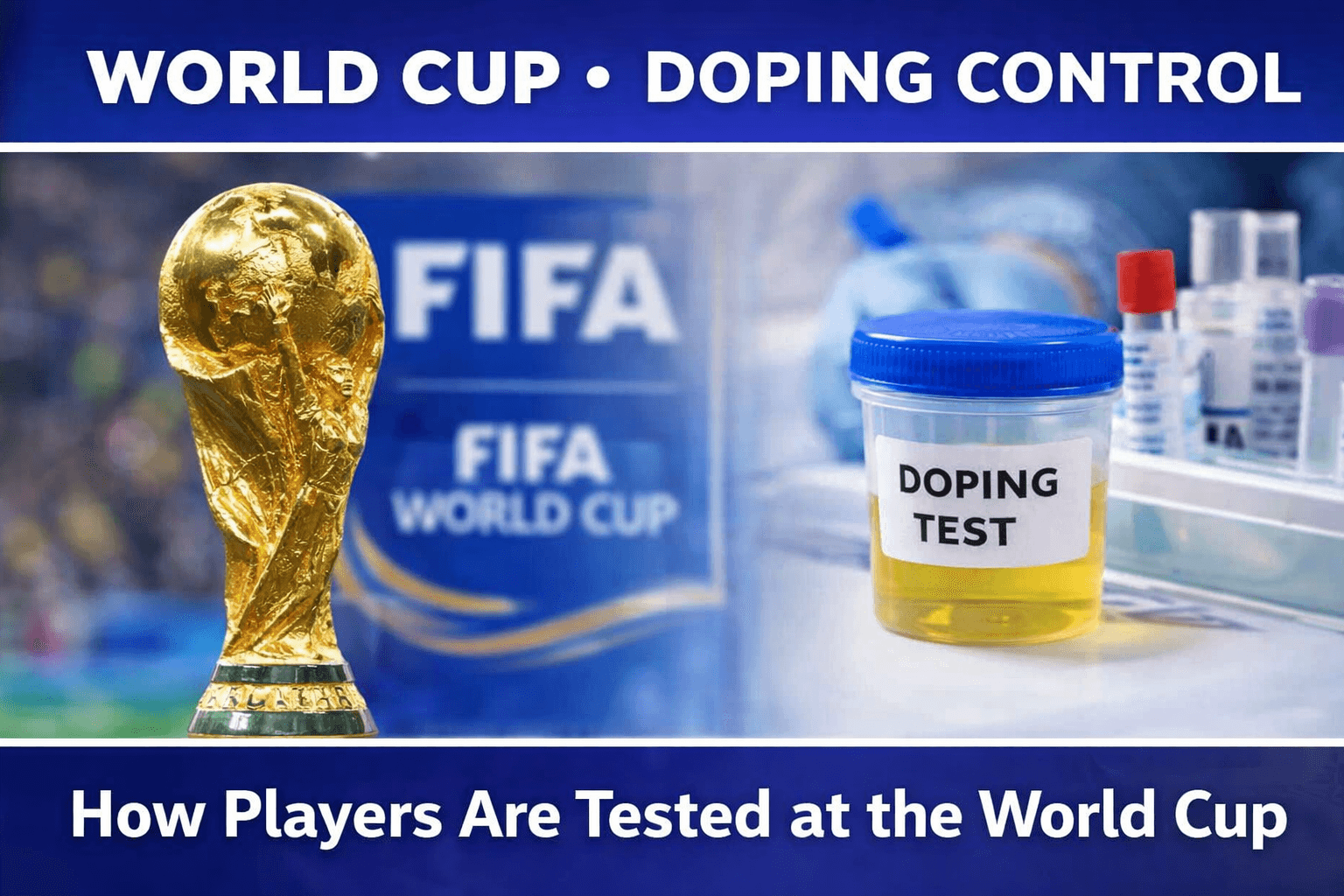
How Doping Control Works at the World Cup

When the World Cup kicks off, the focus is obvious: goals, pressure, the noise inside packed stadiums. What stays out of view is the framework holding it all together — the regulations built to protect competitive balance.

One of those safeguards is doping control. At the 2026 FIFA World Cup, as with every modern edition, anti-doping protocols are part of the tournament’s core structure. They aren’t symbolic. They’re formal, regulated and aligned with global testing standards.

What follows is a closer look at how doping control operates during the World Cup — and why it remains one of the tournament’s most important, if least visible, layers of oversight.

📘 The Regulatory Framework Behind Doping Control

Doping control at the World Cup isn’t handled informally. It sits directly inside the tournament regulations.

Article 43 of the Regulations for the 2026 FIFA World Cup places anti-doping procedures under the competition’s medical provisions. All teams and players are subject to FIFA’s anti-doping rules for the duration of the event.

Those rules operate in line with the World Anti-Doping Agency’s World Anti-Doping Code. The tournament does not run a separate system. If there is any overlap or dispute, the World Anti-Doping Code governs.

In practice, that means the testing process is predefined. It isn’t improvised and it isn’t optional. The framework applies from the first match through the final.

🧪 When and How Players Are Tested

Testing at the World Cup is routine and structured. After matches, players are selected for mandatory testing. Typically, at least two players per team are tested per match.

Selections may be:

• Random
• Systematic
• Intelligence-based

Once notified, a player must report to the doping control station immediately. A delay is permitted only for valid reasons such as participation in official victory ceremonies, completion of post-match interviews, or with explicit approval from the doping control officer. Outside of those exceptions, the player must proceed directly to doping control in accordance with FIFA anti-doping regulations. There is no prior notice. Refusal or failure to report is treated as a violation under FIFA regulations and may result in a ban of up to 4 years.

If a player is under 18, they must be told about the test in front of an adult. The player is also allowed to have a representative stay with them during the entire sample collection process.

🔬 Inside the Testing Process

The testing procedure follows a controlled sequence. It includes:

• Verification of the player’s identity
• Supervised sample collection
• Secure labeling and sealing of samples
• Documented chain of custody
• Analysis of the “A” sample, with the “B” sample stored for potential confirmation

The structure is procedural rather than dramatic. Each step is recorded and standardized, reducing uncertainty and maintaining the integrity of the process under FIFA regulations.

⏱️ Testing Beyond Matchday

Doping control is not confined to matchdays.

Players can also be tested outside competition periods, including during training camps, rest days, or other preparation phases. These controls may be conducted without prior notice.

The requirement applies continuously. Testing obligations are in force throughout the tournament period, not only during matches, under FIFA anti-doping regulations.

⚽ Why Football’s Anti-Doping Landscape Is Unique

Football isn’t built like endurance sport. It’s a game of repeated sprints, short recoveries, and constant changes of pace rather than sustained output over hours.

At a World Cup, though, the scrutiny is different. A violation at this level doesn’t just affect a single season. It carries national weight and can cast a shadow over the tournament itself.

That visibility matters. It raises the stakes for everyone involved and, in doing so, serves as both a deterrent and a layer of protection around the competition.

🌍 Expansion, Travel and Compliance in 2026

The 2026 FIFA World Cup brings 48 teams, a packed match calendar and travel that stretches across North America.

That scale adds pressure behind the scenes. Recovery windows are tighter. Flights are longer. Medical staffs have to track treatments, supplements and paperwork with precision, not guesswork.

Therapeutic Use Exemptions, hydration planning and supplement oversight aren’t side issues in that environment. They become routine parts of tournament management, logged and reviewed alongside training loads and match minutes.

🔒 The Role of Doping Control in Tournament Integrity

World Cup games are remembered for the obvious moments — the goals, the saves, the plays that live on for years. What rarely makes the highlights are the systems working in the background.

Doping control is part of that structure. It exists to make sure performance sits within defined boundaries, not outside them.

The framework is intentionally low-profile. It isn’t built for headlines. It’s built for compliance — and for the confidence that what happens on the field stands up to scrutiny long after the final whistle.

❓ Frequently Asked Questions About World Cup Doping Tests

Are players tested after every match?
Yes. A minimum number of players are selected for testing after each match.

Can players be tested without warning?
Yes. Out-of-competition testing may occur at any time during the tournament period.

Who oversees World Cup anti-doping procedures?
FIFA administers testing in alignment with the World Anti-Doping Code and its own Anti-Doping Regulations.

The World Cup is spectacle. But spectacle without trust erodes quickly. Doping control may operate in silence, but that silence is assurance — a reminder that behind every moment of brilliance stands a framework designed to protect the game.

How Stadiums Are Certified for the FIFA World Cup

When fans walk into a World Cup stadium, they see scale — lights, cameras, banners and tens of thousands of seats wrapped around a rectangle of green.

What they do not see is the inspection trail. Before a single anthem plays, before a ball is placed on the centre spot, a stadium has already passed through layers of certification — regulatory, operational and technical.

Hosting a World Cup match is not simply about architecture or capacity. It is about compliance. Here is how FIFA certifies stadiums for the world’s biggest tournament.

📘 FIFA’s Authority Over World Cup Venues

The Regulations for the FIFA World Cup 26™ make one principle clear: FIFA bears overall responsibility for organising, hosting and staging the tournament.

Under Section V – Stadiums and Training Sites, the competition regulations define the operational standards venues must meet to host matches. Certification is not symbolic — it is regulatory and enforceable.

From the pitch surface to roof operation, authority rests with tournament officials.

🌱 Natural Grass Is Mandatory

World Cup matches must be played on natural grass. Artificial or hybrid substitutes are not permitted unless specifically approved.

The pitch must also be protected in advance:

• No non-football events for two months before the first World Cup match in that stadium
• No events at all for one month before the first match unless FIFA grants written approval

In modern multi-purpose venues, this requirement alone reshapes scheduling and event planning months ahead of kickoff.

📏 Standardised Pitch Dimensions

Certification includes strict dimensional standards. Unless otherwise approved by FIFA, the pitch must measure:

105 metres in length
68 metres in width

Uniform dimensions ensure that every team competes under identical spatial conditions, regardless of host city.

💧 Grass Height and Watering Are Controlled

Even details invisible to most spectators fall under regulatory oversight.

The FIFA Match Director, in consultation with pitch experts, determines the watering schedule and grass height before matches. These decisions can influence ball speed, surface friction and overall tempo.

The pitch is not simply maintained. It is calibrated.

🥅 Equipment Standards and Contingency Requirements

World Cup stadiums must also meet strict equipment standards.

• White goalposts and nets
• Dark support posts with padding
• Spare goals, nets and corner flags available near the pitch

Certification includes contingency planning. Replacement equipment must be immediately accessible if required.

🏟️ Retractable Roofs: Centralised Control

In venues equipped with retractable roofs, control rests with FIFA, not the stadium operator.

The FIFA Match Director determines the roof position before kickoff. If conditions change, the referee can order closure after consulting with match officials.

Once play is underway, the roof remains fixed. It cannot be opened or closed while players are on the field, a safeguard intended to maintain safety and consistent playing conditions.

🏋️ Training Sites Must Also Be Approved

Certification extends beyond match venues. In principle, all training sites must be approved by FIFA.

These sites must:

• Be in excellent playing condition
• Meet international pitch size standards
• Be freshly mowed and fully marked
• Be protected from non-football events before the tournament
• Be free of non-FIFA commercial branding during designated periods

Preparation grounds operate under the same philosophy as match stadiums — control, consistency and compliance.

🌍 Certification in an Expanded 2026 Tournament

The 2026 FIFA World Cup expands to 48 teams and spans a wider geographic footprint across North America.

Conditions will vary. Climate, altitude and stadium design are not uniform from one host city to the next. Certification processes exist to keep competitive standards consistent despite those differences.

Pitch condition, player safety, broadcast requirements and match operations all depend on those standards being applied the same way at every venue.

🔒 More Than Architecture — A Regulated Competition Environment

Stadiums are often judged by aesthetics such as rooflines, capacity, and skyline views. But from FIFA’s perspective, a World Cup venue is not a monument. It is a regulated competition environment. Grass is protected months in advance. Dimensions are fixed. Roofs are centrally controlled. Training grounds are approved. Equipment is standardised.

Behind the spectacle stands a rulebook and behind every World Cup match stands a stadium that has already passed it.