
Saudi Arabia’s 2022 shock once made Lionel Messi’s World Cup dream look fragile, even doomed. Four years later, his hat-trick at the 2026 FIFA World Cup turned that old wound into something very different: not the beginning of the end, but the opening page of one of football’s great late chapters.

Table of Contents
The Silence After the Whistle
At the final whistle in Lusail, the noise did not arrive all at once.
First came the stillness.
Lionel Messi stood in the pale winter light of Qatar with the look of a man trying to understand how the floor had disappeared beneath him. Around him, Argentina players moved slowly, not only with exhaustion, but with the confusion of people who had walked into a familiar room and found every wall rearranged.
Saudi Arabia had beaten Argentina.
Not survived them. Not merely troubled them. Beaten them.
The scoreboard said 2-1, but scoreboards are often too polite for football’s deeper violence. This was not just a defeat. It was a puncture in the mythology Argentina had carried into the tournament: the long unbeaten run, the Copa América glow, the last great chance, the idea that Messi had finally gathered around him a team shaped by his rhythm rather than crushed by his name.
Now he walked with his head lowered.
In the stands, Saudi supporters celebrated with the delirium of a nation that had seen the impossible stroll casually into view. On phones, in timelines, in comment sections and clipped videos, the mockery began to move faster than the match itself. Where are you, Messi? Messi who? The words changed from place to place, but the feeling behind them was the same. Football, that old theatre of instant judgement, had found its favourite subject.
The little genius had come for his crown and left with a wound.
For a few hours, perhaps longer, it seemed that history had chosen its direction. Messi was 35. The World Cup had not been kind to his deepest longing. A final had already been lost in 2014. Other campaigns had dissolved in frustration, chaos or fatigue. Here, in what many believed would be his last attempt, the opening act had become a public collapse.
People began to speak in endings.
Football had other plans.
Chapter 1: The Day Everything Went Wrong
Argentina had led. That is part of what made the shock so disorienting.
Messi’s penalty in the 10th minute appeared to settle the afternoon into its expected shape. Argentina would control, Saudi Arabia would chase, the tournament favourite would move through the gears. There were disallowed goals, tight offsides, Argentine shirts streaming forward. For a while, the match seemed less like a contest than a delay before the inevitable.
Then came five minutes that ripped open the map.
Saleh Al-Shehri scored. Salem Al-Dawsari scored. The second goal, curling and fierce, felt like someone had thrown a lit match into dry grass. Suddenly Saudi Arabia were not hanging on to a story. They were writing the middle of it in bold green ink.
Argentina lost control of the ball, then of the space, then of themselves. The passes grew impatient. The crosses became hopeful. The faces tightened. Messi drifted into pockets and found bodies around him. Saudi defenders threw themselves across shots as if blocking more than footballs. They were defending a moment that would belong to them forever.
When it ended, Argentina’s 36-match unbeaten run was gone. So too was the comfortable illusion that destiny could be carried into a World Cup like luggage.
The questions came quickly.
Was Argentina too slow? Too dependent? Had the emotional weight of Messi’s final chase become too heavy? Was this another tournament where his brilliance would be trapped inside a national anxiety too large for one man to carry?
There was cruelty in some of it, as there always is when greatness falls in public. But there was also fear. Even those who loved Messi could feel the old shadow returning. World Cups do not wait for sentiment. They do not pause because a player has given the game two decades of beauty. They do not offer extra kindness because time is running out.
For Argentina, Mexico was no longer a second group match.
It was a cliff edge.
Chapter 2: The Refusal to Fall
The story changed with one touch, one shift of weight, one low shot through a forest of pressure.
Against Mexico, Argentina looked trapped for long stretches. The ball moved but did not breathe. The crowd carried tension in waves. Every misplaced pass seemed to ask the same question: what if Saudi Arabia was not an accident? What if it was a warning?
Then Messi received the ball outside the box.
There was no thunder in the movement. No extravagant step-over. Nothing decorative. Just the old economy: the body still, the left foot sudden, the shot skidding low into the corner.
In that moment, the tournament inhaled again.
What followed was not only relief. It was recognition. Argentina had not found a tactical solution so much as an emotional one. They had remembered that their captain was not merely a creator of goals, but a regulator of belief. His presence did not remove fear. It gave fear somewhere to go.
The celebration told its own story. There was release in it, yes, but also command. Messi did not look like a man rescued by a moment. He looked like a man who had pulled his team back toward itself.
Argentina grew from there, not smoothly, not without danger, but with a new hardness. The Saudi defeat did not disappear. It became part of them. A bruise under the shirt. A reminder that nothing would be given, that the road to the trophy would not be paved with admiration.
The team began to change shape around him.
Not tactically alone.
Spiritually.
Chapter 3: Carrying a Nation
Against Poland, Messi missed a penalty and kept playing as if the miss were only weather. That mattered. In earlier years, an Argentine World Cup mistake could become a storm cloud over everything. In Qatar, it passed. The team moved. Alexis Mac Allister scored. Julián Álvarez scored. Argentina topped the group.
The wound had not healed, but it had stopped bleeding.
Against Australia, the match tightened late, and the old nerves returned. Messi scored with the calm of a man opening a locked door with a key he had always kept in his pocket. Yet the night became tense, frantic, human. Argentina survived not as a team floating above pressure, but as one learning to live inside it.
Then came the Netherlands.
That quarter-final was not a football match so much as a fever. It had anger, theatre, late drama, penalties, gestures, collisions of pride. Messi assisted Nahuel Molina with a pass of such disguise that it seemed to travel through a private tunnel only he could see. He scored. Argentina were pulled back. The match became wild. At the end, in the cruelty of the shootout, Argentina stood upright.
Messi was no longer chasing the tournament.
The tournament had begun revolving around him.
Croatia made that even clearer. By then, Argentina had learned how to suffer and how to strike. Messi’s penalty opened the semi-final, but the moment that stayed in the mind came later, near the right touchline, with Joško Gvardiol in front of him. Gvardiol was young, powerful, one of the faces of football’s next age. Messi was smaller, older, slower than the myth of his youth.
Then he turned him.
Not once, but repeatedly, pulling him into a dance with no music, leading him toward the byline and cutting the ball back for Álvarez. It was not simply an assist. It was a message from one football era to another: wait your turn.
Argentina were now Messi’s team in the deepest sense. Not because everything depended on him doing everything, but because everyone seemed to move with the knowledge of what his journey meant. Rodrigo De Paul ran like a man guarding a family heirloom. Álvarez pressed with young lungs. Enzo Fernández gave the midfield a new pulse. Emiliano Martínez carried chaos in his gloves.
And at the centre was Messi, quieter than the noise around him, pulling the country forward by inches.
Chapter 4: The Night the Chase Ended
The final against France felt too large for a single lifetime.
Argentina played for more than a trophy. France refused to surrender theirs. Messi scored. Ángel Di María, fragile and electric, scored. For a while Argentina were not just winning; they were glowing. Then Kylian Mbappé arrived like a storm breaking through a sealed window.
Two goals. Extra time. Messi again. Mbappé again.
By the end, the match had become almost unreasonable. It asked too much of the heart. It asked too much of language. It felt at times like football had gathered all its favourite instruments — beauty, panic, cruelty, nerve, memory — and played them at once until the night shook.
Then came penalties.
When Gonzalo Montiel scored the final kick, Argentina did not merely celebrate. They collapsed into completion. Messi sank into the embrace of teammates, then rose into an image that instantly belonged to football’s permanent gallery: the small man from Rosario holding the World Cup, smiling with the soft disbelief of someone who had reached a place he had imagined for so long that reality seemed almost shy.
It changed the past.
The 2014 final no longer sat alone as a wound. The Copa América heartbreaks lost some of their sting. The Saudi Arabia defeat became a chapter, not a verdict. Messi had the trophy. Argentina had their third star. A nation that had argued, hoped, suffered and waited could finally exhale.
For many, that should have been the closing frame.
The chase had ended.
What else could there be?
Chapter 5: Four Years Later
Time, however, has a strange relationship with Messi.
By 2026, football had moved on in the way football always does. It does not forget, but it turns its head quickly. New faces rise. New arguments gather. Kylian Mbappé was no longer merely the prince of the future; he was already a ruler of the present. Erling Haaland had carried his own force into the global imagination. Younger legs, younger stories, younger storms had begun to claim the spotlight.
Messi arrived in North America at 38, close to 39, already complete in the eyes of history.
That completeness changed the air around him. For most of his career, he had played beneath a demand that greatness required one last missing object. Every tournament, every penalty, every lost final had been weighed against the World Cup. In 2026, that particular burden was gone.
But another question had replaced it.
Why was he still here?
Not as an accusation. As wonder. As curiosity. As a quiet suspicion that time, sooner or later, comes for everyone, even the players who once seemed to bend it.
There had been fitness concerns. There were inevitable doubts about influence, about pace, about whether Argentina could defend a title while still orbiting a star from another football age. And beneath all of it was the most human question of all: after reaching the summit, what does a man do with the mountain?
Messi’s answer did not come in a speech.
It came against Algeria.
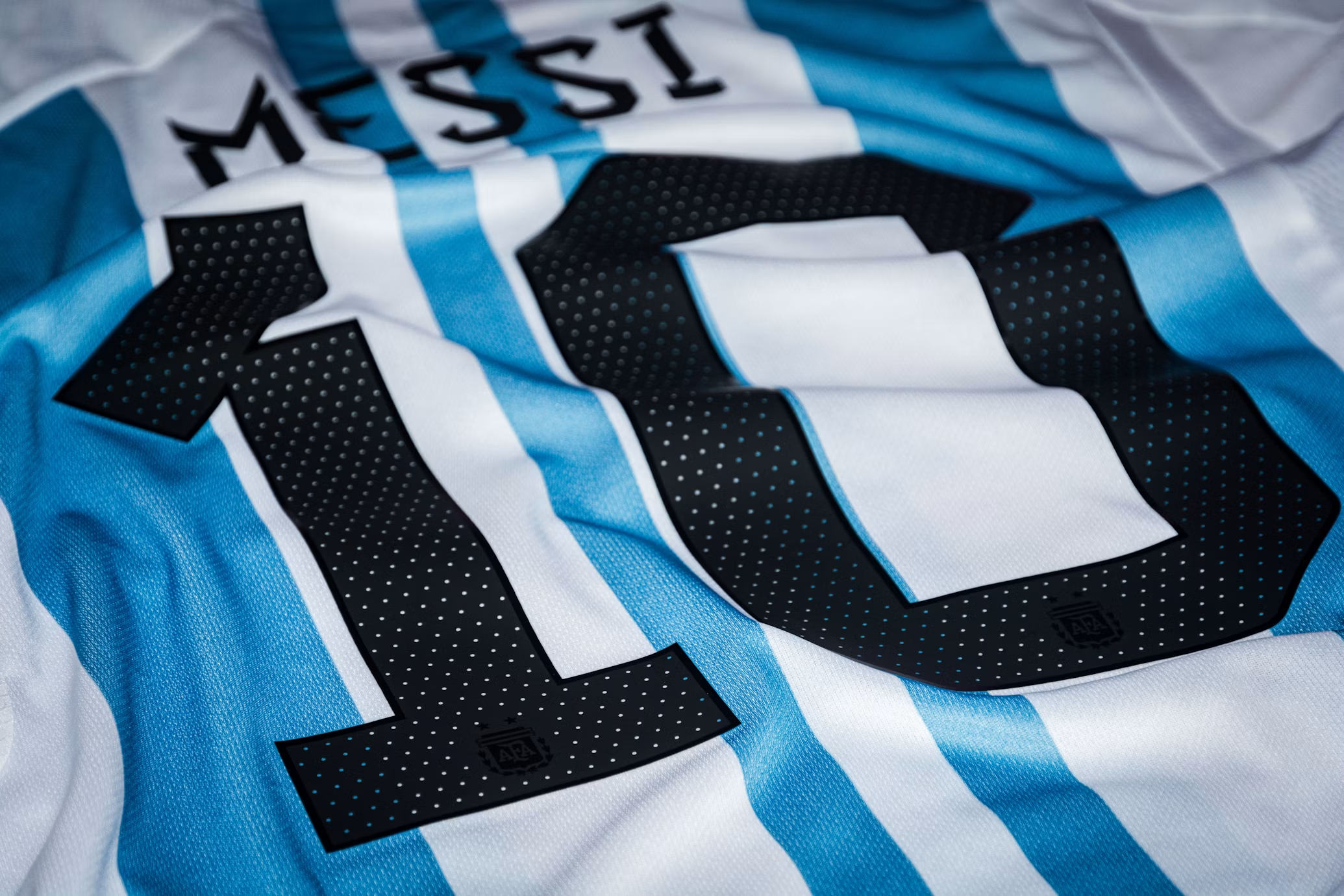
Chapter 6: Then Came the Hat-Trick
The first goal was not delicate.
That mattered.
We remember Messi for the brushstroke, the feathered pass, the dribble through bodies as if gravity had made an exception. But in Kansas City, his first goal was struck with force, a shot from distance that flew beyond Luca Zidane and into the corner. It was a reminder that ageing genius does not always whisper. Sometimes it kicks the door.
The second was different. A spill, a reaction, a poacher’s touch. The kind of goal people once pretended he did not score, because myths are often built by leaving out the ordinary things that make greatness complete. Messi followed the play. Messi waited. Messi finished.
The third was the one that made the night feel symbolic.
A break. A pass. A return. A measured finish placed where the goalkeeper could see it but not reach it. It had the shape of memory. Barcelona years, Argentina years, schoolyard years, all compressed into a few seconds of movement. The body was older. The idea was untouched.
Three goals.
But not merely three goals.
A first World Cup hat-trick. A 200th appearance for Argentina. A sixth World Cup. A share of the all-time World Cup scoring record. The oldest player to score a hat-trick on this stage. Records can sometimes feel cold, like numbers placed behind glass. This did not. This felt alive. It felt like the past reaching forward and touching the present on the shoulder.
The beauty of the hat-trick was not that it erased time. Nothing erases time. His beard carries it. His walk carries it. The way he saves his movements carries it. The miracle is that he has learned how to play with time rather than simply against it.
In 2022, after Saudi Arabia, people looked at Messi and saw a door closing.
In 2026, after Algeria, he made the door look like an entrance.
That is the strange gift of long sporting lives. They rearrange meaning. A defeat that once seemed like an ending becomes the beginning of a deeper arc. A humiliation becomes a shadow that makes the later light more vivid. The mockery remains, but it no longer wounds in the same way. It becomes part of the echo.
“Messi who?”
Four years later, football knew exactly who.
Not because he needed to answer every voice. Not because one hat-trick can define a career already beyond ordinary measurement. But because some players do not simply collect moments. They alter the meaning of the moments that came before.
Final Word
Saudi Arabia’s win will always belong to Saudi Arabia. It was their day, their joy, their thunderclap in the desert. Nothing that happened later should shrink it. But for Messi, it has become something else too: the dark opening to a final movement nobody had the right to expect.
From the silence of Lusail to the roar of Kansas City, from a bowed head to three raised fingers in the imagination, the road has been longer than the scoreboard ever showed.
On the day Saudi Arabia defeated Argentina, many thought they were watching the beginning of the end.
Four years later, a World Cup hat-trick made it feel like the opening page of a much larger story.

