One match is not enough to decide a World Cup. It is barely enough to decide whether a team has solved its nerves, read the room, or adjusted to the weather, the pitch, the crowd and the size of the occasion.
But one match is enough to leave fingerprints.
After every team had played once at the 2026 FIFA World Cup, the tournament already had shape. Not a final shape, of course. Group-stage football is slippery. A team that looks broken on opening night can win twice and suddenly look reborn. A side praised for its discipline can be pulled apart four days later. Still, the first 24 games have given us something more useful than predictions: they have given us clues.
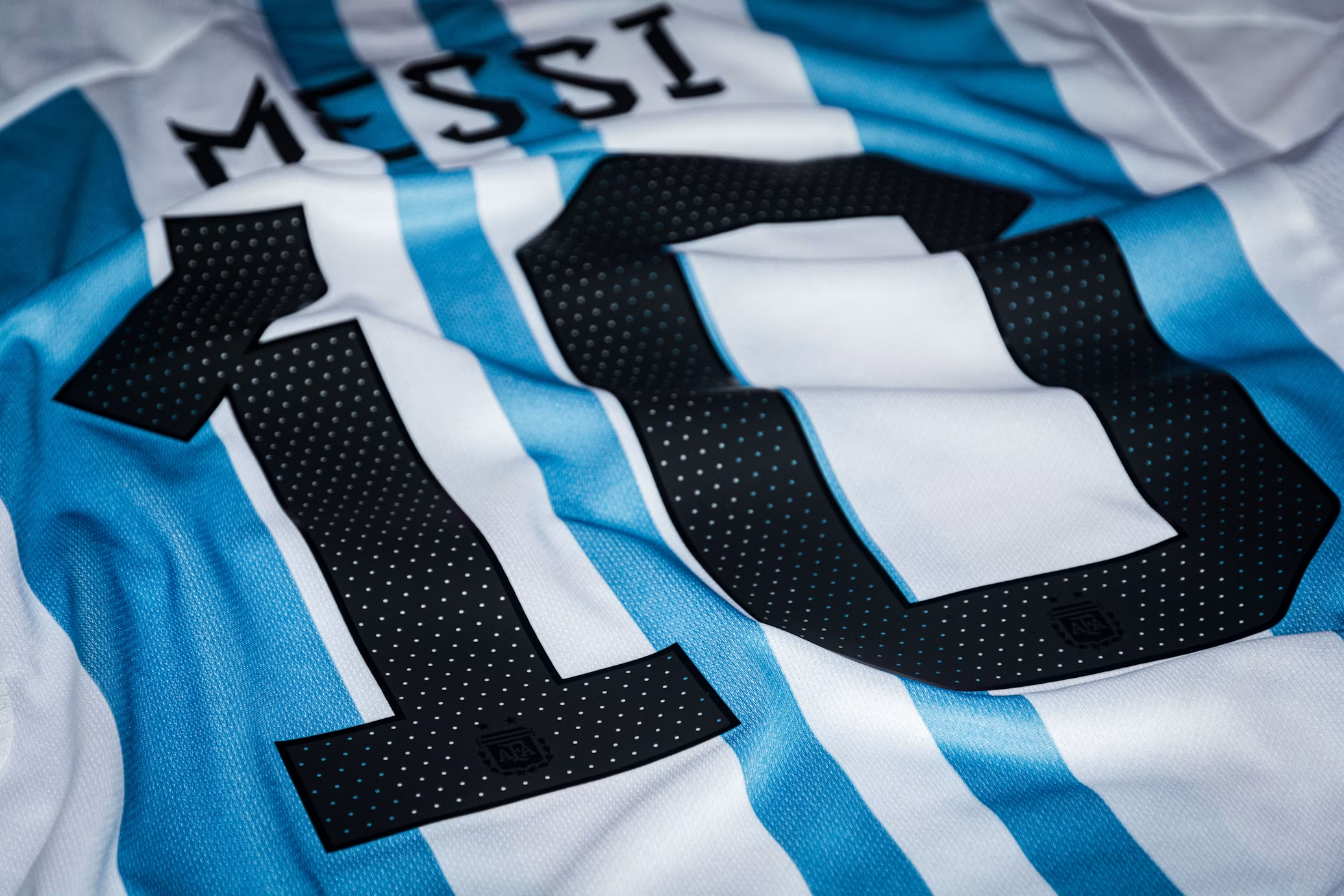
Germany hit seven. Spain could not hit one. Messi produced a hat-trick that felt like a private conversation with football history. Cape Verde held firm against a European champion. Portugal had Cristiano Ronaldo on the pitch and still looked short of ideas. The United States and Mexico gave the hosts a strong start, while Canada had to fight for its first World Cup point.
The expanded 48-team tournament has not produced one simple story. It has produced several at once: more goals, more firsts, more brave defending, more late swings, and more evidence that reputation is not much use once the whistle goes.
Here are the early trends that matter after the opening round of group matches.
The smaller nations are not here as decoration
The first round’s most important message may be this: the gap between football’s old powers and its supposed outsiders is not as comfortable as some expected.
Cape Verde’s 0–0 draw with Spain was the headline result of that theme. Spain had the ball, the territory and the volume of chances. Cape Verde had the nerve, the structure and Vozinha, their 40-year-old goalkeeper, who turned a World Cup debut into a national memory. The numbers told one story — Spain’s dominance — but the result told another. Cape Verde did not play like a team waiting to be overwhelmed. They defended the box, stayed calm, avoided panic fouls and made Spain look strangely blunt.
DR Congo did something similar against Portugal, though in a different register. Portugal scored early through João Neves, then drifted into a performance that became slower and narrower as the night went on. DR Congo grew into the match, equalised through Yoane Wissa and nearly stole it when Cédric Bakambu hit the post. That was not luck dressed up as romance. It was a team refusing to disappear after conceding early.
Morocco’s 1–1 draw with Brazil was less of a shock if you have been paying attention to African football, but it still mattered. Morocco looked organized, brave on the ball and dangerous enough to make Brazil uncomfortable. Brazil needed Vinícius Júnior to rescue a draw after Ismael Saibari had exposed familiar weaknesses.
There were more examples. Egypt took a point from Belgium. Saudi Arabia drew with Uruguay. New Zealand twice led Iran before finishing 2–2. Qatar, beaten three times at home in 2022, claimed their first World Cup point by finding a stoppage-time equaliser against Switzerland.
The trend may not survive every second match. Depth still matters. Recovery still matters. But the opening round has already challenged one easy assumption about expansion: more teams has not simply meant more soft games. It has meant more styles, more tension and more opponents capable of making favourites uncomfortable.
Possession without incision is becoming a trap
Spain’s draw with Cape Verde will be studied because it was so clean as a warning. You can dominate the ball, move it from side to side, build patiently and still spend 90 minutes slowly walking into a wall.
Spain had the numbers that usually make a post-match report look one-sided. They had possession. They had attempts. They had enough territory to make the game feel like it was being played almost exclusively in Cape Verde’s half. Yet the clearest story was not Spain’s control. It was Cape Verde’s control of the danger zones.
That distinction matters. In tournament football, sterile possession is not just unproductive; it can become emotionally draining. Every blocked shot adds weight. Every overhit cross makes the next one more anxious. The underdog starts to believe. The favourite starts to force.
Portugal felt the same problem against DR Congo. After scoring in the sixth minute, they did not build a performance around that advantage. They became predictable. Ronaldo’s presence gave the match its global frame, but Portugal’s bigger problem was structural: not enough speed in the final third, not enough movement around the box, not enough threat after the first blow.
Brazil, too, had stretches against Morocco where possession did not automatically mean control. Morocco’s transitions and midfield pressure made Brazil look like a team still searching for its rhythm under Carlo Ancelotti. Vinícius Júnior’s equaliser was brilliant, but brilliance is not the same as coherence.
The teams that should be concerned are obvious: Spain, Portugal, Brazil and Belgium all have enough individual quality to escape these early issues. But the first round showed that ball dominance alone is not going to bully opponents at this World Cup. The best low-block teams are more athletic, more organised and more comfortable suffering than ever.
When the favourites clicked, they were ruthless
For all the talk of underdog resistance, the opening round was not short of punishment. When the stronger teams found rhythm, games disappeared quickly.
Germany’s 7–1 win over Curaçao was the clearest example. Felix Nmecha scored early, and Germany never allowed the match to settle into a sentimental debut story. Kai Havertz scored twice, Jamal Musiala was on the scoresheet, and the Germans looked like a team determined to make an opening statement rather than merely collect three points.
Sweden’s 5–1 win over Tunisia carried a similar feeling. Yasin Ayari scored twice, Alexander Isak and Viktor Gyökeres also scored, and Sweden produced their first five-goal World Cup match since 1938. That matters not just because of the scoreline, but because Sweden arrived with questions after a difficult qualification route. One game later, the mood around them changed.
The United States were another side who used the opener to shift perception. The 4–1 win over Paraguay had an early own goal, a Folarin Balogun brace and a stoppage-time finish from Giovanni Reyna. More important, it had pace and aggression. This did not look like a host trying to survive the pressure. It looked like a team comfortable making the occasion uncomfortable for someone else.
France beat Senegal 3–1, with Kylian Mbappé scoring twice and Michael Olise giving the attack a different kind of balance. Norway, back on the World Cup stage after a long absence, beat Iraq 4–1 with Erling Haaland scoring twice on his tournament debut. Argentina beat Algeria 3–0 because Lionel Messi decided the opening night of his sixth World Cup was a good time to score three.
This is the other side of the expanded format. Yes, more teams are capable of resisting. But if the elite teams score first and keep accelerating, the scoreboard can still get ugly. The sides that benefit are those with multiple finishers rather than one obvious route to goal. Germany, France, Argentina, Sweden, Norway and the United States all showed that once the first line breaks, they have enough runners to make the second line panic.
Late goals and second-half swings are already shaping the groups
The first round was full of matches that changed late or lived on the edge deep into the second half.
Qatar’s point against Switzerland came through a stoppage-time equaliser, after Switzerland had dominated chances but failed to kill the game. Ghana beat Panama 1–0 through Caleb Yirenkyi in the fifth minute of added time, a classic tournament gut-punch: one counter, one finish, three points. Colombia were pulled back by Uzbekistan after the break, then immediately retook control through Luis Díaz before Jaminton Campaz added a stoppage-time third.
Japan’s 2–2 draw with the Netherlands was one of the round’s best examples of emotional momentum. The game burst open after halftime, with three goals arriving in a frantic 13-minute spell before Japan levelled late through a header that went in off Daichi Kamada. Japan did not treat the draw as a miracle. Their coach and players sounded like a team that believed it could have taken more.
England’s 4–2 win over Croatia was another reminder that no lead feels entirely safe. Croatia twice pulled themselves back into the game before England eventually found separation through Harry Kane, Jude Bellingham and Marcus Rashford.
This is likely to continue. The 2026 format changes the psychology of the group stage. With third-place routes available, teams trailing by one goal have strong incentive to chase, but teams protecting a draw may also value that point more than usual. Add heat, travel and squad rotation, and the final 20 minutes could become the tournament’s most revealing period.
Teams with strong benches and calm game management will benefit. Teams that dominate without scoring a second — Switzerland against Qatar, Portugal against DR Congo, Spain against Cape Verde — have already seen how quickly control can turn into regret.
Goalkeepers are having a louder tournament than expected
Modern football analysis often starts with pressing structures, rest defence and build-up patterns. Fine. But sometimes a World Cup trend is simpler: goalkeepers are already stealing scenes.
Vozinha’s performance against Spain was the obvious masterpiece. At 40, on Cape Verde’s World Cup debut, he became the face of one of the tournament’s first great stories. But he was not alone.
Australia’s Patrick Beach made the saves that kept Türkiye out in Vancouver, giving the Socceroos the platform for a 2–0 win built on defensive discipline and counterattacking timing. Saudi Arabia’s draw with Uruguay also had a strong goalkeeping element, with Mohammed Al Owais helping Saudi Arabia withstand long spells of Uruguayan pressure. Ghana needed Lawrence Ati Zigi in the first half against Panama before his injury forced a change.
There is a reason this keeps happening. The first game of a World Cup can make attacking players tight. Chances are snatched at. Final passes are forced. That gives goalkeepers the chance to become the emotional centre of the match.
The teams that benefit are not only the defensive underdogs. A reliable goalkeeper lets a team survive its worst spell and still keep the match alive. Cape Verde, Australia, Saudi Arabia and Ghana all left their openers with something because they had someone capable of turning pressure into frustration.
Star power still matters, but it is no longer enough by itself

Messi and Mbappé made the strongest case for individual greatness. Messi’s hat-trick against Algeria did not just win Argentina’s opener; it put him level with Miroslav Klose’s men’s World Cup goals record. Mbappé’s two goals against Senegal pushed him further into France’s record books and reminded everyone that France’s ceiling remains terrifying when he is direct and decisive.
Haaland’s World Cup debut also delivered exactly what Norway had waited years to see: two goals, a heavy win, and the sense that one elite striker can change a country’s expectations almost overnight. Kane scored twice for England and produced the sort of captain’s performance that gives a contender room to breathe.
But the first round also showed the limits of celebrity. Ronaldo’s Portugal had the brand-name storyline and still stumbled against DR Congo. Neymar’s absence left Brazil searching for rhythm against Morocco. Spain had Lamine Yamal and Nico Williams start on the bench against Cape Verde and never found the attacking sharpness expected of them. Belgium needed Romelu Lukaku’s introduction to rescue a point against Egypt.
The trend is not that stars are fading. It is that stars now need a functioning platform. Messi had Argentina’s structure around him. Mbappé had Olise helping France connect the attack. Haaland had Norway willing to play quickly and directly into his strengths. Ronaldo, by contrast, often looked isolated inside a Portugal attack that lacked tempo.
The lesson is old but still true: in a World Cup, talent wins moments. Systems win pressure.
The hosts have avoided the nightmare start
The three host nations all had different opening experiences, but none collapsed under the occasion.
Mexico began the tournament with a 2–0 win over South Africa at the Azteca. It was not a perfect performance. The match was scrappy and shaped by red cards. But for Mexico, after the pain of 2022, the first priority was never elegance. It was release. Julián Quiñones and Raúl Jiménez gave the home crowd what it needed: a win, a celebration and permission to believe again.
The United States produced the most impressive host performance with the 4–1 win over Paraguay. Balogun’s finishing, Pulisic’s influence before his calf issue, and Reyna’s late goal gave the Americans a result that immediately changed the tone of Group D. Their next match against Australia now feels like a meeting of two teams who both think they can win the group.
Canada’s 1–1 draw with Bosnia and Herzegovina was less explosive, but still significant. Cyle Larin’s equaliser gave Canada their first World Cup point, and in a group where all four teams drew their openers, it may matter more than it felt on the night.
The host trend could go either way from here. Home pressure can lift a team, but it can also tighten legs once expectation grows. Mexico and the United States have already banked wins; Canada still need one. The first round, though, avoided the worst-case scenario for North America’s tournament: none of the hosts look like passengers.
Discipline and tournament management are already separating teams
The opening match between Mexico and South Africa brought three red cards, and South Africa are already paying the price. Themba Zwane’s suspension, following his red card against Mexico, leaves Hugo Broos with a problem before the second game. South Africa were beaten, reduced, and left with damage that extends beyond the 90 minutes.
Paraguay’s five yellow cards against the United States told a different version of the same story. It was not just that Paraguay lost 4–1; it was that they looked emotionally stretched by the speed and intensity of the match. In a three-game group phase, that matters. You do not get long to reset, and card pressure can quickly influence selection.
This is a tournament where discipline will not only mean avoiding red cards. It will mean managing heat, hydration breaks, long travel, late-game fatigue and the emotional spikes that come with playing in front of huge crowds. Mexico coach Javier Aguirre even spoke about hydration breaks as tactical windows, which is exactly how managers will use them: not just for recovery, but for instructions.
The teams that can stay calm when games get messy will gain an edge. Ghana did that against Panama. Cape Verde did it against Spain. DR Congo did it after conceding early to Portugal. South Africa and Paraguay, in very different ways, showed how quickly a first match can leave a team with problems that bleed into the second.
The tournament’s emotional centre is shifting quickly
Every World Cup finds its emotional stories. After one round, this one already has several.
Cape Verde’s point against Spain is bigger than the table. It is a country’s first World Cup match becoming a night that people will remember forever. Curaçao lost 7–1 to Germany, but Livano Comenencia’s goal still mattered because it was their first on this stage. DR Congo’s draw with Portugal brought their first World Cup point. Qatar’s late equaliser against Switzerland brought their first World Cup point after the disappointment of 2022.
Then there are the giants writing personal chapters. Messi’s hat-trick was not just another elite performance; it was a record-equalling moment from a player nearing 39. Ronaldo’s draw against DR Congo, on the other hand, felt heavy with time. Kane moved level with Gary Lineker on England’s World Cup scoring list. Mbappé kept building his own argument as the defining tournament player of his generation.
This emotional range is part of why the opening round worked. The 2026 World Cup has already offered routs, shocks, returns, debuts, records and relief. The football has not always been smooth. Some matches have been scrappy. Some favourites have been cautious. But the tournament already feels alive.
The strongest early trend is not one tactic or one region. It is that the old hierarchy is being tested from several angles at once. Some favourites have responded by scoring freely. Others have been dragged into discomfort. The next round will tell us which of these first impressions were real and which were only opening-night noise.
For now, one match has been enough to tell us this: nobody has earned the right to coast.