The Hidden Role Every 2026 World Cup Team Must Appoint

When fans imagine the 2026 FIFA World Cup, their minds usually leap to the obvious headlines — a 48-team field, a sprawling calendar of 104 matches, and the most expansive football tournament the FIFA has ever staged. It promises spectacle on an unprecedented scale.

Yet tucked quietly within the tournament’s official regulations lies a structural change that has received far less attention, despite its significance.

For the first time in the history of the World Cup, every participating nation will be required to formally appoint a Team Safeguarding or Welfare Officer.

This is not a symbolic recommendation or an optional administrative role. The requirement is written directly into the competition’s governing framework. Under Article 27 of the official tournament regulations, each Participating Member Association must designate a safeguarding officer tasked with overseeing the well-being of players and members of the national delegation throughout the competition.

In a tournament that will stretch across three host nations and run for 39 days, football’s global governing body, FIFA, has effectively embedded welfare oversight into the legal architecture of the competition itself which is a clear sign that player protection is now being treated as seriously as the matches on the pitch.

🛡️ What Is A Team Safeguarding/Welfare Officer?

At the 2026 FIFA World Cup, the position is intended to be functional rather than ceremonial. Every participating national side is required to nominate a specific individual from within its accredited delegation to serve as the team’s safeguarding lead.

The responsibility may be assigned to the team doctor or to another officially accredited member of the delegation. What the regulations emphasise, however, is the need for a clearly designated official who holds formal responsibility for safeguarding matters during the tournament.

The appointed officer will act as the primary point of contact for issues relating to player welfare. This includes responding to safeguarding concerns, addressing complaints of abuse or harassment, supporting mental-health matters, and ensuring that the delegation adheres to the safeguarding framework laid down for the competition.

In effect, the measure reflects a broader shift in approach by football’s global governing body, FIFA. Safeguarding which was once addressed largely through internal policy guidance is now embedded within the regulatory structure governing the tournament.

🎓 Certification Is Mandatory

The regulations extend beyond merely creating the position. The individual appointed as safeguarding officer is also required to complete the FIFA Guardians Safeguarding Essentials online course and provide proof of certification to FIFA.

This requirement is framed as a matter of compliance rather than guidance. For the 2026 FIFA World Cup, safeguarding oversight has been standardised through a formal certification process that must be documented and submitted to the governing body.

In effect, the measure signals a broader institutional shift. By mandating training and verification, FIFA has moved to professionalise welfare governance within the operational framework of the tournament.

📋 What Are The Officer’s Responsibilities?

Article 27 outlines the safeguarding lead’s duties clearly. The officer must:

• Act as the first contact for all safeguarding matters within the team
• Liaise directly with FIFA’s Event Safeguarding Manager
• Ensure awareness of the Safeguarding and Anti-Discrimination Code of Conduct
• Prioritize players’ mental and physical well-being
• Report concerns involving psychological, physical or sexual abuse
• Attend FIFA safeguarding workshops during the tournament

The scope extends beyond matchday. It covers hotels, training sites, travel environments, and internal team dynamics.

🌍 Why This Matters In A 48-Team World Cup

The 2026 World Cup is the largest ever staged:

• 48 teams
• 104 matches
• 16 host cities
• Three host nations
• A 39-day tournament

The scale increases complexity — logistically, socially, and operationally.

Larger delegations, extended travel, increased media exposure, and cross-border coordination all raise safeguarding considerations. Embedding a welfare officer within each team creates an internal accountability layer designed to protect participants.

⚖️ A Response To Modern Football’s Reality

The safeguarding mandate reflects broader changes in global sport. Increased scrutiny of abuse cases, greater awareness of mental health challenges, and governance reforms across federations have reshaped expectations.

Previous tournaments had safeguarding policies. But 2026 formalizes the responsibility inside the competition regulations themselves.

That regulatory shift is significant.

🏆 The Hidden Figure Behind The Tournament

The spotlight in 2026 will fall on players, managers, and tactical decisions. But behind every dressing room door, there will be a certified safeguarding lead responsible for ensuring that welfare standards are upheld throughout the tournament.

It is a quiet role. It will not trend on social media. It will not lift a trophy.

But in the most expansive World Cup ever staged, it may be one of the most important positions of all.

2026 FIFA World Cup Points Table: All Groups Standings

The 2026 FIFA World Cup points table is where the real group-stage excitement unfolds. With the tournament hosted across the United States, Canada, and Mexico, and an expanded field of 48 teams, the race for qualification is more competitive than ever. Every match result, goal scored, and even disciplinary points can influence the standings.

For the first time in World Cup history, 12 groups of four teams will compete in the group stage. The top two teams from each group will automatically qualify for the knockout stage. In addition, eight of the twelve third-placed teams will also advance to the Round of 32, ensuring that qualification battles continue until the final group matches.

This page tracks the World Cup Points Table in real-time, updated immediately after each match. The tables display points, goal difference, and team form which are the key factors used to determine which teams progress to the knockout rounds.

📋 How the 2026 World Cup Points Table Works

Each team plays three group-stage matches. Points are awarded according to FIFA’s standard system:

  • Win: 3 points
  • Draw: 1 point
  • Loss: 0 points

Teams in each group are ranked primarily by the total number of points earned. When teams finish level on points, FIFA first applies head-to-head criteria. The initial comparison is limited to the matches played between the tied teams. Points earned in those direct encounters are considered first, followed by goal difference and goals scored in those same matches. This means a win in a head-to-head meeting can be more decisive than results against other teams in the group.

If the tie still cannot be resolved, FIFA then considers each team’s overall performance across all group matches. Goal difference becomes the next deciding factor, followed by total goals scored. These criteria reward teams that have performed consistently well throughout the entire group stage. Although very rare, even if the teams are still at the same level even at this point, then disciplinary record and past ranking decide which team move ahead.

It is also important to note that group stage matches end after the standard 90 minutes. If a match finishes as a draw, both teams receive one point each. There is no extra time or penalty shootout during the group stage.

For a detailed explanation of all ranking rules, you can read more about how FIFA determines group standings at the World Cup.

📊 Live 2026 FIFA World Cup Points Table

Below are the latest points tables for all 12 groups at the 2026 FIFA World Cup. The standings are updated after every match, reflecting the current positions of each team as the group stage progresses.

These tables display P (Played), W (Won), D (Drawn), L (Lost), GF (Goals For), GA (Goals Against), GD (Goal Difference) and Pts (Points), providing a clear picture of which teams are on track to qualify for the knockout stage and which teams still need strong results to advance.

Group A

# Team P W D L GF GA GD Pts
1
Czechia flagCzechia
00000000
2
Mexico flagMexico
00000000
3
South Africa flagSouth Africa
00000000
4
South Korea flagSouth Korea
00000000
Advance to Round of 32
Possible Qualification for Round of 32
Eliminated
No matches played yet.

Group B

# Team P W D L GF GA GD Pts
1
Bosnia flagBosnia
00000000
2
Canada flagCanada
00000000
3
Qatar flagQatar
00000000
4
Switzerland flagSwitzerland
00000000
Advance to Round of 32
Possible Qualification for Round of 32
Eliminated
No matches played yet.

Group C

# Team P W D L GF GA GD Pts
1
Brazil flagBrazil
00000000
2
Haiti flagHaiti
00000000
3
Morocco flagMorocco
00000000
4
Scotland flagScotland
00000000
Advance to Round of 32
Possible Qualification for Round of 32
Eliminated
No matches played yet.

Group D

# Team P W D L GF GA GD Pts
1
Australia flagAustralia
00000000
2
Paraguay flagParaguay
00000000
3
Turkey flagTurkey
00000000
4
USA flagUSA
00000000
Advance to Round of 32
Possible Qualification for Round of 32
Eliminated
No matches played yet.

Group E

# Team P W D L GF GA GD Pts
1
Curaçao flagCuraçao
00000000
2
Ecuador flagEcuador
00000000
3
Germany flagGermany
00000000
4
Ivory Coast flagIvory Coast
00000000
Advance to Round of 32
Possible Qualification for Round of 32
Eliminated
No matches played yet.

Group F

# Team P W D L GF GA GD Pts
1
Japan flagJapan
00000000
2
Netherlands flagNetherlands
00000000
3
Sweden flagSweden
00000000
4
Tunisia flagTunisia
00000000
Advance to Round of 32
Possible Qualification for Round of 32
Eliminated
No matches played yet.

Group G

# Team P W D L GF GA GD Pts
1
Belgium flagBelgium
00000000
2
Egypt flagEgypt
00000000
3
Iran flagIran
00000000
4
New Zealand flagNew Zealand
00000000
Advance to Round of 32
Possible Qualification for Round of 32
Eliminated
No matches played yet.

Group H

# Team P W D L GF GA GD Pts
1
Cape Verde flagCape Verde
00000000
2
Saudi Arabia flagSaudi Arabia
00000000
3
Spain flagSpain
00000000
4
Uruguay flagUruguay
00000000
Advance to Round of 32
Possible Qualification for Round of 32
Eliminated
No matches played yet.

Group I

# Team P W D L GF GA GD Pts
1
France flagFrance
00000000
2
Iraq flagIraq
00000000
3
Norway flagNorway
00000000
4
Senegal flagSenegal
00000000
Advance to Round of 32
Possible Qualification for Round of 32
Eliminated
No matches played yet.

Group J

# Team P W D L GF GA GD Pts
1
Algeria flagAlgeria
00000000
2
Argentina flagArgentina
00000000
3
Austria flagAustria
00000000
4
Jordan flagJordan
00000000
Advance to Round of 32
Possible Qualification for Round of 32
Eliminated
No matches played yet.

Group K

# Team P W D L GF GA GD Pts
1
Colombia flagColombia
00000000
2
DR Congo flagDR Congo
00000000
3
Portugal flagPortugal
00000000
4
Uzbekistan flagUzbekistan
00000000
Advance to Round of 32
Possible Qualification for Round of 32
Eliminated
No matches played yet.

Group L

# Team P W D L GF GA GD Pts
1
Croatia flagCroatia
00000000
2
England flagEngland
00000000
3
Ghana flagGhana
00000000
4
Panama flagPanama
00000000
Advance to Round of 32
Possible Qualification for Round of 32
Eliminated
No matches played yet.

📈 Best Third-Placed Teams: Live Qualification Race

Third place in the group stage is no longer the end of the road at the 2026 FIFA World Cup. Under the expanded format, all twelve third-placed teams are ranked, and eight of them will qualify for the Round of 32. This change ensures that teams remain in contention until their final group match.

Because qualification can depend on very fine margins, the ranking of third-placed teams has become one of the most closely watched aspects of the tournament. Points, goal difference, goals scored, and disciplinary records can all play a role in determining which teams advance.

Ranking of third-placed teams

# Team Group P W D L GF GA GD Pts
1
Austria flagAustria
Group J00000000
2
Germany flagGermany
Group E00000000
3
Ghana flagGhana
Group L00000000
4
Iran flagIran
Group G00000000
5
Morocco flagMorocco
Group C00000000
6
Norway flagNorway
Group I00000000
7
Portugal flagPortugal
Group K00000000
8
Qatar flagQatar
Group B00000000
9
South Africa flagSouth Africa
Group A00000000
10
Spain flagSpain
Group H00000000
11
Sweden flagSweden
Group F00000000
12
Turkey flagTurkey
Group D00000000
Qualified for Round of 32
Eliminated

👉 How the Top 8 Third-Placed Teams Qualify at the 2026 World Cup

🔥 Group Stage Analysis & Qualification Picture

As the group stage progresses, some groups will emerge as classic “Groups of Death,” where even strong teams cannot rely on an early lead. In tightly contested groups, four points may not guarantee qualification, forcing teams to keep pushing for results rather than defending narrow advantages. In other groups, teams must carefully judge whether a draw will be enough to secure second place or if they need to take risks to avoid dropping into third.

The expanded format has only increased the tension. Late goals can instantly reshape the standings, and even fair play records can become decisive in close races. The final round of group matches, played simultaneously, is expected to deliver the most drama with qualification and elimination often decided in the final minutes.

📊 Looking for Player & Team Statistics?

This page is dedicated to tracking the group standings and qualification picture as the tournament unfolds. It shows where each team stands and what they need to advance, based on points and official tie-breaking criteria.

For a deeper look at individual and team performances, including goals scored, assists, clean sheets, minutes played, and disciplinary records, you can visit our full statistics section.

👉 Explore Complete 2026 World Cup Player & Team Stats

📚 How 2026 Compares to Previous World Cups

During the 2022 World Cup, many groups were decided relatively early. In several cases, earning four points was enough to secure qualification, allowing teams to approach their final group match with confidence. The expanded 2026 format has changed that dynamic. With more teams and additional qualification spots for third place, the group stage has become more competitive and far less predictable.

As a result, goal difference has become a crucial factor. It is no longer just a statistic, but a key element that can determine whether a team advances or is eliminated, especially when teams are level on points.

The 2026 FIFA World Cup points table is updated live throughout the tournament. Bookmark this page to follow group standings, qualification battles, and knockout progression as the world’s biggest football event unfolds.

Next up? Check the live Round of 32 bracket and the full match schedule by local time.

World Cup 2026 Goalkeeper Rule Explained: Why Keepers Get Special Treatment

When FIFA confirmed that the 2026 FIFA World Cup would expand to 48 teams, the headlines wrote themselves. A new format. More matches. A broader global footprint. For months, the debate revolved around scheduling, player workload and competitive balance.

Yet tucked away in the tournament regulations is a clause that may influence results just as profoundly as the expanded group stage: goalkeepers and goalkeepers alone are afforded a level of protection no outfield player enjoys.

Once the tournament kicks off in 2026 (teams’ first match to be more precise), defenders, midfielders and forwards are effectively frozen into their squads. Barring truly exceptional administrative circumstances, what you start with is what you finish with. Goalkeepers operate under a different provision altogether. According to the official competition regulations, any goalkeeper who suffers a serious injury or illness during the tournament may be replaced at any stage.

This is not a loophole. It is a deliberate safeguard.

Those who have followed international tournaments closely understand why. The goalkeeper’s position is unlike any other on the pitch. It demands specialist training, a distinct psychological profile and tactical familiarity with the defensive unit that cannot be improvised overnight. An outfield player can often be repositioned in an emergency; a midfielder may fill in at full-back, a forward can drop deeper. But there is no credible substitute for a trained goalkeeper at the highest level.

Modern international football has only sharpened that reality. Keepers today are not merely shot-stoppers. They initiate build-up play, manage defensive lines, command aerial zones and function as the team’s first point of distribution. Losing one mid-tournament particularly to injury can derail not just a match plan, but an entire campaign.

FIFA’s provision recognises that fragility. It ensures that teams are not competitively crippled by circumstances unique to the position. The replacement, however, is tightly regulated: it must be medically justified, formally approved, and applies strictly to the goalkeeper role. It is not an open door to tactical reshuffling.

In a 48-team World Cup, where the margins will be thinner and the schedule denser, this seemingly technical rule could carry real strategic weight. Coaches will travel with three goalkeepers, but the knowledge that an emergency replacement remains possible changes risk calculations particularly deep into the knockout stages.

In tournaments of this magnitude, it is often the small-print regulations, not the grand announcements, that shape defining moments. In 2026, the special protection granted to goalkeepers may prove to be one such detail — quiet on paper, decisive on the pitch.

📋 Understanding The Provisional And Final Squad Lists

Before the World Cup begins, each nation must submit two separate player lists to FIFA: a provisional list and a final list.

The provisional list contains between 35 and 55 players, including at least four goalkeepers. This larger pool acts as the federation’s reserve database for potential call-ups and medical replacements.

From that provisional group, each team then submits its final squad of 23 to 26 players, including at least three goalkeepers. Once this final list is confirmed and the tournament begins, the squad is effectively locked.

Outfield players can only be replaced up to 24 hours before the team’s first match, and only in cases of serious injury or illness — subject to FIFA medical approval.

After that deadline passes, no outfield changes are permitted. This is what makes the goalkeeper exception so significant.

🧤 Goalkeepers Can Be Replaced At Any Stage Of The Tournament

As stated earlier, each team in the 2026 FIFA World Cup is required to submit their final squad of 23–26 players. Importantly, at least three of the declared players must be goalkeepers, a requirement that shows the high regard for the position at the international level.

As to the field players, the room for changing is very limited and strictly regulated. A substitute is only allowed up to 24 hours before a teams first match, and only in the case of a serious injury or illness. When the tournament starts, the window is nearly closed. Except for cases of extraordinary administrative rulings, the defenders, midfielders, and strikers who start the World Cup are the only ones available till the end.

Nevertheless, goalkeepers are a special case in terms of regulations.

If a goalkeeper gets severely injured or ill during any phase of the World Cup (group stage or knockout rounds), the team can still ask for a replacement. The application must be medically and procedurally verified; however, the option remains available until the very end of the competition.

In reality, this policy implies that the goalkeeper is the only field position given the liberty of change during the tournament. It is a small nuance in the regulations; however, it recognises that this role is subjected to unique demands and vulnerabilities. And certainly, this could be a very instrumental factor in a five-and-a-half-week tournament where the margins are very small.

⚖️ Why FIFA Gives Goalkeepers Special Status

FIFA did not carve out an exception for goalkeepers on a whim. The reasoning is rooted in football logic and tournament realities.

1. It is the most specialised position on the pitch

There is no comparable role in the sport. A winger can be asked to track back and operate as a full-back in an emergency. A defensive midfielder can slot into central defence if required. Managers routinely shuffle outfield combinations when injuries strike.

That flexibility ends with the goalkeeper.

The technical demands — positioning, reflex work, aerial command, distribution under pressure — are developed over years of position-specific training. At international level, where the margins are microscopic, improvisation is not a viable strategy. You cannot simply hand gloves to an outfield player and expect structural stability.

FIFA’s allowance reflects that reality.

2. The 48-team format stretches the physical limits

The 2026 FIFA World Cup will be the largest in history. A total of 104 matches will be played across three host nations, with travel spanning vast distances. Teams reaching the final could play as many as eight matches over five-and-a-half-weeks.

Add to that varying climates, recovery demands and the modern expectation that goalkeepers act as auxiliary playmakers, and the physical strain becomes evident. Repetitive diving, aerial collisions and high-intensity build-up involvement increase the risk of knocks turning into tournament-ending injuries.

In such a marathon, attrition is inevitable. The regulation is, in many ways, insurance against that grind.

3. Protecting competitive balance

At its core, the World Cup is about sporting fairness. Without a mid-tournament replacement provision, a side that loses two or three goalkeepers to injury could find itself entering a knockout fixture with an outfield player in goal — a scenario that would undermine competitive integrity at the highest stage of the game.

By permitting goalkeeper replacements under strict medical oversight, FIFA ensures that results are determined by footballing quality rather than administrative rigidity or sheer misfortune.

It is a narrow exception, but an essential one designed less to offer advantage and more to prevent chaos in a tournament where the stakes could not be higher.

📋 How The Goalkeeper Replacement Process Works

The replacement system is tightly controlled and cannot be used as a tactical loophole.

If a goalkeeper is injured or ill:

• The federation must nominate a replacement from its provisional list.
• A detailed medical assessment must be submitted.
• FIFA’s Medical Committee must confirm the severity of the injury.
• The injured goalkeeper must return their accreditation.
• The replacement goalkeeper receives the next available squad number.

Only after FIFA approval can the change be finalized. This ensures the rule is applied strictly for medical reasons.

🏆 Why This Rule Matters More Than It Appears

Modern World Cups are rarely settled by sweeping dominance. More often than not, they turn on moments — a deflection, a lapse in concentration, or the unforgiving theatre of a penalty shoot-out. In that arena, the goalkeeper is no longer a peripheral figure; he is central to the script.

Today’s elite keepers are expected to do far more than repel shots. They initiate attacks, split defensive lines with their passing, command their penalty areas and organise the back four with constant communication. In many systems, the goalkeeper is effectively the first playmaker.

Remove that pillar unexpectedly, and the structural impact can be immediate. Defensive coordination suffers. Build-up patterns break down. Confidence wavers. Relying on an untested or makeshift replacement at that level is not merely inconvenient — it can distort the competitive balance of a match.

By permitting goalkeeper replacements throughout the tournament, FIFA has sought to guard against precisely that scenario at the 2026 FIFA World Cup. The intention is not to hand teams an advantage, but to ensure that contests are decided by preparation and performance, not by avoidable regulatory rigidity.

At a World Cup, where margins are measured in millimetres and nerves, that distinction matters.

🚫 Can Teams Exploit The Rule?

In theory, any regulatory exception invites suspicion. In practice, this one leaves little room for manoeuvre.

The process is neither casual nor discretionary. A team seeking to replace a goalkeeper must submit detailed medical documentation, obtain formal approval from FIFA, and complete the necessary administrative procedures including surrendering the outgoing player’s accreditation. Once replaced, that goalkeeper cannot return to the tournament.

Those layers are not ornamental. They are deliberate safeguards.

The provision exists to address genuine medical emergencies, not to facilitate tactical reshuffles or strategic fine-tuning midway through a campaign. Attempting to manipulate it would require falsifying medical evidence and risking severe disciplinary consequences, a gamble no federation at a World Cup is likely to entertain.

In short, the rule is narrow by design. It protects teams from unforeseen misfortune without opening the door to competitive gamesmanship.

🌍 A Tournament Built Around Structure And Stability

The 2026 World Cup will usher in the most expansive overhaul the tournament has seen in decades — a 48-team field, additional knockout fixtures and a calendar that stretches the physical and logistical limits of the modern game. Within that broader redesign, one relatively understated regulation speaks volumes about how the sport is evolving.

The goalkeeper replacement provision is not a cosmetic tweak. It is part of FIFA’s attempt to balance expansion with competitive integrity at the 2026 FIFA World Cup.

From the moment the competition begins, outfield players are effectively locked into place. Coaches must navigate injuries, suspensions and dips in form with the resources already registered. Goalkeepers stand apart — not by privilege, but by necessity. Their role demands a separate layer of contingency planning, one that acknowledges how exposed a team becomes if that position is suddenly compromised.

In a month-long tournament where margins are microscopic and legacies hinge on moments, that distinction is not trivial. World Cups have been defined by a single save, a fingertip deflection, a penalty stopped under unbearable pressure.

In 2026, the safeguard afforded to goalkeepers may appear technical on paper. On the pitch, it could prove decisive.

2026 FIFA World Cup Schedule in Zona Centro (Mexico Central Time)

In Mexico, the World Cup is never the same as other tournaments. With the 2026 edition returning to North America, and Mexico playing a leading part as one of the three hosts, the excitement is already starting to feel somewhat different. The whole country is gearing up for a football-filled summer with streets, sports bars, and living rooms all ready for the sport. For those living in Zona Centro, the right knowledge of the local match times will be very helpful.

Fans can count on the time difference this time to be in their favour. Since the games take place in the United States, Canada, and Mexico, there is a high chance that most of the match hours will be in the afternoon and evening in the Central region. In short, there will be fewer occasions to set the alarm clock for the early morning and more opportunities to watch live without interrupting the day.

Below you will get a complete 2026 World Cup schedule in Zona Centro time. It covers all 104 matches, from the first match on June 11, 2026, to the final on July 19, 2026. If you are planning to explore every group-stage turn or only follow the Mexicans’ journey, this schedule will help you stay on time with your clock.

Zona Centro is on Central Standard Time (UTC-6) and switches to Central Daylight Time (UTC-5) in the summer months. Since the World Cup is held in June and July, all the game times indicated are in Central Daylight Time (CDT).

🌍 FIFA World Cup History at a Glance

Back in 1930 when the FIFA World Cup was first held, it was a rather small tournament with only 13 teams participating. Later, it turned into the most popular sporting event globally, attracting millions of viewers from different continents. Almost a hundred years later, the tournament will enter a new era in 2026 by increasing the number of participating countries to 48 and stretching its global appeal to an even greater level.

Mexico’s part in that story is noteworthy. It hosted the world football championship first in 1970 and then in 1986, thus becoming the first country to host the World Cup twice. In 2026, it will break another record by becoming the first nation to host the tournament three times, a testament to its long-standing love for football.

The World Cup has through the years given us events that are still vividly remembered: last-minute goals, nerve-wracking finals, and outstanding performances that made legends. Mexico, on many occasions, has been the setting of those stories either as a host providing the venue or as a competitor playing under the pressure of the home crowd’s high expectations.

⚽ Quick Facts – 2026 FIFA World Cup

Category Details
Host Nations United States, Canada, Mexico
Tournament Dates 11 June – 19 July 2026
Total Teams 48
Total Matches 104
Time Zone Used Zona Centro – Central Daylight Time (CDT, UTC−5)
Final Venue MetLife Stadium, New Jersey, USA

🇲🇽 Mexico at the FIFA World Cup

Mexico have literally been part of the World Cup since the beginning as they played the first-ever tournament back in 1930. Over the years, El Tri has become one of the most consistent representatives of North America on the global stage, earning a name for themselves through continuous qualifying and strong performances.

Their greatest World Cup runs have been when they played on their own territory. In 1970 and again in 1986, Mexico went as far as the quarter-finals, equalling their best finish in the tournament, both achieved in front of their home crowd. Those moments are milestones Mexico football will always remember — times when the national team stood equal with the biggest names in the world.

From 1994 to 2018, Mexico achieved one of the most remarkable records in modern World Cup history by reaching the Round of 16 in seven consecutive tournaments. Although the 2022 event saw them exit at the group stage, their overall consistency has not diminished, and they remain one of the top teams in the region.

In 2026, as co-hosts, Mexico will enter a new chapter. They will become the first country to host the World Cup three times. With familiar stadiums and passionate home support behind them, there will be little doubt about their ambition: to equal — and possibly surpass — those historic quarter-final runs.

🇲🇽 Mexico’s Matches in Zona Centro Time

Date Time Team 1 Score Team 2
(Thursday)
1:00 PM (CDT)
Mexico
vs
South Africa
Mexico City
Match No. 1
Group A
(Thursday)
7:00 PM (CDT)
Mexico
vs
South Korea
Guadalajara
Match No. 28
Group A
(Wednesday)
7:00 PM (CDT)
Czechia
vs
Mexico
Mexico City
Match No. 53
Group A

📅 Horario del Mundial 2026 en Hora Centro (México)

For fans in Mexico’s Central Zone, the 2026 World Cup offers one of the most convenient viewing schedules globally. Matches will be distributed across afternoon and evening kick-off slots, making it easier to follow every stage of the tournament live.

The opening match will kick off on 11 June 2026 at 1:00 PM (CDT), while the final will be played on 19 July 2026 at 1:00 PM (CDT). Below is the full list of all 104 matches, converted into Zona Centro time. Use filters to sort by team, venue, or stage.

Date Time Team 1 Score Team 2
(Thursday)
1:00 PM (CDT)
Mexico
vs
South Africa
Mexico City
Match No. 1
Group A
8:00 PM (CDT)
South Korea
vs
Czechia
Guadalajara
Match No. 2
Group A
(Friday)
1:00 PM (CDT)
Canada
vs
Bosnia
Toronto
Match No. 3
Group B
7:00 PM (CDT)
USA
vs
Paraguay
Los Angeles
Match No. 4
Group D
(Saturday)
1:00 PM (CDT)
Qatar
vs
Switzerland
SF Bay Area
Match No. 8
Group B
4:00 PM (CDT)
Brazil
vs
Morocco
New York
Match No. 7
Group C
7:00 PM (CDT)
Haiti
vs
Scotland
Boston
Match No. 5
Group C
10:00 PM (CDT)
Australia
vs
Turkey
Vancouver
Match No. 6
Group D
(Sunday)
11:00 AM (CDT)
Germany
vs
Curaçao
Houston
Match No. 10
Group E
2:00 PM (CDT)
Netherlands
vs
Japan
Dallas
Match No. 11
Group F
5:00 PM (CDT)
Ivory Coast
vs
Ecuador
Philadelphia
Match No. 9
Group E
8:00 PM (CDT)
Sweden
vs
Tunisia
Monterrey
Match No. 12
Group F
(Monday)
10:00 AM (CDT)
Spain
vs
Cape Verde
Atlanta
Match No. 14
Group H
1:00 PM (CDT)
Belgium
vs
Egypt
Seattle
Match No. 16
Group G
4:00 PM (CDT)
Saudi Arabia
vs
Uruguay
Miami
Match No. 13
Group H
7:00 PM (CDT)
Iran
vs
New Zealand
Los Angeles
Match No. 15
Group G
(Tuesday)
1:00 PM (CDT)
France
vs
Senegal
New York
Match No. 17
Group I
4:00 PM (CDT)
Iraq
vs
Norway
Boston
Match No. 18
Group I
7:00 PM (CDT)
Argentina
vs
Algeria
Kansas City
Match No. 19
Group J
10:00 PM (CDT)
Austria
vs
Jordan
SF Bay Area
Match No. 20
Group J
(Wednesday)
11:00 AM (CDT)
Portugal
vs
DR Congo
Houston
Match No. 23
Group K
2:00 PM (CDT)
England
vs
Croatia
Dallas
Match No. 22
Group L
5:00 PM (CDT)
Ghana
vs
Panama
Toronto
Match No. 21
Group L
8:00 PM (CDT)
Uzbekistan
vs
Colombia
Mexico City
Match No. 24
Group K
(Thursday)
10:00 AM (CDT)
Czechia
vs
South Africa
Atlanta
Match No. 25
Group A
1:00 PM (CDT)
Switzerland
vs
Bosnia
Los Angeles
Match No. 26
Group B
4:00 PM (CDT)
Canada
vs
Qatar
Vancouver
Match No. 27
Group B
7:00 PM (CDT)
Mexico
vs
South Korea
Guadalajara
Match No. 28
Group A
(Friday)
1:00 PM (CDT)
USA
vs
Australia
Seattle
Match No. 32
Group D
4:00 PM (CDT)
Scotland
vs
Morocco
Boston
Match No. 30
Group C
7:00 PM (CDT)
Brazil
vs
Haiti
Philadelphia
Match No. 29
Group C
10:00 PM (CDT)
Turkey
vs
Paraguay
SF Bay Area
Match No. 31
Group D
(Saturday)
11:00 AM (CDT)
Netherlands
vs
Sweden
Houston
Match No. 35
Group F
2:00 PM (CDT)
Germany
vs
Ivory Coast
Toronto
Match No. 33
Group E
6:00 PM (CDT)
Ecuador
vs
Curaçao
Kansas City
Match No. 34
Group E
10:00 PM (CDT)
Tunisia
vs
Japan
Monterrey
Match No. 36
Group F
(Sunday)
10:00 AM (CDT)
Spain
vs
Saudi Arabia
Atlanta
Match No. 38
Group H
1:00 PM (CDT)
Belgium
vs
Iran
Los Angeles
Match No. 39
Group G
4:00 PM (CDT)
Uruguay
vs
Cape Verde
Miami
Match No. 37
Group H
7:00 PM (CDT)
New Zealand
vs
Egypt
Vancouver
Match No. 40
Group G
(Monday)
11:00 AM (CDT)
Argentina
vs
Austria
Dallas
Match No. 43
Group J
3:00 PM (CDT)
France
vs
Iraq
Philadelphia
Match No. 42
Group I
6:00 PM (CDT)
Norway
vs
Senegal
New York
Match No. 41
Group I
9:00 PM (CDT)
Jordan
vs
Algeria
SF Bay Area
Match No. 44
Group J
(Tuesday)
11:00 AM (CDT)
Portugal
vs
Uzbekistan
Houston
Match No. 47
Group K
2:00 PM (CDT)
England
vs
Ghana
Boston
Match No. 45
Group L
5:00 PM (CDT)
Panama
vs
Croatia
Toronto
Match No. 46
Group L
8:00 PM (CDT)
Colombia
vs
DR Congo
Guadalajara
Match No. 48
Group K
(Wednesday)
1:00 PM (CDT)
Switzerland
vs
Canada
Vancouver
Match No. 51
Group B
1:00 PM (CDT)
Bosnia
vs
Qatar
Seattle
Match No. 52
Group B
4:00 PM (CDT)
Scotland
vs
Brazil
Miami
Match No. 49
Group C
4:00 PM (CDT)
Morocco
vs
Haiti
Atlanta
Match No. 50
Group C
7:00 PM (CDT)
Czechia
vs
Mexico
Mexico City
Match No. 53
Group A
7:00 PM (CDT)
South Africa
vs
South Korea
Monterrey
Match No. 54
Group A
(Thursday)
2:00 PM (CDT)
Curaçao
vs
Ivory Coast
Philadelphia
Match No. 55
Group E
2:00 PM (CDT)
Ecuador
vs
Germany
New York
Match No. 56
Group E
5:00 PM (CDT)
Japan
vs
Sweden
Dallas
Match No. 57
Group F
5:00 PM (CDT)
Tunisia
vs
Netherlands
Kansas City
Match No. 58
Group F
8:00 PM (CDT)
Turkey
vs
USA
Los Angeles
Match No. 59
Group D
8:00 PM (CDT)
Paraguay
vs
Australia
SF Bay Area
Match No. 60
Group D
(Friday)
1:00 PM (CDT)
Norway
vs
France
Boston
Match No. 61
Group I
1:00 PM (CDT)
Senegal
vs
Iraq
Toronto
Match No. 62
Group I
6:00 PM (CDT)
Cape Verde
vs
Saudi Arabia
Houston
Match No. 65
Group H
6:00 PM (CDT)
Uruguay
vs
Spain
Guadalajara
Match No. 66
Group H
9:00 PM (CDT)
Egypt
vs
Iran
Seattle
Match No. 63
Group G
9:00 PM (CDT)
New Zealand
vs
Belgium
Vancouver
Match No. 64
Group G
(Saturday)
3:00 PM (CDT)
Panama
vs
England
New York
Match No. 67
Group L
3:00 PM (CDT)
Croatia
vs
Ghana
Philadelphia
Match No. 68
Group L
5:30 PM (CDT)
Colombia
vs
Portugal
Miami
Match No. 71
Group K
5:30 PM (CDT)
DR Congo
vs
Uzbekistan
Atlanta
Match No. 72
Group K
8:00 PM (CDT)
Algeria
vs
Austria
Kansas City
Match No. 69
Group J
8:00 PM (CDT)
Jordan
vs
Argentina
Dallas
Match No. 70
Group J
(Sunday)
1:00 PM (CDT)
Runner-up Group A
vs
Runner-up Group B
Los Angeles
Match No. 73
Round of 32
(Monday)
11:00 AM (CDT)
Winner Group C
vs
Runner-up Group F
Houston
Match No. 76
Round of 32
2:30 PM (CDT)
Winner Group E
vs
3rd Group A/B/C/D/F
Boston
Match No. 74
Round of 32
7:00 PM (CDT)
Winner Group F
vs
Runner-up Group C
Monterrey
Match No. 75
Round of 32
(Tuesday)
11:00 AM (CDT)
Runner-up Group E
vs
Runner-up Group I
Dallas
Match No. 78
Round of 32
3:00 PM (CDT)
Winner Group I
vs
3rd Group C/D/F/G/H
New York
Match No. 77
Round of 32
7:00 PM (CDT)
Winner Group A
vs
3rd Group C/E/F/H/I
Mexico City
Match No. 79
Round of 32
(Wednesday)
10:00 AM (CDT)
Winner Group L
vs
3rd Group E/H/I/J/K
Atlanta
Match No. 80
Round of 32
2:00 PM (CDT)
Winner Group G
vs
3rd Group A/E/H/I/J
Seattle
Match No. 82
Round of 32
6:00 PM (CDT)
Winner Group D
vs
3rd Group B/E/F/I/J
SF Bay Area
Match No. 81
Round of 32
(Thursday)
1:00 PM (CDT)
Winner Group H
vs
Runner-up Group J
Los Angeles
Match No. 84
Round of 32
5:00 PM (CDT)
Runner-up Group K
vs
Runner-up Group L
Toronto
Match No. 83
Round of 32
9:00 PM (CDT)
Winner Group B
vs
3rd Group E/F/G/I/J
Vancouver
Match No. 85
Round of 32
(Friday)
12:00 PM (CDT)
Runner-up Group D
vs
Runner-up Group G
Dallas
Match No. 88
Round of 32
4:00 PM (CDT)
Winner Group J
vs
Runner-up Group H
Miami
Match No. 86
Round of 32
7:30 PM (CDT)
Winner Group K
vs
3rd Group D/E/I/J/L
Kansas City
Match No. 87
Round of 32
(Saturday)
11:00 AM (CDT)
Winner Match 73
vs
Winner Match 75
Houston
Match No. 90
Round of 16
3:00 PM (CDT)
Winner Match 74
vs
Winner Match 77
Philadelphia
Match No. 89
Round of 16
(Sunday)
2:00 PM (CDT)
Winner Match 76
vs
Winner Match 78
New York
Match No. 91
Round of 16
6:00 PM (CDT)
Winner Match 79
vs
Winner Match 80
Mexico City
Match No. 92
Round of 16
(Monday)
1:00 PM (CDT)
Winner Match 83
vs
Winner Match 84
Dallas
Match No. 93
Round of 16
6:00 PM (CDT)
Winner Match 81
vs
Winner Match 82
Seattle
Match No. 94
Round of 16
(Tuesday)
10:00 AM (CDT)
Winner Match 86
vs
Winner Match 88
Atlanta
Match No. 95
Round of 16
2:00 PM (CDT)
Winner Match 85
vs
Winner Match 87
Vancouver
Match No. 96
Round of 16
(Thursday)
2:00 PM (CDT)
Winner Match 89
vs
Winner Match 90
Boston
Match No. 97
Quarterfinals
(Friday)
1:00 PM (CDT)
Winner Match 93
vs
Winner Match 94
Los Angeles
Match No. 98
Quarterfinals
(Saturday)
3:00 PM (CDT)
Winner Match 91
vs
Winner Match 92
Miami
Match No. 99
Quarterfinals
7:00 PM (CDT)
Winner Match 95
vs
Winner Match 96
Kansas City
Match No. 100
Quarterfinals
(Tuesday)
1:00 PM (CDT)
Winner Match 97
vs
Winner Match 98
Dallas
Match No. 101
Semifinals
(Wednesday)
1:00 PM (CDT)
Winner Match 99
vs
Winner Match 100
Atlanta
Match No. 102
Semifinals
(Saturday)
3:00 PM (CDT)
Loser Match 101
vs
Loser Match 102
Miami
Match No. 103
Third place
(Sunday)
1:00 PM (CDT)
Winner Match 101
vs
Winner Match 102
New York
Match No. 104
Final

🌍 Host Nations & Match Venues

The 2026 FIFA World Cup will be staged across three nations and 16 cities, making it the most expansive tournament in history.

🇲🇽 Mexico
Mexico City, Guadalajara, Monterrey
🇺🇸 United States
New York / New Jersey, Los Angeles, Dallas, Miami, Atlanta, Houston, Seattle, San Francisco Bay Area, Boston, Philadelphia, Kansas City
🇨🇦 Canada
Toronto, Vancouver

With matches hosted across multiple North American time zones, displaying fixtures in Zona Centro (CDT) ensures clarity and convenience for Mexican fans.

📺 How to Watch the 2026 FIFA World Cup in Mexico

  • Televisa (Canal 5 & TUDN)
  • TV Azteca
  • ViX (Streaming)
  • FIFA+ (Highlights and official coverage)

❓ Zona Centro & 2026 World Cup – FAQs

Q1. Are all match times shown in Mexico Central Time?
Yes. Every fixture on this page is displayed in Central Daylight Time (CDT), which applies during June and July 2026.

Q2. Does Mexico observe daylight saving time?
Yes. Zona Centro shifts to CDT (UTC −5) during summer months.

Q3. How many cities in Mexico will host matches?
Three cities: Mexico City, Guadalajara, and Monterrey.

Q4. Has Mexico hosted the World Cup before?
Yes. Mexico hosted in 1970 and 1986, and 2026 will mark their historic third hosting.

🌐 View Schedules in Other Time Zones

With Mexico hosting once again and match times aligned perfectly with Zona Centro, the 2026 FIFA World Cup promises unforgettable football nights. Bookmark this page and follow every moment — from the opening whistle to the final celebration.

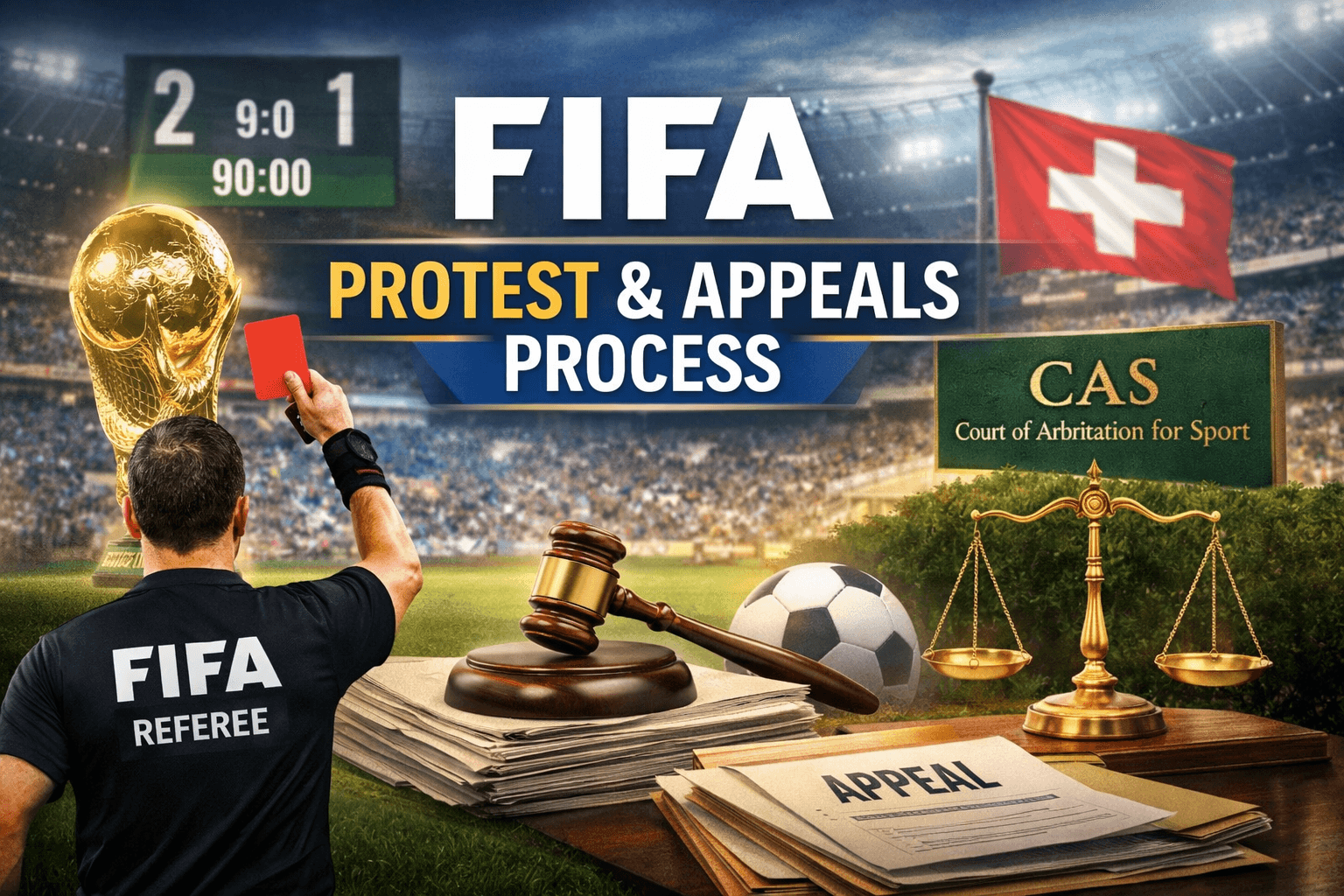
How FIFA Handles Match Protests and Appeals at the World Cup

At the FIFA World Cup, any disputes are not resolved in the media or through public argument. Rather, they follow a formal procedure written in FIFA’s competition rules. When a team files a protest or a matter of discipline comes up, the case follows a normal pattern, with the system defining how the case is submitted, examined, and adjudicated.

This system is in place because of the significance of World Cup matches. These games decide who will continue and who will be eliminated, usually in front of a worldwide audience. Although decisions have to be made quickly, they must still remain consistent with the official regulations. FIFA’s procedure is intended to protect the legal rights of the parties involved while permitting the tournament to proceed without interruption.

Here is the detailed explanation of the system, from the moment a protest is filed, through the disciplinary process, and, if necessary, to the final authority responsible for deciding the case.

📌 FIFA Protest and Appeals Process — Quick Summary

Match protest deadline: Within 2 hours after the match.

Who reviews protests: FIFA Disciplinary Committee.

Can referee decisions be protested: No, referee decisions are final.

Appeal authority: FIFA internal appeals first, then Court of Arbitration for Sport (CAS).

Purpose: Ensure fair competition while keeping the World Cup on schedule.

📋 What Qualifies as a Match Protest

A match protest is a written complaint that a team submits if it feels that the problem outside the game that they are playing has influenced the match. There can be a variety of factors involved, such as questions about players eligibility, the state of the pitch, the equipment used during the game, or operational aspects related to the stadium or competition setup.

Such protests exclude refereeing errors and tactical disagreements. They are essentially about whether the competition rules and procedures were implemented correctly. The goal is to deal with instances in which there might have been a violation of FIFAs regulations.

This method provides teams with a proper channel through which they can raise such issues, at the same time allowing FIFA to examine the case within its disciplinary framework and take a decision which will be communicated on the basis of the regulations.

⏱️ Strict Deadlines for Filing Protests

Timing is essential to a World Cup protest. If a team wants to claim a wrong in the game, they should first notify the FIFA Match Director right after the match. Then the team has to submit a formal protest following the FIFA legal process within the time limit.

The reason for these strict deadlines is to make sure that disputes are settled without holding up the schedule of the tournament. When games are so close in time, FIFA cannot have unfinished matters that block the flow or the competition.

If a team is late, the chance to protest is normally lost. Therefore, teams become very alert and respond very fast whenever they think a decision or a procedure has been wrongly followed.

🚫 Referee Decisions Are Final

One of the foundations of the World Cup is the referee’s authority on the field. Decisions involving fouls, penalties, offsides, or other match incidents are final. Teams cannot file a protest simply because they disagree with how a referee interpreted a moment during the game.

This principle exists to preserve the flow and credibility of the competition. Results are meant to be decided on the pitch, not revisited later through legal disputes over routine match decisions.

That said, FIFA can still review certain disciplinary matters separately. But when it comes to factual incidents and the referee’s judgment during play, those decisions remain binding.

👨‍⚖️ FIFA’s Disciplinary Committee Reviews Protests

A protest which has been submitted via the official channel will be immediately taken over by FIFA’s Disciplinary Committee. This committee is tasked with reviewing the case, the evidence, and, if necessary, the relevant regulations, to establish whether a rule infringement has taken place.

Should it turn out that there has been a violation, the committee is empowered to decide on the appropriate action. It can, for example, impose disciplinary sanctions, financial penalties, suspensions, or other measures as provided under the FIFA rules.

The committee’s function is indispensable in the matter of enforcement of the competition regulations. Their rulings ensure that all teams are treated according to the same standards, thus fair play is maintained throughout the World Cup.

⚠️ Frivolous or Unfounded Protests Can Lead to Sanctions

The protest mechanism during the World Cup is meant to address authentic regulatory issues rather than tactical manoeuvres or speculative claims. Under FIFA’s rules of competition, teams are expected to file protests only if there is a clear and unmistakable basis for their claims.

Should a protest be deemed unmeritorious or the manner of its submission irresponsible, FIFA is authorised to apply disciplinary measures. These could include sanctions or other measures that are stipulated in the regulations and take into account the circumstances.

This policy prevents the misuse of the protest procedure and ensures that formal protests focus on genuine issues. It also strengthens confidence in the tournament’s disciplinary system and its ability to resolve disputes fairly.

⚖️ FIFA Controls the Appeals Process

FIFA has a legal process in place for appeals against disciplinary decisions, and these decisions cannot be bypassed by teams or disputes directly taken to courts.

The appeal has to be issued through FIFA’s system, where the matter will be examined according to the organization’s rules.

This framework is deliberately designed to ensure that decisions are handled in a uniform manner and within a single governing framework. Besides, it gives FIFA the possibility to have full control of the competition affairs instead of relinquishing them to external legal systems.

By handling appeals internally, FIFA is able to facilitate the settlement of disputes efficiently, while keeping the tournament in line with its official rules and procedures.

🌍 The Court of Arbitration for Sport Is the Final Authority

Once FIFA’s internal appeal procedure has been fully utilized, teams have the right to submit their case to the Court of Arbitration for Sport (CAS) in Switzerland. CAS is the highest independent authority for settling disputes in international sport.

A decision from CAS is binding and represents the final stage of the legal process. It provides teams with an external channel for review, separate from FIFA’s own decision-making system.

The presence of CAS adds an additional layer of oversight and accountability. While FIFA manages the competition and its disciplinary system, CAS ensures that teams have access to independent arbitration if they choose to challenge a decision beyond FIFA’s internal framework.

🏆 Why FIFA’s Protest System Is Essential to the World Cup

The World Cup operates on a quite tight schedule, with matches being played one after another and watched all over the world. Any argument is to be solved immediately, but also carefully, so that decisions are just and do not spoil the tournament.

The protest and appeals process of FIFA is made with that balance in mind. On the one hand, it allows teams to raise their issues regarding the regulations in a formal manner. On the other hand, it safeguards the authority of referees and the competition’s framework.

The idea is to sort out the issues quickly so that the attention is on the matches themselves. The system is a kind of guarantee that the results will be decided by the players and not by the drawn-out legal procedures off the field.

The main purpose of the protest system is to safeguard the competition. It ensures that the World Cup can continue smoothly by providing a structure based on clear procedures, accountability, and transparency.

This system is an important part of the regulatory framework that helps keep the tournament fair, reliable, and trusted by teams and fans worldwide.

2026 FIFA World Cup Schedule in Western Indonesia Time (WIB)

For football fans across Indonesia, the FIFA World Cup is one of the few sporting events that commands nationwide attention. With the 2026 FIFA World Cup being hosted by the United States, Canada, and Mexico, supporters in Western Indonesia will need to carefully track the time difference in order to watch the matches live without missing a moment.

Because of the large time gap between Southeast Asia and North America, many matches will take place late at night or in the early morning hours in Indonesia. Although this schedule demands real dedication, Indonesian fans are well accustomed to adjusting their routines, as the World Cup has long attracted some of the most passionate overnight audiences in the region.

This page provides the complete 2026 FIFA World Cup fixture list in Western Indonesia Time (WIB), featuring all 104 matches from the opening game on 11 June 2026 to the final on 19 July 2026. Whether you are watching from home, enjoying the matches with friends, or following the tournament online, this schedule helps you stay perfectly in sync with every kick-off.

Western Indonesia Time is set at UTC+7 and is observed throughout the year. As Indonesia does not use daylight saving time, match timings will remain consistent for the entire tournament, allowing fans to plan their World Cup viewing comfortably and with confidence from start to finish.

🌍 FIFA World Cup History at a Glance

First held in 1930 in Uruguay, the FIFA World Cup has grown into the most widely watched sporting event in the world. What began as a modest 13-team competition has become a global football celebration, and from 2026, the tournament will open a new chapter with its expansion to 48 competing nations.

Over nearly a century, the World Cup has delivered unforgettable goals, legendary matches, and players whose names are forever written into football history. While teams from South America and Europe have long dominated the list of champions, the modern tournament increasingly reflects the game’s global reach, with rising influence from Asia, Africa, and North America.

The expanded 2026 World Cup promises an even richer and more diverse spectacle, with more matches, more nations, and more stories than ever before. In doing so, it reinforces the World Cup’s unrivalled status as the ultimate festival of the global game.

Year Host Nation Winner
2022 Qatar Argentina
2018 Russia France
2014 Brazil Germany
2010 South Africa Spain
2006 Germany Italy
2002 Japan & South Korea Brazil

⚽ Quick Facts – 2026 FIFA World Cup

Category Details
Host Nations United States, Canada, Mexico
Tournament Dates 11 June – 19 July 2026
Total Teams 48
Total Matches 104
Time Zone Used Western Indonesia Time (WIB, UTC+7)
Final Venue MetLife Stadium, New Jersey, USA

Football in Indonesia

Football has always been at the heart of Indonesian sports culture. It is the country’s most popular sport, followed passionately by millions. Domestic league matches regularly fill stadiums, and major international tournaments attract massive television audiences, reflecting the deep loyalty and enthusiasm Indonesians have for the game.

The history of football in Indonesia dates back to the early 20th century, and the nation holds a unique place in World Cup history. Competing as the Dutch East Indies, Indonesia became the first Asian team to qualify for a FIFA World Cup when they appeared at the 1938 tournament in France. Although they have not returned to the finals since, that appearance remains a cherished milestone and an important chapter in Asian football history.

Domestic club competitions such as Liga 1 continue to draw large crowds, driven by fierce rivalries, passionate supporters, and some of the most vibrant atmospheres in Southeast Asian football. In recent years, increased investment in youth academies, stadium development, and league reforms has signaled a strong desire to strengthen the domestic game and work toward a future return to the global stage.

Although Indonesia will not be among the teams competing at the 2026 FIFA World Cup, the tournament will still capture nationwide attention. Millions of Indonesian fans are expected to follow the matches closely, cheering on their favorite teams and continuing the country’s long-standing love affair with the world’s game.

🕓 2026 FIFA World Cup Match Schedule (Western Indonesia Time)

For fans following the tournament in Western Indonesia Time (WIB), most matches will take place during the late night and early morning hours. Group-stage fixtures often begin after midnight, while knockout matches may extend into the early hours of the morning.

The opening match of the tournament will kick off on 12 June 2026 at 2:00 AM (WIB), while the final will be played on 20 July 2026 at 2:00 AM (WIB).

Below is the complete list of all 104 matches, with kick-off times shown in Western Indonesia Time (WIB). Use the filters to sort by team, venue, or stage.

Date Time Team 1 Score Team 2
(Friday)
2:00 AM (WIB)
Mexico
vs
South Africa
Mexico City
Match No. 1
Group A
9:00 AM (WIB)
South Korea
vs
Czechia
Guadalajara
Match No. 2
Group A
(Saturday)
2:00 AM (WIB)
Canada
vs
Bosnia
Toronto
Match No. 3
Group B
8:00 AM (WIB)
USA
vs
Paraguay
Los Angeles
Match No. 4
Group D
(Sunday)
2:00 AM (WIB)
Qatar
vs
Switzerland
SF Bay Area
Match No. 8
Group B
5:00 AM (WIB)
Brazil
vs
Morocco
New York
Match No. 7
Group C
8:00 AM (WIB)
Haiti
vs
Scotland
Boston
Match No. 5
Group C
11:00 AM (WIB)
Australia
vs
Turkey
Vancouver
Match No. 6
Group D
(Monday)
12:00 AM (WIB)
Germany
vs
Curaçao
Houston
Match No. 10
Group E
3:00 AM (WIB)
Netherlands
vs
Japan
Dallas
Match No. 11
Group F
6:00 AM (WIB)
Ivory Coast
vs
Ecuador
Philadelphia
Match No. 9
Group E
9:00 AM (WIB)
Sweden
vs
Tunisia
Monterrey
Match No. 12
Group F
11:00 PM (WIB)
Spain
vs
Cape Verde
Atlanta
Match No. 14
Group H
(Tuesday)
2:00 AM (WIB)
Belgium
vs
Egypt
Seattle
Match No. 16
Group G
5:00 AM (WIB)
Saudi Arabia
vs
Uruguay
Miami
Match No. 13
Group H
8:00 AM (WIB)
Iran
vs
New Zealand
Los Angeles
Match No. 15
Group G
(Wednesday)
2:00 AM (WIB)
France
vs
Senegal
New York
Match No. 17
Group I
5:00 AM (WIB)
Iraq
vs
Norway
Boston
Match No. 18
Group I
8:00 AM (WIB)
Argentina
vs
Algeria
Kansas City
Match No. 19
Group J
11:00 AM (WIB)
Austria
vs
Jordan
SF Bay Area
Match No. 20
Group J
(Thursday)
12:00 AM (WIB)
Portugal
vs
DR Congo
Houston
Match No. 23
Group K
3:00 AM (WIB)
England
vs
Croatia
Dallas
Match No. 22
Group L
6:00 AM (WIB)
Ghana
vs
Panama
Toronto
Match No. 21
Group L
9:00 AM (WIB)
Uzbekistan
vs
Colombia
Mexico City
Match No. 24
Group K
11:00 PM (WIB)
Czechia
vs
South Africa
Atlanta
Match No. 25
Group A
(Friday)
2:00 AM (WIB)
Switzerland
vs
Bosnia
Los Angeles
Match No. 26
Group B
5:00 AM (WIB)
Canada
vs
Qatar
Vancouver
Match No. 27
Group B
8:00 AM (WIB)
Mexico
vs
South Korea
Guadalajara
Match No. 28
Group A
(Saturday)
2:00 AM (WIB)
USA
vs
Australia
Seattle
Match No. 32
Group D
5:00 AM (WIB)
Scotland
vs
Morocco
Boston
Match No. 30
Group C
8:00 AM (WIB)
Brazil
vs
Haiti
Philadelphia
Match No. 29
Group C
11:00 AM (WIB)
Turkey
vs
Paraguay
SF Bay Area
Match No. 31
Group D
(Sunday)
12:00 AM (WIB)
Netherlands
vs
Sweden
Houston
Match No. 35
Group F
3:00 AM (WIB)
Germany
vs
Ivory Coast
Toronto
Match No. 33
Group E
7:00 AM (WIB)
Ecuador
vs
Curaçao
Kansas City
Match No. 34
Group E
11:00 AM (WIB)
Tunisia
vs
Japan
Monterrey
Match No. 36
Group F
11:00 PM (WIB)
Spain
vs
Saudi Arabia
Atlanta
Match No. 38
Group H
(Monday)
2:00 AM (WIB)
Belgium
vs
Iran
Los Angeles
Match No. 39
Group G
5:00 AM (WIB)
Uruguay
vs
Cape Verde
Miami
Match No. 37
Group H
8:00 AM (WIB)
New Zealand
vs
Egypt
Vancouver
Match No. 40
Group G
(Tuesday)
12:00 AM (WIB)
Argentina
vs
Austria
Dallas
Match No. 43
Group J
4:00 AM (WIB)
France
vs
Iraq
Philadelphia
Match No. 42
Group I
7:00 AM (WIB)
Norway
vs
Senegal
New York
Match No. 41
Group I
10:00 AM (WIB)
Jordan
vs
Algeria
SF Bay Area
Match No. 44
Group J
(Wednesday)
12:00 AM (WIB)
Portugal
vs
Uzbekistan
Houston
Match No. 47
Group K
3:00 AM (WIB)
England
vs
Ghana
Boston
Match No. 45
Group L
6:00 AM (WIB)
Panama
vs
Croatia
Toronto
Match No. 46
Group L
9:00 AM (WIB)
Colombia
vs
DR Congo
Guadalajara
Match No. 48
Group K
(Thursday)
2:00 AM (WIB)
Switzerland
vs
Canada
Vancouver
Match No. 51
Group B
2:00 AM (WIB)
Bosnia
vs
Qatar
Seattle
Match No. 52
Group B
5:00 AM (WIB)
Scotland
vs
Brazil
Miami
Match No. 49
Group C
5:00 AM (WIB)
Morocco
vs
Haiti
Atlanta
Match No. 50
Group C
8:00 AM (WIB)
Czechia
vs
Mexico
Mexico City
Match No. 53
Group A
8:00 AM (WIB)
South Africa
vs
South Korea
Monterrey
Match No. 54
Group A
(Friday)
3:00 AM (WIB)
Curaçao
vs
Ivory Coast
Philadelphia
Match No. 55
Group E
3:00 AM (WIB)
Ecuador
vs
Germany
New York
Match No. 56
Group E
6:00 AM (WIB)
Japan
vs
Sweden
Dallas
Match No. 57
Group F
6:00 AM (WIB)
Tunisia
vs
Netherlands
Kansas City
Match No. 58
Group F
9:00 AM (WIB)
Turkey
vs
USA
Los Angeles
Match No. 59
Group D
9:00 AM (WIB)
Paraguay
vs
Australia
SF Bay Area
Match No. 60
Group D
(Saturday)
2:00 AM (WIB)
Norway
vs
France
Boston
Match No. 61
Group I
2:00 AM (WIB)
Senegal
vs
Iraq
Toronto
Match No. 62
Group I
7:00 AM (WIB)
Cape Verde
vs
Saudi Arabia
Houston
Match No. 65
Group H
7:00 AM (WIB)
Uruguay
vs
Spain
Guadalajara
Match No. 66
Group H
10:00 AM (WIB)
Egypt
vs
Iran
Seattle
Match No. 63
Group G
10:00 AM (WIB)
New Zealand
vs
Belgium
Vancouver
Match No. 64
Group G
(Sunday)
4:00 AM (WIB)
Panama
vs
England
New York
Match No. 67
Group L
4:00 AM (WIB)
Croatia
vs
Ghana
Philadelphia
Match No. 68
Group L
6:30 AM (WIB)
Colombia
vs
Portugal
Miami
Match No. 71
Group K
6:30 AM (WIB)
DR Congo
vs
Uzbekistan
Atlanta
Match No. 72
Group K
9:00 AM (WIB)
Algeria
vs
Austria
Kansas City
Match No. 69
Group J
9:00 AM (WIB)
Jordan
vs
Argentina
Dallas
Match No. 70
Group J
(Monday)
2:00 AM (WIB)
Runner-up Group A
vs
Runner-up Group B
Los Angeles
Match No. 73
Round of 32
(Tuesday)
12:00 AM (WIB)
Winner Group C
vs
Runner-up Group F
Houston
Match No. 76
Round of 32
3:30 AM (WIB)
Winner Group E
vs
3rd Group A/B/C/D/F
Boston
Match No. 74
Round of 32
8:00 AM (WIB)
Winner Group F
vs
Runner-up Group C
Monterrey
Match No. 75
Round of 32
(Wednesday)
12:00 AM (WIB)
Runner-up Group E
vs
Runner-up Group I
Dallas
Match No. 78
Round of 32
4:00 AM (WIB)
Winner Group I
vs
3rd Group C/D/F/G/H
New York
Match No. 77
Round of 32
8:00 AM (WIB)
Winner Group A
vs
3rd Group C/E/F/H/I
Mexico City
Match No. 79
Round of 32
11:00 PM (WIB)
Winner Group L
vs
3rd Group E/H/I/J/K
Atlanta
Match No. 80
Round of 32
(Thursday)
3:00 AM (WIB)
Winner Group G
vs
3rd Group A/E/H/I/J
Seattle
Match No. 82
Round of 32
7:00 AM (WIB)
Winner Group D
vs
3rd Group B/E/F/I/J
SF Bay Area
Match No. 81
Round of 32
(Friday)
2:00 AM (WIB)
Winner Group H
vs
Runner-up Group J
Los Angeles
Match No. 84
Round of 32
6:00 AM (WIB)
Runner-up Group K
vs
Runner-up Group L
Toronto
Match No. 83
Round of 32
10:00 AM (WIB)
Winner Group B
vs
3rd Group E/F/G/I/J
Vancouver
Match No. 85
Round of 32
(Saturday)
1:00 AM (WIB)
Runner-up Group D
vs
Runner-up Group G
Dallas
Match No. 88
Round of 32
5:00 AM (WIB)
Winner Group J
vs
Runner-up Group H
Miami
Match No. 86
Round of 32
8:30 AM (WIB)
Winner Group K
vs
3rd Group D/E/I/J/L
Kansas City
Match No. 87
Round of 32
(Sunday)
12:00 AM (WIB)
Winner Match 73
vs
Winner Match 75
Houston
Match No. 90
Round of 16
4:00 AM (WIB)
Winner Match 74
vs
Winner Match 77
Philadelphia
Match No. 89
Round of 16
(Monday)
3:00 AM (WIB)
Winner Match 76
vs
Winner Match 78
New York
Match No. 91
Round of 16
7:00 AM (WIB)
Winner Match 79
vs
Winner Match 80
Mexico City
Match No. 92
Round of 16
(Tuesday)
2:00 AM (WIB)
Winner Match 83
vs
Winner Match 84
Dallas
Match No. 93
Round of 16
7:00 AM (WIB)
Winner Match 81
vs
Winner Match 82
Seattle
Match No. 94
Round of 16
11:00 PM (WIB)
Winner Match 86
vs
Winner Match 88
Atlanta
Match No. 95
Round of 16
(Wednesday)
3:00 AM (WIB)
Winner Match 85
vs
Winner Match 87
Vancouver
Match No. 96
Round of 16
(Friday)
3:00 AM (WIB)
Winner Match 89
vs
Winner Match 90
Boston
Match No. 97
Quarterfinals
(Saturday)
2:00 AM (WIB)
Winner Match 93
vs
Winner Match 94
Los Angeles
Match No. 98
Quarterfinals
(Sunday)
4:00 AM (WIB)
Winner Match 91
vs
Winner Match 92
Miami
Match No. 99
Quarterfinals
8:00 AM (WIB)
Winner Match 95
vs
Winner Match 96
Kansas City
Match No. 100
Quarterfinals
(Wednesday)
2:00 AM (WIB)
Winner Match 97
vs
Winner Match 98
Dallas
Match No. 101
Semifinals
(Thursday)
2:00 AM (WIB)
Winner Match 99
vs
Winner Match 100
Atlanta
Match No. 102
Semifinals
(Sunday)
4:00 AM (WIB)
Loser Match 101
vs
Loser Match 102
Miami
Match No. 103
Third place
(Monday)
2:00 AM (WIB)
Winner Match 101
vs
Winner Match 102
New York
Match No. 104
Final

🌍 Host Nations & Match Venues

The 2026 FIFA World Cup will be hosted across three countries and 16 venues in North America, making it the largest and most geographically widespread tournament in the history of the competition. For the first time, the United States, Canada, and Mexico will jointly stage football’s biggest event, with matches spread across an entire continent.

In the United States, games will be played in New York–New Jersey, Los Angeles, Dallas, Miami, Atlanta, Houston, Seattle, the San Francisco Bay Area, Boston, Philadelphia, and Kansas City. Canada will host matches in Toronto and Vancouver, while Mexico will stage games in Mexico City, Guadalajara, and Monterrey.

📺 How to Watch the 2026 FIFA World Cup in Indonesia

  • TVRI Nasional
  • TVRI Sport
  • Vision+ (official streaming platform)
  • FIFA+ – highlights and official content

❓ Western Indonesia Time (WIB) & 2026 World Cup – FAQs

Are all match times shown in Western Indonesia Time?
Yes. All kick-off times on this page are displayed in WIB.

Does Indonesia observe daylight saving time?
No. Indonesia uses fixed time zones year-round.

What time will most matches kick off in WIB?
Most matches will start between midnight and early morning hours.

When is the 2026 World Cup final in WIB?
The final will be played on 20 July 2026 at 2:00 AM (WIB).

With passionate fans, a rich football culture, and a complete schedule displayed in Western Indonesia Time, the 2026 FIFA World Cup promises unforgettable nights of football across Indonesia. Bookmark this page and enjoy every match from opening kick to final whistle.

What Happens If Iran Withdraws from the 2026 FIFA World Cup?

Iran national team potential withdrawal from the 2026 FIFA World Cup

Iran national team potential withdrawal from the 2026 FIFA World Cup

The FIFA World Cup is often presented as football’s grand global gathering — a stage where nations compete fiercely on the pitch while politics supposedly stays outside the stadium gates.

History suggests otherwise.

International sport rarely exists in isolation from world events, and the World Cup has often found itself intersecting with diplomatic tensions, security concerns and shifting geopolitical realities.

As planning continues for the 2026 FIFA World Cup — which will be hosted across the United States, Mexico and Canada — a new question has quietly entered the conversation: what happens if a qualified team decides not to participate?

The discussion has emerged in connection with Iran. The country’s national team has been a regular presence at the tournament over the past two decades and remains one of Asia’s strongest sides. Yet wider diplomatic tensions and security concerns have prompted speculation about how participation might unfold in a World Cup partly staged in the United States.

If such a situation were ever to arise, the consequences would extend beyond the team itself. Organisers would have to navigate the competition regulations while managing the logistical realities of staging the largest tournament the sport has ever attempted — a complex challenge for FIFA as it prepares for a 48-team World Cup across North America.

📌 Iran and the 2026 World Cup — Key Facts

Tournament hosts: United States, Mexico, and Canada.

Teams participating: Expanded to 48 nations for the first time.

Iran’s record: One of Asia’s most consistent World Cup qualifiers.

Current debate: Whether political tensions could affect participation.

Decision authority: FIFA ultimately controls tournament regulations and disciplinary measures.

🌍 When International Politics Reaches the Pitch

Football has often found itself impacted by international politics. Diplomatic disputes, sanctions, and conflicts have at times shaped the participation of national teams.

In the case of Iran, the issue is particularly sensitive because one of the primary hosts of the 2026 tournament is the United States. Relations between the two countries have been tense for many years, and recent geopolitical developments have renewed questions about whether Iran could comfortably compete in a U.S.-hosted environment.

While football federations technically operate independently from national governments, political realities can still influence decisions surrounding travel, security, and public messaging.

Should Iran decide not to participate, it would represent a rare moment when global politics directly reshapes the lineup of teams at the World Cup.

📜 FIFA’s Rules on World Cup Participation

The regulations governing the World Cup make it clear that teams which qualify for the final tournament are expected to play their scheduled matches unless they are eliminated through competition.

Participation in the tournament comes with formal obligations. Once a national federation accepts its place in the World Cup, withdrawing becomes more than just a sporting choice; it becomes a regulatory issue governed by FIFA’s disciplinary framework.

The governing body has the authority to impose sanctions if a qualified team fails to participate. These measures may include financial penalties, repayment of preparation funding, or additional disciplinary actions, depending on the circumstances.

Such rules exist to protect the integrity of the tournament and ensure that a competition planned years in advance can proceed without disruption.

💰 Financial Consequences of Withdrawing

FIFA regulations outline financial penalties for any federation that withdraws from the World Cup after qualifying.

If a national federation withdraws from the tournament more than 30 days before the first match, the FIFA Disciplinary Committee may impose a minimum fine of CHF 250,000. If the withdrawal occurs within 30 days of the opening match, the minimum penalty increases to CHF 500,000.

In addition to fines, the federation involved may also be required to return funds provided by FIFA to support tournament preparation.

These measures are designed to discourage last-minute withdrawals that could disrupt the tournament schedule and affect other participating teams.

⚽ Could Another Team Replace Iran?

If a qualified team withdraws before the tournament begins, FIFA has the authority to determine whether another national team should take its place.

In most situations, a replacement would likely come from the same confederation. In Iran’s case, that would mean another team from the Asian Football Confederation.

However, the decision would depend heavily on timing. If the withdrawal occurred close to the start of the tournament, finding a suitable replacement and integrating that team into the existing schedule could become complicated.

For that reason, FIFA would weigh multiple factors before deciding whether to replace the team or adjust the tournament structure.

🌎 Could Iran Play Only in Canada or Mexico?

Another scenario sometimes discussed is whether Iran could still participate while avoiding matches in the United States.

Because the 2026 World Cup will be staged across three countries, FIFA technically has some flexibility when assigning match venues.

In theory, matches involving Iran could be moved to stadiums in Canada or Mexico rather than the United States. Such an arrangement might allow the team to remain in the tournament while avoiding potential diplomatic complications.

Whether such a solution would be practical would depend on scheduling logistics and agreement from tournament organizers, but the multi-nation hosting format makes venue adjustments possible if exceptional circumstances arise.

📊 What It Could Mean for the Group Stage

The 2026 World Cup will feature a new format with 48 teams divided into 12 groups of four. This structure depends on each group containing the same number of teams.

If a team withdraws before the tournament begins, FIFA would most likely attempt to replace that team to maintain the format.

However, if the withdrawal occurred late in the preparation phase, the governing body might have to explore alternative solutions in order to keep the competition running smoothly.

Maintaining competitive balance while avoiding disruption would be the main priority.

⏱️ What If a Withdrawal Happens During the Tournament?

A withdrawal after the tournament has begun would create an even more complex situation.

In such cases, the governing body may decide to remove the team from the competition and adjust the standings accordingly. Matches already played could potentially be invalidated depending on the circumstances and timing.

The rules also allow tournament organizers to reschedule or relocate matches if security or operational concerns arise.

Although such situations are extremely rare, FIFA’s regulations are designed to ensure that the tournament can continue even under unexpected conditions.

📚 Rare but Not Unprecedented in Football

Withdrawals from major international tournaments are uncommon, but history shows that political developments can sometimes affect sporting events.

One well-known example occurred at UEFA Euro 1992, when Yugoslavia was excluded from the competition due to international sanctions. Denmark, originally not qualified, took its place and went on to win the tournament.

Although the World Cup operates on a much larger scale, the episode illustrates how unexpected events can reshape a tournament.

👥 The Players in the Middle of the Debate

Lost in the political discussion are the players themselves. For professional footballers, appearing at the World Cup represents the peak of their international careers.

Many members of Iran’s squad compete in professional leagues across Europe and Asia and have spent years working toward another opportunity to play on football’s biggest stage.

A withdrawal caused by political circumstances could deny those players a chance they may never receive again.

It is a reminder that athletes often find themselves caught between international politics and global sport.

🏆 Why the Issue Matters for the Tournament

The 2026 World Cup will feature more teams and matches than any previous edition, making it the largest tournament in football history. If even a single team were to withdraw, the impact could ripple through the event, affecting match schedules, media coverage, travel logistics and competitive balance.

Changes could follow quickly. Match timings might need adjustment, broadcasters would require new plans, and travel arrangements for teams and officials could shift. Tournament organisers would also need to examine the competition format to maintain fairness.

Situations like this highlight how international sport remains connected to global politics. While FIFA has regulations designed to manage team withdrawals, the consequences can extend well beyond those formal rules.

Ultimately, the scenario illustrates that major sporting events cannot exist entirely separate from wider global dynamics. Political pressures, diplomatic considerations and national decisions can all influence how teams approach participation in competitions of this scale.

If Iran ultimately takes part in the tournament, the debate will likely fade once the opening matches begin and attention returns to the football itself.

But if the country does withdraw, it would create one of the most unusual and politically charged situations in modern World Cup history.

Either way, the discussion serves as a reminder that the World Cup is more than just a sporting event. It is also a global stage where politics, diplomacy, and football sometimes intersect in unexpected ways.

2026 FIFA World Cup Schedule in Hong Kong Time (HKT)

For football fans in Hong Kong, timing is the key to everything when it comes to catching the FIFA World Cup live. With the 2026 event hosted by the United States, Canada, and Mexico, the huge geographical distance means that most games will be played during the late, night and early morning hours in Hong Kong Time. It will be crucial for fans to know the exact kick-off times in order not to miss the biggest moments of the tournament.

Although some of the group stage games are scheduled near midnight, several of the high-profile knockout matches, as well as the final, will be held in the early morning. For hardcore fans, this becomes a perfect chance to watch the live action and get to work or school fresh.

This site contains the entire 2026 FIFA World Cup match schedule converted into Hong Kong Time, including all 104 games from the opening match on June 11, 2026, to the final on July 19, 2026. Whether you are at home, with friends or tracking your favorite teams overnight, the guide is aimed at helping you keep up to date with every kick-off.

Hong Kong Time is always UTC+8, and no daylight saving time is applied. Therefore, all the kick-off times will stay the same throughout the tournament, which is very convenient for fans in Hong Kong when it comes to scheduling.

🌍 FIFA World Cup History at a Glance

The FIFA World Cup, which was an event first organized in Uruguay in 1930, is now the biggest and most widely watched sporting event in the world. At the beginning, the competition only featured 13 teams, but now it attracts teams from every corner of the globe. From 2026 onwards, the tournament will feature 48 teams, giving more nations than ever a chance to be a part of the biggest football event.

Throughout its existence, the World Cup has been home to legendary matches, incredible goals and shocking results which have become football folklore. Even though the main winners out of the traditional football power regions of South America and Europe have been, lately, the football scene is changing as the cases of teams from Asia, Africa, and North America are showing up rapidly, which mirrors the worldwide popularity of football.

When, in 2026, the new formatting will be in place, the World Cup is going to be full of even more diversity and fun. More nations, more matches, and new rivalries are a promise of a better show, as the newcomers will be eager to get their first World Cup trophy on the biggest stage. Here are some recent FIFA World Cup winners:

Year Host Nation Winner
2022 Qatar Argentina
2018 Russia France
2014 Brazil Germany
2010 South Africa Spain
2006 Germany Italy
2002 Japan & South Korea Brazil

⚽ Quick Facts – 2026 FIFA World Cup

Category Details
Host Nations United States, Canada, Mexico
Tournament Dates 11 June – 19 July 2026
Total Teams 48
Total Matches 104
Time Zone Used Hong Kong Time (HKT, UTC+8)
Final Venue MetLife Stadium, New Jersey, USA

Football in Hong Kong

Football holds the first place among Hong Kong‘s sports and its history goes back to the early years of British colonial rule. The city was one of the first in Asia to organise football formally, and its premier domestic competition, currently called the Hong Kong Premier League, is one of the oldest professional leagues in the region, thus demonstrating a long-standing and deeply embedded football culture.

On the world stage, the Hong Kong football team has appeared regularly in East Asian and continental competitions, including the AFC Asian Cup on several occasions. Although the team has not yet qualified for the FIFA World Cup finals, Hong Kong continues to develop talented players and maintain a strong grassroots foundation that keeps the sport vibrant at every level.

International tournaments such as the FIFA World Cup generate immense enthusiasm across the city. During the World Cup, Hong Kong’s streets turn into a football festival, with fan gatherings, late-night television viewing, packed sports bars, and lively public events that transform the city into a centre of celebration. This clearly reflects the city’s deep love for the game and its strong connection to the world’s biggest sporting event.

🕓 2026 FIFA World Cup Match Schedule (Hong Kong Time)

For fans watching in Hong Kong Time (HKT), most matches will kick off during the late night and early morning hours, typically between 3:00 AM and 10:00 AM. While group-stage games often start after midnight, many knockout matches and the final fall into early-morning prime viewing slots.

The opening match will begin on 12 June 2026 at 3:00 AM (HKT), while the final will be played on 20 July 2026 at 3:00 AM (HKT).

Below is the complete list of all 104 matches, with kick-off times displayed in Hong Kong Time (HKT). Use the filters to sort by team, venue, or stage.

Date Time Team 1 Score Team 2
(Friday)
3:00 AM (HKT)
Mexico
vs
South Africa
Mexico City
Match No. 1
Group A
10:00 AM (HKT)
South Korea
vs
Czechia
Guadalajara
Match No. 2
Group A
(Saturday)
3:00 AM (HKT)
Canada
vs
Bosnia
Toronto
Match No. 3
Group B
9:00 AM (HKT)
USA
vs
Paraguay
Los Angeles
Match No. 4
Group D
(Sunday)
3:00 AM (HKT)
Qatar
vs
Switzerland
SF Bay Area
Match No. 8
Group B
6:00 AM (HKT)
Brazil
vs
Morocco
New York
Match No. 7
Group C
9:00 AM (HKT)
Haiti
vs
Scotland
Boston
Match No. 5
Group C
12:00 PM (HKT)
Australia
vs
Turkey
Vancouver
Match No. 6
Group D
(Monday)
1:00 AM (HKT)
Germany
vs
Curaçao
Houston
Match No. 10
Group E
4:00 AM (HKT)
Netherlands
vs
Japan
Dallas
Match No. 11
Group F
7:00 AM (HKT)
Ivory Coast
vs
Ecuador
Philadelphia
Match No. 9
Group E
10:00 AM (HKT)
Sweden
vs
Tunisia
Monterrey
Match No. 12
Group F
(Tuesday)
12:00 AM (HKT)
Spain
vs
Cape Verde
Atlanta
Match No. 14
Group H
3:00 AM (HKT)
Belgium
vs
Egypt
Seattle
Match No. 16
Group G
6:00 AM (HKT)
Saudi Arabia
vs
Uruguay
Miami
Match No. 13
Group H
9:00 AM (HKT)
Iran
vs
New Zealand
Los Angeles
Match No. 15
Group G
(Wednesday)
3:00 AM (HKT)
France
vs
Senegal
New York
Match No. 17
Group I
6:00 AM (HKT)
Iraq
vs
Norway
Boston
Match No. 18
Group I
9:00 AM (HKT)
Argentina
vs
Algeria
Kansas City
Match No. 19
Group J
12:00 PM (HKT)
Austria
vs
Jordan
SF Bay Area
Match No. 20
Group J
(Thursday)
1:00 AM (HKT)
Portugal
vs
DR Congo
Houston
Match No. 23
Group K
4:00 AM (HKT)
England
vs
Croatia
Dallas
Match No. 22
Group L
7:00 AM (HKT)
Ghana
vs
Panama
Toronto
Match No. 21
Group L
10:00 AM (HKT)
Uzbekistan
vs
Colombia
Mexico City
Match No. 24
Group K
(Friday)
12:00 AM (HKT)
Czechia
vs
South Africa
Atlanta
Match No. 25
Group A
3:00 AM (HKT)
Switzerland
vs
Bosnia
Los Angeles
Match No. 26
Group B
6:00 AM (HKT)
Canada
vs
Qatar
Vancouver
Match No. 27
Group B
9:00 AM (HKT)
Mexico
vs
South Korea
Guadalajara
Match No. 28
Group A
(Saturday)
3:00 AM (HKT)
USA
vs
Australia
Seattle
Match No. 32
Group D
6:00 AM (HKT)
Scotland
vs
Morocco
Boston
Match No. 30
Group C
9:00 AM (HKT)
Brazil
vs
Haiti
Philadelphia
Match No. 29
Group C
12:00 PM (HKT)
Turkey
vs
Paraguay
SF Bay Area
Match No. 31
Group D
(Sunday)
1:00 AM (HKT)
Netherlands
vs
Sweden
Houston
Match No. 35
Group F
4:00 AM (HKT)
Germany
vs
Ivory Coast
Toronto
Match No. 33
Group E
8:00 AM (HKT)
Ecuador
vs
Curaçao
Kansas City
Match No. 34
Group E
12:00 PM (HKT)
Tunisia
vs
Japan
Monterrey
Match No. 36
Group F
(Monday)
12:00 AM (HKT)
Spain
vs
Saudi Arabia
Atlanta
Match No. 38
Group H
3:00 AM (HKT)
Belgium
vs
Iran
Los Angeles
Match No. 39
Group G
6:00 AM (HKT)
Uruguay
vs
Cape Verde
Miami
Match No. 37
Group H
9:00 AM (HKT)
New Zealand
vs
Egypt
Vancouver
Match No. 40
Group G
(Tuesday)
1:00 AM (HKT)
Argentina
vs
Austria
Dallas
Match No. 43
Group J
5:00 AM (HKT)
France
vs
Iraq
Philadelphia
Match No. 42
Group I
8:00 AM (HKT)
Norway
vs
Senegal
New York
Match No. 41
Group I
11:00 AM (HKT)
Jordan
vs
Algeria
SF Bay Area
Match No. 44
Group J
(Wednesday)
1:00 AM (HKT)
Portugal
vs
Uzbekistan
Houston
Match No. 47
Group K
4:00 AM (HKT)
England
vs
Ghana
Boston
Match No. 45
Group L
7:00 AM (HKT)
Panama
vs
Croatia
Toronto
Match No. 46
Group L
10:00 AM (HKT)
Colombia
vs
DR Congo
Guadalajara
Match No. 48
Group K
(Thursday)
3:00 AM (HKT)
Switzerland
vs
Canada
Vancouver
Match No. 51
Group B
3:00 AM (HKT)
Bosnia
vs
Qatar
Seattle
Match No. 52
Group B
6:00 AM (HKT)
Scotland
vs
Brazil
Miami
Match No. 49
Group C
6:00 AM (HKT)
Morocco
vs
Haiti
Atlanta
Match No. 50
Group C
9:00 AM (HKT)
Czechia
vs
Mexico
Mexico City
Match No. 53
Group A
9:00 AM (HKT)
South Africa
vs
South Korea
Monterrey
Match No. 54
Group A
(Friday)
4:00 AM (HKT)
Curaçao
vs
Ivory Coast
Philadelphia
Match No. 55
Group E
4:00 AM (HKT)
Ecuador
vs
Germany
New York
Match No. 56
Group E
7:00 AM (HKT)
Japan
vs
Sweden
Dallas
Match No. 57
Group F
7:00 AM (HKT)
Tunisia
vs
Netherlands
Kansas City
Match No. 58
Group F
10:00 AM (HKT)
Turkey
vs
USA
Los Angeles
Match No. 59
Group D
10:00 AM (HKT)
Paraguay
vs
Australia
SF Bay Area
Match No. 60
Group D
(Saturday)
3:00 AM (HKT)
Norway
vs
France
Boston
Match No. 61
Group I
3:00 AM (HKT)
Senegal
vs
Iraq
Toronto
Match No. 62
Group I
8:00 AM (HKT)
Cape Verde
vs
Saudi Arabia
Houston
Match No. 65
Group H
8:00 AM (HKT)
Uruguay
vs
Spain
Guadalajara
Match No. 66
Group H
11:00 AM (HKT)
Egypt
vs
Iran
Seattle
Match No. 63
Group G
11:00 AM (HKT)
New Zealand
vs
Belgium
Vancouver
Match No. 64
Group G
(Sunday)
5:00 AM (HKT)
Panama
vs
England
New York
Match No. 67
Group L
5:00 AM (HKT)
Croatia
vs
Ghana
Philadelphia
Match No. 68
Group L
7:30 AM (HKT)
Colombia
vs
Portugal
Miami
Match No. 71
Group K
7:30 AM (HKT)
DR Congo
vs
Uzbekistan
Atlanta
Match No. 72
Group K
10:00 AM (HKT)
Algeria
vs
Austria
Kansas City
Match No. 69
Group J
10:00 AM (HKT)
Jordan
vs
Argentina
Dallas
Match No. 70
Group J
(Monday)
3:00 AM (HKT)
Runner-up Group A
vs
Runner-up Group B
Los Angeles
Match No. 73
Round of 32
(Tuesday)
1:00 AM (HKT)
Winner Group C
vs
Runner-up Group F
Houston
Match No. 76
Round of 32
4:30 AM (HKT)
Winner Group E
vs
3rd Group A/B/C/D/F
Boston
Match No. 74
Round of 32
9:00 AM (HKT)
Winner Group F
vs
Runner-up Group C
Monterrey
Match No. 75
Round of 32
(Wednesday)
1:00 AM (HKT)
Runner-up Group E
vs
Runner-up Group I
Dallas
Match No. 78
Round of 32
5:00 AM (HKT)
Winner Group I
vs
3rd Group C/D/F/G/H
New York
Match No. 77
Round of 32
9:00 AM (HKT)
Winner Group A
vs
3rd Group C/E/F/H/I
Mexico City
Match No. 79
Round of 32
(Thursday)
12:00 AM (HKT)
Winner Group L
vs
3rd Group E/H/I/J/K
Atlanta
Match No. 80
Round of 32
4:00 AM (HKT)
Winner Group G
vs
3rd Group A/E/H/I/J
Seattle
Match No. 82
Round of 32
8:00 AM (HKT)
Winner Group D
vs
3rd Group B/E/F/I/J
SF Bay Area
Match No. 81
Round of 32
(Friday)
3:00 AM (HKT)
Winner Group H
vs
Runner-up Group J
Los Angeles
Match No. 84
Round of 32
7:00 AM (HKT)
Runner-up Group K
vs
Runner-up Group L
Toronto
Match No. 83
Round of 32
11:00 AM (HKT)
Winner Group B
vs
3rd Group E/F/G/I/J
Vancouver
Match No. 85
Round of 32
(Saturday)
2:00 AM (HKT)
Runner-up Group D
vs
Runner-up Group G
Dallas
Match No. 88
Round of 32
6:00 AM (HKT)
Winner Group J
vs
Runner-up Group H
Miami
Match No. 86
Round of 32
9:30 AM (HKT)
Winner Group K
vs
3rd Group D/E/I/J/L
Kansas City
Match No. 87
Round of 32
(Sunday)
1:00 AM (HKT)
Winner Match 73
vs
Winner Match 75
Houston
Match No. 90
Round of 16
5:00 AM (HKT)
Winner Match 74
vs
Winner Match 77
Philadelphia
Match No. 89
Round of 16
(Monday)
4:00 AM (HKT)
Winner Match 76
vs
Winner Match 78
New York
Match No. 91
Round of 16
8:00 AM (HKT)
Winner Match 79
vs
Winner Match 80
Mexico City
Match No. 92
Round of 16
(Tuesday)
3:00 AM (HKT)
Winner Match 83
vs
Winner Match 84
Dallas
Match No. 93
Round of 16
8:00 AM (HKT)
Winner Match 81
vs
Winner Match 82
Seattle
Match No. 94
Round of 16
(Wednesday)
12:00 AM (HKT)
Winner Match 86
vs
Winner Match 88
Atlanta
Match No. 95
Round of 16
4:00 AM (HKT)
Winner Match 85
vs
Winner Match 87
Vancouver
Match No. 96
Round of 16
(Friday)
4:00 AM (HKT)
Winner Match 89
vs
Winner Match 90
Boston
Match No. 97
Quarterfinals
(Saturday)
3:00 AM (HKT)
Winner Match 93
vs
Winner Match 94
Los Angeles
Match No. 98
Quarterfinals
(Sunday)
5:00 AM (HKT)
Winner Match 91
vs
Winner Match 92
Miami
Match No. 99
Quarterfinals
9:00 AM (HKT)
Winner Match 95
vs
Winner Match 96
Kansas City
Match No. 100
Quarterfinals
(Wednesday)
3:00 AM (HKT)
Winner Match 97
vs
Winner Match 98
Dallas
Match No. 101
Semifinals
(Thursday)
3:00 AM (HKT)
Winner Match 99
vs
Winner Match 100
Atlanta
Match No. 102
Semifinals
(Sunday)
5:00 AM (HKT)
Loser Match 101
vs
Loser Match 102
Miami
Match No. 103
Third place
(Monday)
3:00 AM (HKT)
Winner Match 101
vs
Winner Match 102
New York
Match No. 104
Final

🌍 Host Nations & Match Venues

The 2026 FIFA World Cup is going to be the first collaboration of three countries in which 16 cities across North America will be hosting multiple games. The tournament will be the most extensive one in terms of location in the history of FIFA World Cups. It will be the first time that the United States, Canada, and Mexico will share the responsibilities of hosting the games, which will be scattered throughout a whole continent.

In the United States, the host cities will be New York and New Jersey, Los Angeles, Dallas, Miami, Atlanta, Houston, Seattle, the San Francisco Bay Area, Boston, Philadelphia, and Kansas City. Canada‘s part will be Toronto and Vancouver, whereas Mexico will complete the three hosts by holding games in Mexico City, Guadalajara, and Monterrey.

As matches will be staged in various North American time zones, game start times will fluctuate considerably throughout the tournament. Demonstrating the full schedule in Hong Kong Time helps eliminate confusion, thereby granting fans the opportunity to organize their viewing properly and enjoy the World Cup stress-free, without having to calculate time conversions manually.

📺 How to Watch the 2026 FIFA World Cup in Hong Kong

  • Now TV – Official local broadcaster with full live coverage
  • ViuTV – Selected free-to-air matches
  • FIFA+ – Highlights, replays, and official content

❓ Hong Kong Time (HKT) & 2026 World Cup – FAQs

Q1. Are all kick-off times shown in Hong Kong Time?
Yes. All matches on this page are displayed in Hong Kong Time (HKT).

Q2. Does Hong Kong observe daylight saving time?
No. Hong Kong uses HKT (UTC+8) all year.

Q3. What time will most matches be played in HKT?
Most matches will kick off between midnight and early morning.

Q4. When is the 2026 World Cup final in HKT?
The final will be played on 20 July 2026 at 3:00 AM (HKT).

With reliable scheduling, a passionate football community, and kick-off times clearly displayed in Hong Kong Time, the 2026 FIFA World Cup promises thrilling overnight football for fans across Hong Kong. Bookmark this page and follow every moment of the tournament from the first whistle to the final goal.

2026 FIFA World Cup Schedule in Palestine Standard Time (PSST)

Few sporting events attract a global audience like the FIFA World Cup, and football fans in Palestine following every kick of the 2026 tournament are set for another memorable football journey. With matches being played across the United States, Canada, and Mexico, keeping track of kick-off times in Palestine Standard Time will be essential to ensure that no moment is missed.

The schedule offers good news for local viewers, as many matches are planned for the evening and late-night hours, allowing fans to watch live without disrupting work or daily routines. While a few early group-stage fixtures may extend into the early morning, most key matches and knockout games are scheduled at times that are comfortable for audiences across Palestine.

This page presents the complete 2026 FIFA World Cup schedule in Palestine Standard Time, covering all 104 matches from the opening game on 11 June 2026 to the final on 19 July 2026. Whether you are watching at home, gathering with friends, or following the action in local cafés, this guide helps you stay close to every kick-off.

Palestine Standard Time is UTC+2 in winter and shifts to UTC+3 during daylight saving time. As the World Cup takes place in June and July, all match timings are shown in Palestine Summer Time, ensuring accurate and reliable planning throughout the tournament.

🌍 FIFA World Cup History at a Glance

Beginning its journey in 1930 in Uruguay, the FIFA World Cup has grown into the most widely watched sporting event in the world. What started with just 13 participating teams has evolved into a truly global competition, and with the 2026 World Cup, the tournament will reach a new level by expanding to 48 teams, opening the door to more nations and new football stories from every corner of the globe.

Over the decades, the competition has been defined by legendary teams, unforgettable goals, dramatic finals, and champions whose fame extends far beyond the sport itself. While countries from South America and Europe have traditionally dominated the trophy list, recent tournaments reflect a changing landscape, with rising competitiveness from Asia, Africa, and the Middle East, highlighting football’s continuing global expansion.

Below is a look at the most recent FIFA World Cup winners:

Year Host Nation Winner
2022 Qatar Argentina
2018 Russia France
2014 Brazil Germany
2010 South Africa Spain
2006 Germany Italy
2002 Japan & South Korea Brazil

⚽ Quick Facts – 2026 FIFA World Cup

Category Details
Host Nations United States, Canada, Mexico
Tournament Dates 11 June – 19 July 2026
Total Teams 48
Total Matches 104
Time Zone Used Palestine Summer Time (PSDT, UTC+3)
Final Venue MetLife Stadium, New Jersey, USA

Palestine & International Football

Football is passionately loved by the people of Palestine, often reflecting deep emotions and the nation’s enduring struggle for freedom. Over the past two decades, the Palestine national football team, supported by the Palestinian Football Association, has worked tirelessly to strengthen its presence and reputation within Asian football.

A historic breakthrough came in 2015, when Palestine qualified for the AFC Asian Cup for the first time, marking their debut on Asia’s biggest football stage. Their subsequent appearances in 2019 and 2023 confirmed their steady progress, with the memorable victory in 2019 delivering their first Asian Cup win and bringing joy not only to the players but to the entire nation, while also demonstrating their growing competitiveness to the world.

Although Palestine has not yet appeared at the FIFA World Cup finals, their continued improvement in Asian qualification campaigns has inspired hope across the football community. With the World Cup expanding to 48 teams and more qualification places now available for Asia, many believe that Palestine’s long-awaited debut on football’s biggest stage may finally be within reach.

🕓 2026 FIFA World Cup Match Schedule (Palestine Standard Time)

For fans following the tournament in Palestine Standard Time (PSDT), most matches will take place during the evening and late-night hours, with a smaller number of fixtures kicking off in the early morning.

The opening match of the tournament will begin on 11 June 2026 at 10:00 PM (PSDT), while the final will be played on 19 July 2026 at 10:00 PM (PSDT).

Below is the complete list of all 104 matches, with kick-off times shown in Palestine Standard Time. Use the filters to quickly find matches by team, venue, or stage.

Date Time Team 1 Score Team 2
(Thursday)
10:00 PM (PSDT)
Mexico
vs
South Africa
Mexico City
Match No. 1
Group A
(Friday)
5:00 AM (PSDT)
South Korea
vs
Czechia
Guadalajara
Match No. 2
Group A
10:00 PM (PSDT)
Canada
vs
Bosnia
Toronto
Match No. 3
Group B
(Saturday)
4:00 AM (PSDT)
USA
vs
Paraguay
Los Angeles
Match No. 4
Group D
10:00 PM (PSDT)
Qatar
vs
Switzerland
SF Bay Area
Match No. 8
Group B
(Sunday)
1:00 AM (PSDT)
Brazil
vs
Morocco
New York
Match No. 7
Group C
4:00 AM (PSDT)
Haiti
vs
Scotland
Boston
Match No. 5
Group C
7:00 AM (PSDT)
Australia
vs
Turkey
Vancouver
Match No. 6
Group D
8:00 PM (PSDT)
Germany
vs
Curaçao
Houston
Match No. 10
Group E
11:00 PM (PSDT)
Netherlands
vs
Japan
Dallas
Match No. 11
Group F
(Monday)
2:00 AM (PSDT)
Ivory Coast
vs
Ecuador
Philadelphia
Match No. 9
Group E
5:00 AM (PSDT)
Sweden
vs
Tunisia
Monterrey
Match No. 12
Group F
7:00 PM (PSDT)
Spain
vs
Cape Verde
Atlanta
Match No. 14
Group H
10:00 PM (PSDT)
Belgium
vs
Egypt
Seattle
Match No. 16
Group G
(Tuesday)
1:00 AM (PSDT)
Saudi Arabia
vs
Uruguay
Miami
Match No. 13
Group H
4:00 AM (PSDT)
Iran
vs
New Zealand
Los Angeles
Match No. 15
Group G
10:00 PM (PSDT)
France
vs
Senegal
New York
Match No. 17
Group I
(Wednesday)
1:00 AM (PSDT)
Iraq
vs
Norway
Boston
Match No. 18
Group I
4:00 AM (PSDT)
Argentina
vs
Algeria
Kansas City
Match No. 19
Group J
7:00 AM (PSDT)
Austria
vs
Jordan
SF Bay Area
Match No. 20
Group J
8:00 PM (PSDT)
Portugal
vs
DR Congo
Houston
Match No. 23
Group K
11:00 PM (PSDT)
England
vs
Croatia
Dallas
Match No. 22
Group L
(Thursday)
2:00 AM (PSDT)
Ghana
vs
Panama
Toronto
Match No. 21
Group L
5:00 AM (PSDT)
Uzbekistan
vs
Colombia
Mexico City
Match No. 24
Group K
7:00 PM (PSDT)
Czechia
vs
South Africa
Atlanta
Match No. 25
Group A
10:00 PM (PSDT)
Switzerland
vs
Bosnia
Los Angeles
Match No. 26
Group B
(Friday)
1:00 AM (PSDT)
Canada
vs
Qatar
Vancouver
Match No. 27
Group B
4:00 AM (PSDT)
Mexico
vs
South Korea
Guadalajara
Match No. 28
Group A
10:00 PM (PSDT)
USA
vs
Australia
Seattle
Match No. 32
Group D
(Saturday)
1:00 AM (PSDT)
Scotland
vs
Morocco
Boston
Match No. 30
Group C
4:00 AM (PSDT)
Brazil
vs
Haiti
Philadelphia
Match No. 29
Group C
7:00 AM (PSDT)
Turkey
vs
Paraguay
SF Bay Area
Match No. 31
Group D
8:00 PM (PSDT)
Netherlands
vs
Sweden
Houston
Match No. 35
Group F
11:00 PM (PSDT)
Germany
vs
Ivory Coast
Toronto
Match No. 33
Group E
(Sunday)
3:00 AM (PSDT)
Ecuador
vs
Curaçao
Kansas City
Match No. 34
Group E
7:00 AM (PSDT)
Tunisia
vs
Japan
Monterrey
Match No. 36
Group F
7:00 PM (PSDT)
Spain
vs
Saudi Arabia
Atlanta
Match No. 38
Group H
10:00 PM (PSDT)
Belgium
vs
Iran
Los Angeles
Match No. 39
Group G
(Monday)
1:00 AM (PSDT)
Uruguay
vs
Cape Verde
Miami
Match No. 37
Group H
4:00 AM (PSDT)
New Zealand
vs
Egypt
Vancouver
Match No. 40
Group G
8:00 PM (PSDT)
Argentina
vs
Austria
Dallas
Match No. 43
Group J
(Tuesday)
12:00 AM (PSDT)
France
vs
Iraq
Philadelphia
Match No. 42
Group I
3:00 AM (PSDT)
Norway
vs
Senegal
New York
Match No. 41
Group I
6:00 AM (PSDT)
Jordan
vs
Algeria
SF Bay Area
Match No. 44
Group J
8:00 PM (PSDT)
Portugal
vs
Uzbekistan
Houston
Match No. 47
Group K
11:00 PM (PSDT)
England
vs
Ghana
Boston
Match No. 45
Group L
(Wednesday)
2:00 AM (PSDT)
Panama
vs
Croatia
Toronto
Match No. 46
Group L
5:00 AM (PSDT)
Colombia
vs
DR Congo
Guadalajara
Match No. 48
Group K
10:00 PM (PSDT)
Switzerland
vs
Canada
Vancouver
Match No. 51
Group B
10:00 PM (PSDT)
Bosnia
vs
Qatar
Seattle
Match No. 52
Group B
(Thursday)
1:00 AM (PSDT)
Scotland
vs
Brazil
Miami
Match No. 49
Group C
1:00 AM (PSDT)
Morocco
vs
Haiti
Atlanta
Match No. 50
Group C
4:00 AM (PSDT)
Czechia
vs
Mexico
Mexico City
Match No. 53
Group A
4:00 AM (PSDT)
South Africa
vs
South Korea
Monterrey
Match No. 54
Group A
11:00 PM (PSDT)
Curaçao
vs
Ivory Coast
Philadelphia
Match No. 55
Group E
11:00 PM (PSDT)
Ecuador
vs
Germany
New York
Match No. 56
Group E
(Friday)
2:00 AM (PSDT)
Japan
vs
Sweden
Dallas
Match No. 57
Group F
2:00 AM (PSDT)
Tunisia
vs
Netherlands
Kansas City
Match No. 58
Group F
5:00 AM (PSDT)
Turkey
vs
USA
Los Angeles
Match No. 59
Group D
5:00 AM (PSDT)
Paraguay
vs
Australia
SF Bay Area
Match No. 60
Group D
10:00 PM (PSDT)
Norway
vs
France
Boston
Match No. 61
Group I
10:00 PM (PSDT)
Senegal
vs
Iraq
Toronto
Match No. 62
Group I
(Saturday)
3:00 AM (PSDT)
Cape Verde
vs
Saudi Arabia
Houston
Match No. 65
Group H
3:00 AM (PSDT)
Uruguay
vs
Spain
Guadalajara
Match No. 66
Group H
6:00 AM (PSDT)
Egypt
vs
Iran
Seattle
Match No. 63
Group G
6:00 AM (PSDT)
New Zealand
vs
Belgium
Vancouver
Match No. 64
Group G
(Sunday)
12:00 AM (PSDT)
Panama
vs
England
New York
Match No. 67
Group L
12:00 AM (PSDT)
Croatia
vs
Ghana
Philadelphia
Match No. 68
Group L
2:30 AM (PSDT)
Colombia
vs
Portugal
Miami
Match No. 71
Group K
2:30 AM (PSDT)
DR Congo
vs
Uzbekistan
Atlanta
Match No. 72
Group K
5:00 AM (PSDT)
Algeria
vs
Austria
Kansas City
Match No. 69
Group J
5:00 AM (PSDT)
Jordan
vs
Argentina
Dallas
Match No. 70
Group J
10:00 PM (PSDT)
Runner-up Group A
vs
Runner-up Group B
Los Angeles
Match No. 73
Round of 32
(Monday)
8:00 PM (PSDT)
Winner Group C
vs
Runner-up Group F
Houston
Match No. 76
Round of 32
11:30 PM (PSDT)
Winner Group E
vs
3rd Group A/B/C/D/F
Boston
Match No. 74
Round of 32
(Tuesday)
4:00 AM (PSDT)
Winner Group F
vs
Runner-up Group C
Monterrey
Match No. 75
Round of 32
8:00 PM (PSDT)
Runner-up Group E
vs
Runner-up Group I
Dallas
Match No. 78
Round of 32
(Wednesday)
12:00 AM (PSDT)
Winner Group I
vs
3rd Group C/D/F/G/H
New York
Match No. 77
Round of 32
4:00 AM (PSDT)
Winner Group A
vs
3rd Group C/E/F/H/I
Mexico City
Match No. 79
Round of 32
7:00 PM (PSDT)
Winner Group L
vs
3rd Group E/H/I/J/K
Atlanta
Match No. 80
Round of 32
11:00 PM (PSDT)
Winner Group G
vs
3rd Group A/E/H/I/J
Seattle
Match No. 82
Round of 32
(Thursday)
3:00 AM (PSDT)
Winner Group D
vs
3rd Group B/E/F/I/J
SF Bay Area
Match No. 81
Round of 32
10:00 PM (PSDT)
Winner Group H
vs
Runner-up Group J
Los Angeles
Match No. 84
Round of 32
(Friday)
2:00 AM (PSDT)
Runner-up Group K
vs
Runner-up Group L
Toronto
Match No. 83
Round of 32
6:00 AM (PSDT)
Winner Group B
vs
3rd Group E/F/G/I/J
Vancouver
Match No. 85
Round of 32
9:00 PM (PSDT)
Runner-up Group D
vs
Runner-up Group G
Dallas
Match No. 88
Round of 32
(Saturday)
1:00 AM (PSDT)
Winner Group J
vs
Runner-up Group H
Miami
Match No. 86
Round of 32
4:30 AM (PSDT)
Winner Group K
vs
3rd Group D/E/I/J/L
Kansas City
Match No. 87
Round of 32
8:00 PM (PSDT)
Winner Match 73
vs
Winner Match 75
Houston
Match No. 90
Round of 16
(Sunday)
12:00 AM (PSDT)
Winner Match 74
vs
Winner Match 77
Philadelphia
Match No. 89
Round of 16
11:00 PM (PSDT)
Winner Match 76
vs
Winner Match 78
New York
Match No. 91
Round of 16
(Monday)
3:00 AM (PSDT)
Winner Match 79
vs
Winner Match 80
Mexico City
Match No. 92
Round of 16
10:00 PM (PSDT)
Winner Match 83
vs
Winner Match 84
Dallas
Match No. 93
Round of 16
(Tuesday)
3:00 AM (PSDT)
Winner Match 81
vs
Winner Match 82
Seattle
Match No. 94
Round of 16
7:00 PM (PSDT)
Winner Match 86
vs
Winner Match 88
Atlanta
Match No. 95
Round of 16
11:00 PM (PSDT)
Winner Match 85
vs
Winner Match 87
Vancouver
Match No. 96
Round of 16
(Thursday)
11:00 PM (PSDT)
Winner Match 89
vs
Winner Match 90
Boston
Match No. 97
Quarterfinals
(Friday)
10:00 PM (PSDT)
Winner Match 93
vs
Winner Match 94
Los Angeles
Match No. 98
Quarterfinals
(Sunday)
12:00 AM (PSDT)
Winner Match 91
vs
Winner Match 92
Miami
Match No. 99
Quarterfinals
4:00 AM (PSDT)
Winner Match 95
vs
Winner Match 96
Kansas City
Match No. 100
Quarterfinals
(Tuesday)
10:00 PM (PSDT)
Winner Match 97
vs
Winner Match 98
Dallas
Match No. 101
Semifinals
(Wednesday)
10:00 PM (PSDT)
Winner Match 99
vs
Winner Match 100
Atlanta
Match No. 102
Semifinals
(Sunday)
12:00 AM (PSDT)
Loser Match 101
vs
Loser Match 102
Miami
Match No. 103
Third place
10:00 PM (PSDT)
Winner Match 101
vs
Winner Match 102
New York
Match No. 104
Final

🌍 Host Nations & Match Venues

The 2026 FIFA World Cup will be staged across three North American countries and a total of 16 host cities, making it the most geographically expansive tournament in the history of the competition.

For the first time, the United States, Canada, and Mexico will jointly host football’s biggest event, with matches spread across an entire continent.

In the United States, games will be played in New York–New Jersey, Los Angeles, Dallas, Miami, Atlanta, Houston, Seattle, the San Francisco Bay Area, Boston, Philadelphia, and Kansas City. Canada will host matches in Toronto and Vancouver, while Mexico completes the lineup with fixtures in Mexico City, Guadalajara, and Monterrey.

With venues spread across several time zones, kick-off times will vary widely throughout the tournament. By presenting the full schedule in Palestine Standard Time, fans can avoid confusion, plan their viewing accurately, and follow every match smoothly from the opening whistle to the final minute.

📺 How to Watch the 2026 FIFA World Cup in Palestine

  • beIN Sports MENA – Official Middle East broadcaster with full live coverage
  • beIN CONNECT – Streaming platform for mobile and online viewing
  • Palestine TV – Selected free-to-air matches
  • FIFA+ – Highlights, replays, and official content

❓ Palestine Standard Time (PSST) & 2026 World Cup – FAQs

Q1. Are all kick-off times shown in Palestine local time?
Yes. Every match listed on this page is displayed in Palestine Standard / Summer Time.

Q2. Does Palestine observe daylight saving time?
Yes. During June and July, Palestine observes daylight saving time (UTC+3), which is reflected in this schedule.

Q3. What time will most matches kick off in PSST?
Most matches will start between the evening and early-morning hours, with prime fixtures usually scheduled late in the evening.

Q4. When is the 2026 FIFA World Cup final in PSST?
The final will be played on 19 July 2026 at 10:00 PM (PSST).

Q5. Has Palestine ever qualified for a FIFA World Cup?
Not yet. However, with the expanded 48-team format, Palestine have improved chances of reaching future World Cups.

With clear kick-off times, passionate supporters, and football growing steadily across the region, the 2026 FIFA World Cup promises unforgettable nights for fans across Palestine. Bookmark this page and follow every moment of the world’s greatest football festival.

2026 FIFA World Cup Schedule in Sri Lankan Standard Time (SLST)

The FIFA World Cup is one of those events that really tickles the fancy of football fans in Sri Lanka, isnt it? And now that the tournament is coming to the United States, Canada and Mexico in 2026, it is going to be crucial to have the correct match start times in Sri Lankan Standard Time if you want to watch the matches live.

Being that the competition is held in North America, the majority of the games in Sri Lanka will be shown on TV late at night, overnight, or early in the morning. So, if you are a hardcore fan, you might have to sacrifice a few hours of sleep. Still, the schedule is such that even at the time when the knockout games and high-profile clash matches take place, a lot of them can be watched at decent hours.

On this site, you will get to see the complete fixture list of the FIFA World Cup 2026, which has been converted to Sri Lankan Standard Time. It is a comprehensive slate that includes the 104 games from the opening match on 11 June 2026 right up to the final on 19 July 2026. Whether you are watching the games in the comfort of your home, at the cafes, or merely following the tournament with your friends, this guide will help you not to miss a single moment of the biggest football event.

Sri Lankan Standard Time is 5 hours and 30 minutes ahead of UTC, and it operates all year without the observance of daylight saving time. Thus, since there is no daylight saving, the time of all kick-offs will remain the same throughout the tournament, making it very straightforward for all the supporters in the country to plan their time accordingly.

🌍 FIFA World Cup History at a Glance

The FIFA World Cup, first staged in Uruguay in 1930, has developed into the most popular sporting event worldwide. A 13-team competition in those days, it is now entering the next stage of development, with 48 nations from 2026 and thus a new historic chapter in the tournament’s evolution.

Over the years, the World Cup has seen the rise of great players, stunning goals, and exciting finals that have become part of football history. The switch to the 48-team format will allow more countries than ever to participate, thereby providing fans of a wider range of nations the opportunity to watch the game at its highest level and also the tournament with new stories, rivals and ambitions.

Below is a look at the most recent FIFA World Cup winners:

Year Host Nation Winner
2022 Qatar Argentina
2018 Russia France
2014 Brazil Germany
2010 South Africa Spain
2006 Germany Italy
2002 Japan & South Korea Brazil

⚽ Quick Facts – 2026 FIFA World Cup

Category Details
Host Nations United States, Canada, Mexico
Tournament Dates 11 June – 19 July 2026
Total Teams 48
Total Matches 104
Time Zone Used Sri Lankan Standard Time (SLST, UTC+5:30)
Final Venue MetLife Stadium, New Jersey, USA

Football in Sri Lanka

Football might be overshadowed by cricket in Sri Lanka; however, the sport has had a presence and continues to grow steadily throughout the island. Football on a competitive level has been played since the early 1900s, and over time the game has been receiving a lot of attention through a broad range of youth activities, more competitive club leagues, and a higher rate of regional level participation.

The national team, nicknamed the Golden Army, gets involved in AFC and South Asian competitions on a regular basis including the SAFF Championship and the Asian Cup qualifiers. Though the team still has to achieve results at the continental level, regular participation can be seen as gaining experience and, at the same time, raising the national programme’s profile.

Sri Lanka Super League and other provincial competitions underpin the structure of the domestic game, which is continuously supported by ever-growing grassroots projects aimed at a more durable future. In fact, even though Sri Lanka have not yet appeared in a FIFA World Cup, events such as the 2026 tournament still serve as motivation for players and fans, thereby cementing the increasing influence of football in the country’s sports scene.

🕓 2026 FIFA World Cup Match Schedule (Sri Lankan Standard Time)

For fans following the tournament in Sri Lankan Standard Time (SLST), most matches will kick off during the late evening, midnight, and early morning hours. Some knockout matches and headline fixtures will fall into more convenient late-night windows.

The opening match will begin on 12 June 2026 at 12:30 AM (SLST), while the final will be played on 20 July 2026 at 12:30 AM (SLST).

Below is the complete list of all 104 matches, shown in Sri Lankan Standard Time. Use the filters to find your favourite teams and fixtures.

Date Time Team 1 Score Team 2
(Friday)
12:30 AM (SLST)
Mexico
vs
South Africa
Mexico City
Match No. 1
Group A
7:30 AM (SLST)
South Korea
vs
Czechia
Guadalajara
Match No. 2
Group A
(Saturday)
12:30 AM (SLST)
Canada
vs
Bosnia
Toronto
Match No. 3
Group B
6:30 AM (SLST)
USA
vs
Paraguay
Los Angeles
Match No. 4
Group D
(Sunday)
12:30 AM (SLST)
Qatar
vs
Switzerland
SF Bay Area
Match No. 8
Group B
3:30 AM (SLST)
Brazil
vs
Morocco
New York
Match No. 7
Group C
6:30 AM (SLST)
Haiti
vs
Scotland
Boston
Match No. 5
Group C
9:30 AM (SLST)
Australia
vs
Turkey
Vancouver
Match No. 6
Group D
10:30 PM (SLST)
Germany
vs
Curaçao
Houston
Match No. 10
Group E
(Monday)
1:30 AM (SLST)
Netherlands
vs
Japan
Dallas
Match No. 11
Group F
4:30 AM (SLST)
Ivory Coast
vs
Ecuador
Philadelphia
Match No. 9
Group E
7:30 AM (SLST)
Sweden
vs
Tunisia
Monterrey
Match No. 12
Group F
9:30 PM (SLST)
Spain
vs
Cape Verde
Atlanta
Match No. 14
Group H
(Tuesday)
12:30 AM (SLST)
Belgium
vs
Egypt
Seattle
Match No. 16
Group G
3:30 AM (SLST)
Saudi Arabia
vs
Uruguay
Miami
Match No. 13
Group H
6:30 AM (SLST)
Iran
vs
New Zealand
Los Angeles
Match No. 15
Group G
(Wednesday)
12:30 AM (SLST)
France
vs
Senegal
New York
Match No. 17
Group I
3:30 AM (SLST)
Iraq
vs
Norway
Boston
Match No. 18
Group I
6:30 AM (SLST)
Argentina
vs
Algeria
Kansas City
Match No. 19
Group J
9:30 AM (SLST)
Austria
vs
Jordan
SF Bay Area
Match No. 20
Group J
10:30 PM (SLST)
Portugal
vs
DR Congo
Houston
Match No. 23
Group K
(Thursday)
1:30 AM (SLST)
England
vs
Croatia
Dallas
Match No. 22
Group L
4:30 AM (SLST)
Ghana
vs
Panama
Toronto
Match No. 21
Group L
7:30 AM (SLST)
Uzbekistan
vs
Colombia
Mexico City
Match No. 24
Group K
9:30 PM (SLST)
Czechia
vs
South Africa
Atlanta
Match No. 25
Group A
(Friday)
12:30 AM (SLST)
Switzerland
vs
Bosnia
Los Angeles
Match No. 26
Group B
3:30 AM (SLST)
Canada
vs
Qatar
Vancouver
Match No. 27
Group B
6:30 AM (SLST)
Mexico
vs
South Korea
Guadalajara
Match No. 28
Group A
(Saturday)
12:30 AM (SLST)
USA
vs
Australia
Seattle
Match No. 32
Group D
3:30 AM (SLST)
Scotland
vs
Morocco
Boston
Match No. 30
Group C
6:30 AM (SLST)
Brazil
vs
Haiti
Philadelphia
Match No. 29
Group C
9:30 AM (SLST)
Turkey
vs
Paraguay
SF Bay Area
Match No. 31
Group D
10:30 PM (SLST)
Netherlands
vs
Sweden
Houston
Match No. 35
Group F
(Sunday)
1:30 AM (SLST)
Germany
vs
Ivory Coast
Toronto
Match No. 33
Group E
5:30 AM (SLST)
Ecuador
vs
Curaçao
Kansas City
Match No. 34
Group E
9:30 AM (SLST)
Tunisia
vs
Japan
Monterrey
Match No. 36
Group F
9:30 PM (SLST)
Spain
vs
Saudi Arabia
Atlanta
Match No. 38
Group H
(Monday)
12:30 AM (SLST)
Belgium
vs
Iran
Los Angeles
Match No. 39
Group G
3:30 AM (SLST)
Uruguay
vs
Cape Verde
Miami
Match No. 37
Group H
6:30 AM (SLST)
New Zealand
vs
Egypt
Vancouver
Match No. 40
Group G
10:30 PM (SLST)
Argentina
vs
Austria
Dallas
Match No. 43
Group J
(Tuesday)
2:30 AM (SLST)
France
vs
Iraq
Philadelphia
Match No. 42
Group I
5:30 AM (SLST)
Norway
vs
Senegal
New York
Match No. 41
Group I
8:30 AM (SLST)
Jordan
vs
Algeria
SF Bay Area
Match No. 44
Group J
10:30 PM (SLST)
Portugal
vs
Uzbekistan
Houston
Match No. 47
Group K
(Wednesday)
1:30 AM (SLST)
England
vs
Ghana
Boston
Match No. 45
Group L
4:30 AM (SLST)
Panama
vs
Croatia
Toronto
Match No. 46
Group L
7:30 AM (SLST)
Colombia
vs
DR Congo
Guadalajara
Match No. 48
Group K
(Thursday)
12:30 AM (SLST)
Switzerland
vs
Canada
Vancouver
Match No. 51
Group B
12:30 AM (SLST)
Bosnia
vs
Qatar
Seattle
Match No. 52
Group B
3:30 AM (SLST)
Scotland
vs
Brazil
Miami
Match No. 49
Group C
3:30 AM (SLST)
Morocco
vs
Haiti
Atlanta
Match No. 50
Group C
6:30 AM (SLST)
Czechia
vs
Mexico
Mexico City
Match No. 53
Group A
6:30 AM (SLST)
South Africa
vs
South Korea
Monterrey
Match No. 54
Group A
(Friday)
1:30 AM (SLST)
Curaçao
vs
Ivory Coast
Philadelphia
Match No. 55
Group E
1:30 AM (SLST)
Ecuador
vs
Germany
New York
Match No. 56
Group E
4:30 AM (SLST)
Japan
vs
Sweden
Dallas
Match No. 57
Group F
4:30 AM (SLST)
Tunisia
vs
Netherlands
Kansas City
Match No. 58
Group F
7:30 AM (SLST)
Turkey
vs
USA
Los Angeles
Match No. 59
Group D
7:30 AM (SLST)
Paraguay
vs
Australia
SF Bay Area
Match No. 60
Group D
(Saturday)
12:30 AM (SLST)
Norway
vs
France
Boston
Match No. 61
Group I
12:30 AM (SLST)
Senegal
vs
Iraq
Toronto
Match No. 62
Group I
5:30 AM (SLST)
Cape Verde
vs
Saudi Arabia
Houston
Match No. 65
Group H
5:30 AM (SLST)
Uruguay
vs
Spain
Guadalajara
Match No. 66
Group H
8:30 AM (SLST)
Egypt
vs
Iran
Seattle
Match No. 63
Group G
8:30 AM (SLST)
New Zealand
vs
Belgium
Vancouver
Match No. 64
Group G
(Sunday)
2:30 AM (SLST)
Panama
vs
England
New York
Match No. 67
Group L
2:30 AM (SLST)
Croatia
vs
Ghana
Philadelphia
Match No. 68
Group L
5:00 AM (SLST)
Colombia
vs
Portugal
Miami
Match No. 71
Group K
5:00 AM (SLST)
DR Congo
vs
Uzbekistan
Atlanta
Match No. 72
Group K
7:30 AM (SLST)
Algeria
vs
Austria
Kansas City
Match No. 69
Group J
7:30 AM (SLST)
Jordan
vs
Argentina
Dallas
Match No. 70
Group J
(Monday)
12:30 AM (SLST)
Runner-up Group A
vs
Runner-up Group B
Los Angeles
Match No. 73
Round of 32
10:30 PM (SLST)
Winner Group C
vs
Runner-up Group F
Houston
Match No. 76
Round of 32
(Tuesday)
2:00 AM (SLST)
Winner Group E
vs
3rd Group A/B/C/D/F
Boston
Match No. 74
Round of 32
6:30 AM (SLST)
Winner Group F
vs
Runner-up Group C
Monterrey
Match No. 75
Round of 32
10:30 PM (SLST)
Runner-up Group E
vs
Runner-up Group I
Dallas
Match No. 78
Round of 32
(Wednesday)
2:30 AM (SLST)
Winner Group I
vs
3rd Group C/D/F/G/H
New York
Match No. 77
Round of 32
6:30 AM (SLST)
Winner Group A
vs
3rd Group C/E/F/H/I
Mexico City
Match No. 79
Round of 32
9:30 PM (SLST)
Winner Group L
vs
3rd Group E/H/I/J/K
Atlanta
Match No. 80
Round of 32
(Thursday)
1:30 AM (SLST)
Winner Group G
vs
3rd Group A/E/H/I/J
Seattle
Match No. 82
Round of 32
5:30 AM (SLST)
Winner Group D
vs
3rd Group B/E/F/I/J
SF Bay Area
Match No. 81
Round of 32
(Friday)
12:30 AM (SLST)
Winner Group H
vs
Runner-up Group J
Los Angeles
Match No. 84
Round of 32
4:30 AM (SLST)
Runner-up Group K
vs
Runner-up Group L
Toronto
Match No. 83
Round of 32
8:30 AM (SLST)
Winner Group B
vs
3rd Group E/F/G/I/J
Vancouver
Match No. 85
Round of 32
11:30 PM (SLST)
Runner-up Group D
vs
Runner-up Group G
Dallas
Match No. 88
Round of 32
(Saturday)
3:30 AM (SLST)
Winner Group J
vs
Runner-up Group H
Miami
Match No. 86
Round of 32
7:00 AM (SLST)
Winner Group K
vs
3rd Group D/E/I/J/L
Kansas City
Match No. 87
Round of 32
10:30 PM (SLST)
Winner Match 73
vs
Winner Match 75
Houston
Match No. 90
Round of 16
(Sunday)
2:30 AM (SLST)
Winner Match 74
vs
Winner Match 77
Philadelphia
Match No. 89
Round of 16
(Monday)
1:30 AM (SLST)
Winner Match 76
vs
Winner Match 78
New York
Match No. 91
Round of 16
5:30 AM (SLST)
Winner Match 79
vs
Winner Match 80
Mexico City
Match No. 92
Round of 16
(Tuesday)
12:30 AM (SLST)
Winner Match 83
vs
Winner Match 84
Dallas
Match No. 93
Round of 16
5:30 AM (SLST)
Winner Match 81
vs
Winner Match 82
Seattle
Match No. 94
Round of 16
9:30 PM (SLST)
Winner Match 86
vs
Winner Match 88
Atlanta
Match No. 95
Round of 16
(Wednesday)
1:30 AM (SLST)
Winner Match 85
vs
Winner Match 87
Vancouver
Match No. 96
Round of 16
(Friday)
1:30 AM (SLST)
Winner Match 89
vs
Winner Match 90
Boston
Match No. 97
Quarterfinals
(Saturday)
12:30 AM (SLST)
Winner Match 93
vs
Winner Match 94
Los Angeles
Match No. 98
Quarterfinals
(Sunday)
2:30 AM (SLST)
Winner Match 91
vs
Winner Match 92
Miami
Match No. 99
Quarterfinals
6:30 AM (SLST)
Winner Match 95
vs
Winner Match 96
Kansas City
Match No. 100
Quarterfinals
(Wednesday)
12:30 AM (SLST)
Winner Match 97
vs
Winner Match 98
Dallas
Match No. 101
Semifinals
(Thursday)
12:30 AM (SLST)
Winner Match 99
vs
Winner Match 100
Atlanta
Match No. 102
Semifinals
(Sunday)
2:30 AM (SLST)
Loser Match 101
vs
Loser Match 102
Miami
Match No. 103
Third place
(Monday)
12:30 AM (SLST)
Winner Match 101
vs
Winner Match 102
New York
Match No. 104
Final

🌍 Host Nations & Match Venues

The 2026 FIFA World Cup will take place in three countries and 16 host cities in North America, which means it will be the largest and most geographically diverse tournament in the history of the competition. For the first time ever, the US, Canada, and Mexico will co, host the world’s biggest football event, spreading games across an entire continent.

In the United States, matches will take place in New York and New Jersey, Los Angeles, Dallas, Miami, Atlanta, Houston, Seattle, San Francisco Bay Area, Boston, Philadelphia, and Kansas City. Canada‘s hosts will be Toronto and Vancouver, and the Mexican cities of Mexico City, Guadalajara, and Monterrey will complete the group.

Since the matches will be played across various North American time zones, kick, off times will differ a lot throughout the tournament. Showing the entire schedule in Sri Lankan Standard Time eliminates any doubt for the home fans, thus making it possible for them to plan accurately and enjoy a smooth, relaxing viewing experience right from the first match until the final one.

📺 How to Watch the 2026 FIFA World Cup in Sri Lanka

  • Sony Sports Network – Official TV broadcaster in Sri Lanka
  • Sony LIV – Official streaming platform
  • FIFA+ – Highlights, replays, and official content

❓ Sri Lankan Standard Time (SLST) & 2026 World Cup – FAQs

Q1. Are all match times shown in Sri Lankan Standard Time?
Yes. All kick-off times on this page are displayed in SLST.

Q2. Does Sri Lanka observe daylight saving time?
No. Sri Lanka uses the same time zone all year round.

Q3. What time will most matches be played in Sri Lanka?
Most matches will take place during late evenings and early mornings.

Q4. When is the 2026 World Cup final in SLST?
The final will be played on 20 July 2026 at 12:30 AM (SLST).

With kick-off times clearly shown in Sri Lankan Standard Time and football fever rising across the island, the 2026 FIFA World Cup promises unforgettable nights for fans in Sri Lanka. Bookmark this page and enjoy every goal, upset, and celebration from start to finish.