Complete Guide to FIFA World Cup 2026 Format: New Rules Explained Simply

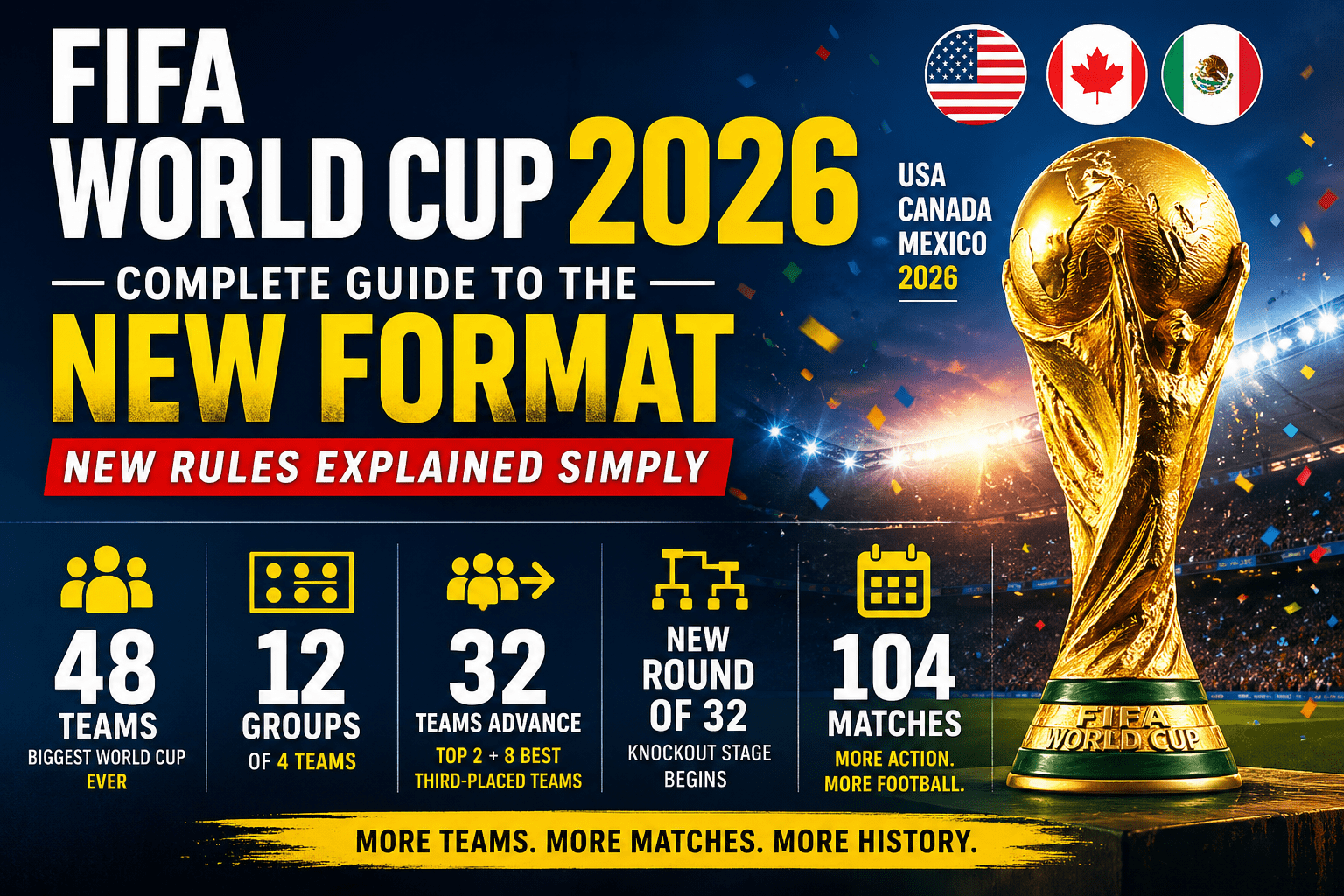
The 2026 FIFA World Cup is going to see an unprecedented growth in international football. For the first time we will see 48 teams take part which brings in new nations to the stage and we see a very different format from what we are used to in past editions.

With more games, a longer competition, and a restructured format it is easy for the average fan to get confused. This guide breaks down the 2026 World Cup format in a simple and easy way.

🌍 Expansion to 48 Teams

The big change we see is the increase from 32 teams to 48 teams. That is the highest increase in the tournament’s history and this has truly made the tournament inclusive.

With more teams in the mix we see greater representation from different continents which in turn gives countries that had trouble qualifying a chance to compete on football’s biggest stage.

Also as a result the total number of matches will go up to 104 from 64 in the past tournaments.

⚽ Group Stage Format Explained

There will be 12 groups and each group will have 4 teams making a total of 48 teams divided into groups. Each team will have three Group-stage games in the form of a round-robin.

Each team will play against the other three teams in their group only once. Points allocation will be based on the usual system: 3 points for the winner, 1 point to each in case of a draw, and 0 for the loser.

This system is quite fair and avoids the problems that could arise with smaller groups.

✅ Who Qualifies for the Knockout Stage?

The qualification system has been altered given that there are more teams.

The top two teams from each group get direct qualification to the knockout round. Besides that, other eight best third-ranked teams from all groups will also qualify.

So altogether 32 teams will be in the second round, which allows the first round to be less strict yet highly competitive.

🏆 Introduction of the Round of 32

Having 32 teams qualify, the knockout phase is kicking off at the Round of 32, meaning that instead of the conventional Round of 16 as the first elimination round, there will be the Round of 32.

Then the competition goes on with the usual sequence: Round of 16, quarterfinals, semifinals, and the final.

The result of each knockout game is determined on that day only. If after regular 90 minutes the scores are tied, then extra time is played and if there is still no winner, penalties are taken.

📊 More Matches, Longer Tournament

Hence, an enlargement results in a considerable rise in the count of matches. A team getting to the final will have 8 encounters on their way rather than 7.

One more game won’t be very noticeable but at the top level that means more physical and tactical input from players and teams.

Keeping up with tiredness, team changes, and getting better will be of a greater concern than even before.

🧠 Why FIFA Changed the Format

The new format is designed to achieve several goals. First, it increases global participation by allowing more teams from different regions to qualify.

Second, it expands the commercial and global reach of the tournament, with more matches and more engagement opportunities for fans worldwide.

Finally, FIFA chose the 12 groups of four teams structure to maintain competitive balance and avoid issues like collusion that could arise in smaller groups.

🟨 Rule Adjustments and Fair Play

As the number of matches increases, a few rules will have to be changed to keep the competition fair throughout the tournament.

One of the main aspects is regulating the yellow cards that can lead to a suspension. Such suspensions are designed in a way so that in most cases, a player who receives a suspension due to yellow cards would not miss a crucial knockout game.

These changes are made to guarantee that the longer format does not over-penalize the teams that advance.

🎯 What It Means for Teams

Regarding teams, the new format alters the strategic thinking of the teams. Since there will be more games and even the chance to qualify as a third-placed team, the group stage will be less about doing everything perfectly and more about being able to keep up the level of performance.

Having a deep squad will become extremely important. Teams having strong substitutes and able to rotate players efficiently will be distinctly ahead of others.

In fact, it will be the longest and hardest journey to the title than at any other time.

👥 What It Means for Fans

For fans, the bigger tournament implies more football games to watch, more countries for the fans to root for. It gives more opportunities for different teams to rise and reveal their game on the world platform.

Allowing third-placed teams to advance means that more games throughout the group stage remain crucial and the atmosphere will be charged with excitement and uncertainty.

On the whole, the experience extends in time, range, and inclusiveness.

🏁 A New Era for the World Cup

There has been no major structural modification to the FIFA World Cup as profound as that of 2026 in the last few decades. It merges the extension of the competition with a recognizable format, thus producing a competition that is not only bigger but also more complicated.

Although issues of quality and competitiveness will still be raised, it is indisputable that the World Cup is stepping into a new era.

And globally, for football fans, it implies that there will be additional games, expanded narratives, and intensified moments that characterize the sport.
World Cup 2026 Goalkeeper Rule Explained: Why Keepers Get Special Treatment

When FIFA confirmed that the 2026 FIFA World Cup would expand to 48 teams, the headlines wrote themselves. A new format. More matches. A broader global footprint. For months, the debate revolved around scheduling, player workload and competitive balance.

Yet tucked away in the tournament regulations is a clause that may influence results just as profoundly as the expanded group stage: goalkeepers and goalkeepers alone are afforded a level of protection no outfield player enjoys.

Once the tournament kicks off in 2026 (teams’ first match to be more precise), defenders, midfielders and forwards are effectively frozen into their squads. Barring truly exceptional administrative circumstances, what you start with is what you finish with. Goalkeepers operate under a different provision altogether. According to the official competition regulations, any goalkeeper who suffers a serious injury or illness during the tournament may be replaced at any stage.

This is not a loophole. It is a deliberate safeguard.

Those who have followed international tournaments closely understand why. The goalkeeper’s position is unlike any other on the pitch. It demands specialist training, a distinct psychological profile and tactical familiarity with the defensive unit that cannot be improvised overnight. An outfield player can often be repositioned in an emergency; a midfielder may fill in at full-back, a forward can drop deeper. But there is no credible substitute for a trained goalkeeper at the highest level.

Modern international football has only sharpened that reality. Keepers today are not merely shot-stoppers. They initiate build-up play, manage defensive lines, command aerial zones and function as the team’s first point of distribution. Losing one mid-tournament particularly to injury can derail not just a match plan, but an entire campaign.

FIFA’s provision recognises that fragility. It ensures that teams are not competitively crippled by circumstances unique to the position. The replacement, however, is tightly regulated: it must be medically justified, formally approved, and applies strictly to the goalkeeper role. It is not an open door to tactical reshuffling.

In a 48-team World Cup, where the margins will be thinner and the schedule denser, this seemingly technical rule could carry real strategic weight. Coaches will travel with three goalkeepers, but the knowledge that an emergency replacement remains possible changes risk calculations particularly deep into the knockout stages.

In tournaments of this magnitude, it is often the small-print regulations, not the grand announcements, that shape defining moments. In 2026, the special protection granted to goalkeepers may prove to be one such detail — quiet on paper, decisive on the pitch.

📋 Understanding The Provisional And Final Squad Lists

Before the World Cup begins, each nation must submit two separate player lists to FIFA: a provisional list and a final list.

The provisional list contains between 35 and 55 players, including at least four goalkeepers. This larger pool acts as the federation’s reserve database for potential call-ups and medical replacements.

From that provisional group, each team then submits its final squad of 23 to 26 players, including at least three goalkeepers. Once this final list is confirmed and the tournament begins, the squad is effectively locked.

Outfield players can only be replaced up to 24 hours before the team’s first match, and only in cases of serious injury or illness — subject to FIFA medical approval.

After that deadline passes, no outfield changes are permitted. This is what makes the goalkeeper exception so significant.

🧤 Goalkeepers Can Be Replaced At Any Stage Of The Tournament

As stated earlier, each team in the 2026 FIFA World Cup is required to submit their final squad of 23–26 players. Importantly, at least three of the declared players must be goalkeepers, a requirement that shows the high regard for the position at the international level.

As to the field players, the room for changing is very limited and strictly regulated. A substitute is only allowed up to 24 hours before a teams first match, and only in the case of a serious injury or illness. When the tournament starts, the window is nearly closed. Except for cases of extraordinary administrative rulings, the defenders, midfielders, and strikers who start the World Cup are the only ones available till the end.

Nevertheless, goalkeepers are a special case in terms of regulations.

If a goalkeeper gets severely injured or ill during any phase of the World Cup (group stage or knockout rounds), the team can still ask for a replacement. The application must be medically and procedurally verified; however, the option remains available until the very end of the competition.

In reality, this policy implies that the goalkeeper is the only field position given the liberty of change during the tournament. It is a small nuance in the regulations; however, it recognises that this role is subjected to unique demands and vulnerabilities. And certainly, this could be a very instrumental factor in a five-and-a-half-week tournament where the margins are very small.

⚖️ Why FIFA Gives Goalkeepers Special Status

FIFA did not carve out an exception for goalkeepers on a whim. The reasoning is rooted in football logic and tournament realities.

1. It is the most specialised position on the pitch

There is no comparable role in the sport. A winger can be asked to track back and operate as a full-back in an emergency. A defensive midfielder can slot into central defence if required. Managers routinely shuffle outfield combinations when injuries strike.

That flexibility ends with the goalkeeper.

The technical demands — positioning, reflex work, aerial command, distribution under pressure — are developed over years of position-specific training. At international level, where the margins are microscopic, improvisation is not a viable strategy. You cannot simply hand gloves to an outfield player and expect structural stability.

FIFA’s allowance reflects that reality.

2. The 48-team format stretches the physical limits

The 2026 FIFA World Cup will be the largest in history. A total of 104 matches will be played across three host nations, with travel spanning vast distances. Teams reaching the final could play as many as eight matches over five-and-a-half-weeks.

Add to that varying climates, recovery demands and the modern expectation that goalkeepers act as auxiliary playmakers, and the physical strain becomes evident. Repetitive diving, aerial collisions and high-intensity build-up involvement increase the risk of knocks turning into tournament-ending injuries.

In such a marathon, attrition is inevitable. The regulation is, in many ways, insurance against that grind.

3. Protecting competitive balance

At its core, the World Cup is about sporting fairness. Without a mid-tournament replacement provision, a side that loses two or three goalkeepers to injury could find itself entering a knockout fixture with an outfield player in goal — a scenario that would undermine competitive integrity at the highest stage of the game.

By permitting goalkeeper replacements under strict medical oversight, FIFA ensures that results are determined by footballing quality rather than administrative rigidity or sheer misfortune.

It is a narrow exception, but an essential one designed less to offer advantage and more to prevent chaos in a tournament where the stakes could not be higher.

📋 How The Goalkeeper Replacement Process Works

The replacement system is tightly controlled and cannot be used as a tactical loophole.

If a goalkeeper is injured or ill:

• The federation must nominate a replacement from its provisional list.
• A detailed medical assessment must be submitted.
• FIFA’s Medical Committee must confirm the severity of the injury.
• The injured goalkeeper must return their accreditation.
• The replacement goalkeeper receives the next available squad number.

Only after FIFA approval can the change be finalized. This ensures the rule is applied strictly for medical reasons.

🏆 Why This Rule Matters More Than It Appears

Modern World Cups are rarely settled by sweeping dominance. More often than not, they turn on moments — a deflection, a lapse in concentration, or the unforgiving theatre of a penalty shoot-out. In that arena, the goalkeeper is no longer a peripheral figure; he is central to the script.

Today’s elite keepers are expected to do far more than repel shots. They initiate attacks, split defensive lines with their passing, command their penalty areas and organise the back four with constant communication. In many systems, the goalkeeper is effectively the first playmaker.

Remove that pillar unexpectedly, and the structural impact can be immediate. Defensive coordination suffers. Build-up patterns break down. Confidence wavers. Relying on an untested or makeshift replacement at that level is not merely inconvenient — it can distort the competitive balance of a match.

By permitting goalkeeper replacements throughout the tournament, FIFA has sought to guard against precisely that scenario at the 2026 FIFA World Cup. The intention is not to hand teams an advantage, but to ensure that contests are decided by preparation and performance, not by avoidable regulatory rigidity.

At a World Cup, where margins are measured in millimetres and nerves, that distinction matters.

🚫 Can Teams Exploit The Rule?

In theory, any regulatory exception invites suspicion. In practice, this one leaves little room for manoeuvre.

The process is neither casual nor discretionary. A team seeking to replace a goalkeeper must submit detailed medical documentation, obtain formal approval from FIFA, and complete the necessary administrative procedures including surrendering the outgoing player’s accreditation. Once replaced, that goalkeeper cannot return to the tournament.

Those layers are not ornamental. They are deliberate safeguards.

The provision exists to address genuine medical emergencies, not to facilitate tactical reshuffles or strategic fine-tuning midway through a campaign. Attempting to manipulate it would require falsifying medical evidence and risking severe disciplinary consequences, a gamble no federation at a World Cup is likely to entertain.

In short, the rule is narrow by design. It protects teams from unforeseen misfortune without opening the door to competitive gamesmanship.

🌍 A Tournament Built Around Structure And Stability

The 2026 World Cup will usher in the most expansive overhaul the tournament has seen in decades — a 48-team field, additional knockout fixtures and a calendar that stretches the physical and logistical limits of the modern game. Within that broader redesign, one relatively understated regulation speaks volumes about how the sport is evolving.

The goalkeeper replacement provision is not a cosmetic tweak. It is part of FIFA’s attempt to balance expansion with competitive integrity at the 2026 FIFA World Cup.

From the moment the competition begins, outfield players are effectively locked into place. Coaches must navigate injuries, suspensions and dips in form with the resources already registered. Goalkeepers stand apart — not by privilege, but by necessity. Their role demands a separate layer of contingency planning, one that acknowledges how exposed a team becomes if that position is suddenly compromised.

In a month-long tournament where margins are microscopic and legacies hinge on moments, that distinction is not trivial. World Cups have been defined by a single save, a fingertip deflection, a penalty stopped under unbearable pressure.

In 2026, the safeguard afforded to goalkeepers may appear technical on paper. On the pitch, it could prove decisive.

How the Eight Best Third-Placed Teams Qualify at the 2026 World Cup

The 2026 FIFA World Cup is rewriting the rules of international football. With an expanded field of 48 teams, a brand-new Round of 32, and matches spread across the United States, Canada and Mexico, the path to the knockout stage has never been more dramatic.

One of the biggest innovations of the tournament is this simple but thrilling fact: finishing third in your group does not mean automatic elimination.

In fact, eight of the twelve third-placed teams will qualify for the Round of 32, keeping more nations alive and turning the final group matches into edge-of-the-seat drama.

So how exactly does FIFA decide which third-placed teams go through and which ones go home? Below you can find complete details.

🏟️ How Many Third-Placed Teams Qualify in 2026?

The 2026 World Cup features 12 groups of four teams. From each group:

• The 12 group winner qualifies automatically
• The 12 runner-ups also qualify automatically
• That gives 24 teams directly into the knockout stage

• The third-placed team enters a special ranking table, wherein to complete the 32-team bracket for the knockout stage, FIFA selects the 8 best teams among those finishing third.

This means four third-placed teams will be eliminated, while eight continue their World Cup journey.

📊 Official Ranking Rules for Third-Placed Teams

All twelve third-placed teams are ranked together using official FIFA tie-breakers applied in a strict order.

The ranking criteria are:

1. Points – Teams with more points rank higher. Four points almost guarantee qualification

2. Goal Difference – Goals scored minus goals conceded.

3. Goals Scored – If goal difference is equal, the team with more goals ranks higher.

4. Fair Play (Disciplinary Record) – Yellow and red cards can decide qualification.

5. FIFA World Ranking – The latest official ranking is used if teams are still tied.

6. Older FIFA Rankings – Earlier rankings are checked until the tie is broken.

🟨 Fair Play Rule – When Discipline Decides Qualification

In tight groups, discipline can be just as important as scoring goals.

Here is how FIFA calculates fair-play points:

• Yellow card = –1 point
• Indirect red (two yellows) = –3 points
• Direct red card = –4 points
• Yellow card + red card = –5 points

The team with the fewest deductions ranks higher.

Fair play points are used not only to rank the best third-placed teams, but also to decide final positions inside each group when teams are level on points. That means a single late yellow card could be the difference between qualifying for the Round of 32 or packing your bags early.

📈 Third-Placed Ranking Table

Below you can check the qualification race for the third place:

Ranking of third-placed teams

# Team Group P W D L GF GA GD Pts
1Group J00000000
2Group E00000000
3Group L00000000
4Group G00000000
5Group C00000000
6Group I00000000
7Group K00000000
8Group B00000000
9Group A00000000
10Group H00000000
11Group F00000000
12Group D00000000
Qualified
Eliminated

🔀 Who Will the Qualified Third-Placed Teams Play Next?

Qualifying as one of the best third-placed teams is only the beginning of the story, since the real excitement lies in discovering the opponents in the knockout stage. These teams, unlike group winners and runners-up, are not given a predetermined opponent. On the contrary, FIFA uses a complex bracket system to determine the matches that depend on which groups the eight third-placed teams come from and a pre-existing matrix of 495 possible combinations, each leading to a different Round of 32 fixture. The fourteenth final matchups are decided only after the group stage is finished and new pairings are unveiled in a constantly changing puzzle. Nevertheless, the one principle that never changes is: a team cannot play an opponent from its own group immediately again, which guarantees variety, fairness, and a new flavour of drama when the tournament reaches the final stage.

❓ Frequently Asked Questions – Third-Placed Team Qualification

Can a team qualify with only three points?
Yes. Many third-placed teams with three points and a decent goal difference will finish among the best eight.

Is four points always enough?
Almost always. A third-placed team with four points is extremely likely to qualify.

Can fair play really eliminate a team?
Yes. If points, goal difference and goals scored are tied, yellow and red cards decide who advances.

Can teams play their group rivals again in the Round of 32?
No. FIFA’s system prevents immediate rematches from the group stage.

Very few new things in the history of the World Cup have had as big an impact on the drama of the group stage as the rule that allows the top eight third-placed teams to progress. The format is geared towards encouraging the teams to be ambitious and punishes those who get comfortable. The formula thus incentivizes attacking football, whereas discipline and tactical brains have become so much more important than before.

The 2026 FIFA World Cup will see the margins become so microscopic that one goal will be able to swing the balance of power, one yellow card could prove to be the difference, and a referee’s decision might be talked about long after the game is over. With this enlarged tournament, it will no longer be just the winners who will ‘earn’ their survival; those players who can keep everything ‘in check’ when the stress level is at its peak will also ‘buy’ their ticket to the next round.