Miguel Almirón’s reported red card in Turkey vs Paraguay has brought FIFA’s new mouth-covering rule into the spotlight.
For most football fans, a red card is easy to understand.
A reckless tackle. A punch. A second yellow. A defender dragging down a striker through on goal.
Miguel Almirón’s sending-off in Turkey vs Paraguay felt different.
The Paraguay forward was shown a red card after covering his mouth during an on-field confrontation, a decision that immediately turned one of FIFA’s newest World Cup rules from a pre-tournament talking point into a live controversy.
And the question many fans were left asking was simple: can a player really be sent off for that?
What happened in Turkey vs Paraguay
Turkey vs Paraguay was already a tense Group D match. Both teams had pressure on them, both needed a response, and every decision carried extra weight.
Then came the Almirón incident.
During a confrontation on the pitch, Almirón covered his mouth while speaking. Under the new World Cup protocol, that action can now bring a red card when it happens in a confrontational situation, because officials are being asked to take a much harder line on players who may be trying to hide abusive, offensive or discriminatory language.
That is what made the decision so unusual to many viewers.
There was no two-footed lunge. No obvious swing of an arm. No familiar flashpoint that fans instantly recognise as a dismissal.
Instead, the red card came from a gesture many supporters have seen hundreds of times in modern football.
Why FIFA introduced the mouth-covering rule
The new rule is not about punishing every player who covers his mouth.
Players still speak behind their hands in ordinary situations. Teammates do it. Opponents who know each other do it. Sometimes players do it to keep tactical instructions or private comments away from cameras and lip-readers.
The difference is confrontation.
FIFA and IFAB’s new approach targets mouth-covering when a player is involved in a heated exchange with an opponent. The concern is that a player may use the gesture to hide language that would otherwise be visible to cameras, officials, lip-readers or disciplinary panels.
That is why the Almirón red card has caused such a strong reaction. It was not just about one moment in one match. It was the first time many fans saw the practical impact of the new World Cup mouth-covering rule in a major match situation.
In simple terms, players are being told this: if you are in a confrontation, do not cover your mouth.
Miguel Almirón’s red card against Turkey brought FIFA’s new mouth-covering rule into the spotlight.
Why fans are debating the decision
The debate has two clear sides.
One side sees the red card as harsh. For many fans, covering the mouth still feels like a minor gesture, not an offence worthy of a sending-off. They are used to judging red cards by visible danger: studs, elbows, late tackles, violent conduct. This kind of offence feels more abstract.
It also raises questions about consistency. Will every similar gesture now lead to a red card? What if a player does it out of habit? What if the confrontation is brief? How much does the referee need to see or hear before acting?
Those are fair questions, because new rules only work when players and fans understand where the line is.
But the other side of the argument is just as important.
Football has spent years promising to take abuse and discriminatory language more seriously. If players know cameras can expose what they say, then covering the mouth during a confrontation becomes more than a harmless habit. It can look like an attempt to hide something.
That is the behaviour FIFA wants to discourage.
Why the Almirón red card matters
This is exactly how new rules become real.
Before the tournament, the mouth-covering protocol sounded like one of those technical law changes that only referees, coaches and analysts would discuss. Then a player gets sent off in a World Cup match, and suddenly everyone is talking about it.
That is why the Almirón incident matters.
It has forced fans to confront a new reality: discipline in football is no longer only about what a player does with his feet or arms. It is also about what he says, how he says it, and whether he appears to be trying to hide it.
The red card will not end the debate. If anything, it will sharpen it.
Players will now know the risk. Referees will know every similar decision will be examined. Fans will watch confrontations differently.
And that may be the biggest change of all.
In the modern World Cup, the cameras see almost everything. The microphones hear more than they used to. Lip-reading, VAR and disciplinary review have made the pitch feel smaller than ever.
Almirón’s red card was not just about a covered mouth.
It was a warning that football’s private arguments are not so private anymore.
Two painful World Cup moments — the Agony of Doha in 1993 and the 14-second heartbreak against Belgium in 2018 — helped shape Japan’s modern football identity.
Football history does not always move slowly.
Sometimes it arrives in a corner kick that hangs too long in the night air. Sometimes it comes through a goalkeeper’s throw, a burst through midfield, one pass across the box, and a finish that leaves an entire country staring at the grass.
Japan know this better than most.
For all the progress, all the technical polish, all the careful planning that has made the Samurai Blue one of the most admired national teams outside football’s traditional powers, two moments still sit close to the heart of the story. They are separated by 25 years, by different generations, by different expectations. Yet they feel connected by the same cruel truth: the biggest dreams can be broken in seconds.
In 1993, Japan were on the edge of reaching the FIFA World Cup for the first time. In Doha, against Iraq, qualification was close enough to touch. Then came the late equalizer that turned celebration into shock and entered Japanese football memory as the “Agony of Doha.”
In 2018, in Rostov-on-Don, Japan were minutes away from something they had never done before: reaching a World Cup quarter-final. They had led Belgium 2-0. They had played with courage and clarity. Then came the counterattack that Japanese football would later examine almost frame by frame — the famous 14 seconds that ended with Nacer Chadli sending Belgium through and Japan home.
Two matches. Two wounds. Two clocks that refused to be kind.
But Japanese football did not collapse after either of them. It studied. It rebuilt. It returned.
And now, as Hajime Moriyasu leads Japan through another World Cup journey in 2026, the question still echoes through those old nights: how did these painful moments ultimately help transform Japanese football?
The Agony of Doha: When Japan’s First World Cup Dream Collapsed
To understand why Doha still hurts, it is necessary to remember what Japanese football was trying to become in 1993.
This was not the Japan that modern viewers know: organized, technically sharp, filled with players hardened in Europe, treated with respect by elite opponents. The country was still near the start of its professional football revolution. The J.League had just begun. A new audience was discovering club football. The national team carried not only sporting ambition but the hope that Japan could finally step onto the game’s biggest stage.
The 1994 World Cup in the United States offered that possibility.
Japan entered the final Asian qualifying match against Iraq in Doha knowing that victory would likely deliver a first-ever World Cup appearance. That alone made the night historic before a ball was kicked. A country that had watched the tournament from outside for decades was suddenly almost inside the gates.
The match became a test of nerve. Japan led. Iraq replied. Japan went ahead again. The minutes began to disappear.
For Japanese players, staff and supporters, the final stretch was not just about defending a scoreline. It was about defending a future. Every clearance carried the weight of a dream that had taken years to build. Every second seemed to bring Japan closer to France, Brazil, Argentina, the United States — the global stage that had always felt slightly out of reach.
Then, deep in stoppage time, Iraq equalized.
There are football moments that do not need dramatic language because the silence around them says enough. This was one of them. Japan did not merely concede a goal. They lost their place in history. The draw allowed others to move past them in the qualifying picture, and Japan’s first World Cup appearance disappeared at the last possible moment.
In Japan, the match became known as the “Agony of Doha.” The phrase endured because it captured more than defeat. It captured helplessness. The feeling of standing one step from a national breakthrough and watching it vanish before anyone could properly understand what had happened.
Hajime Moriyasu was there.
He was not a distant witness, not a later interpreter of the pain. He was part of that Japan squad, a midfielder in the generation that carried the first great World Cup dream of the modern era. Years later, as a coach, he would speak openly about how those memories returned to him in other high-pressure moments. That is what makes Doha more than a historical reference in Japanese football. It became personal memory, institutional memory, and emotional inheritance.
The reaction in Japan was devastating. The country had been ready to celebrate. Instead, it received a lesson in the cruelty of margins.
Yet the important part of Doha is not only that Japan suffered. It is that the suffering did not become an ending. It became a marker. A line between what Japanese football had been and what it now had to become.
Doha told Japan that dreaming was not enough. The next step required structure, professionalism, experience, composure, and depth. It required a football culture that could survive the final seconds rather than fear them.
From Heartbreak to Progress
The timing of the Agony of Doha matters.
It came in the same year the J.League was born, at the exact moment Japanese football was trying to turn itself into a modern professional ecosystem. That made the defeat feel even sharper, but it also meant the country already had the beginnings of a response.
The J.League gave Japanese players a professional platform. Clubs were built around communities rather than company teams alone. Young players had clearer pathways. Coaches had stronger environments. Fans had local identities to follow week after week. Football began to move from a national-team dream into a year-round culture.
This was not instant magic. No serious football nation is built overnight. But the direction changed.
Japan qualified for the 1998 World Cup in France, finally making the debut that had been denied in Doha. Four years later, as co-hosts with South Korea, Japan reached the knockout stage for the first time. The country was no longer asking whether it belonged at the tournament. It was asking what it could do there.
The progress continued through different generations.
There were painful exits, disappointing tournaments and tactical debates, but the broader line kept rising. Japan became a regular World Cup presence. Its players moved abroad in increasing numbers. European clubs became a finishing school for Japanese talent. The national team grew more comfortable against physically powerful and tactically varied opponents.
The J.League remained central to that growth. It gave Japan roots. Europe added edges.
By 2010, Japan could win World Cup matches away from home. By 2018, it could beat Colombia and push Belgium to the brink. By 2022, it could defeat Germany and Spain in the same group and finish above both former champions. These were not isolated miracles. They were signs of a system that had learned how to produce players who could compete under pressure.
Doha did not create all of that by itself. Football development is never that simple. But Doha became part of the national football conscience. It reminded Japan that talent and hope needed to be supported by infrastructure, detail and competitive maturity.
The pain was not forgotten. It was put to work.
The 14 Seconds That Broke Japan’s 2018 Dream
If Doha was the heartbreak of a country trying to enter the World Cup, Rostov was the heartbreak of a country trying to move beyond its ceiling.
Japan had been in the Round of 16 before. They had earned respect. They had produced gifted players and disciplined teams. But the quarter-final remained untouched territory. In 2018, against Belgium, it suddenly felt possible.
Belgium arrived with a golden generation: Kevin De Bruyne, Eden Hazard, Romelu Lukaku, Thibaut Courtois, Vincent Kompany and others. They were not merely talented; they were expected to go deep. Japan, by contrast, were seen as dangerous but vulnerable, capable of elegant football yet still fighting the old question of whether they could finish the job against a heavyweight.
For 45 minutes, Japan stayed in the match. Then, early in the second half, everything opened.
Genki Haraguchi scored. Takashi Inui scored. Japan led 2-0.
It is hard to overstate the emotional force of that moment. A World Cup quarter-final was no longer an abstract ambition written in federation plans or tournament previews. It was on the scoreboard. It was in the body language of the players. It was in the sudden panic of Belgium and the rising disbelief of Japanese supporters watching from Rostov, Tokyo, Osaka and far beyond.
But Belgium came back.
Jan Vertonghen’s looping header made it 2-1. Marouane Fellaini’s header made it 2-2. Japan had been brave enough to climb the mountain, only to find the summit shaking beneath them.
Still, extra time seemed close. Japan even had one final attacking chance from a corner. It was the kind of moment that tempts a team to believe that destiny might still have one last favor to offer.
Instead, Courtois caught the ball.
What followed has been replayed so often in Japan that it no longer feels like a normal counterattack. It feels like a national case study.
Courtois released De Bruyne. De Bruyne drove through the center of the pitch, carrying the ball with that long, smooth stride that makes defenders hesitate. Meunier sprinted on the right. Lukaku ran through the middle and, with one of the most intelligent non-touches of that World Cup, let the low cross pass him. Chadli arrived behind him and finished.
Belgium 3, Japan 2.
The goal came in the fourth minute of stoppage time. Japan’s players fell to the turf. Some looked stunned, others emptied. There was no time left to repair anything.
In Japan, the sequence became known through the language of seconds — Rostov’s 14 seconds. Analysts, coaches and supporters examined it not because it was beautiful for Belgium, though it was, but because it seemed to contain every unresolved question about Japan’s next step.
Should the corner have been taken differently? Should Japan have protected the draw? Could the rest defense have been better organized? Was the team too open, too honest, too eager to win in normal time?
Those questions were not fan theories in the shallow sense. They reflected a serious football culture trying to understand how a historic opportunity had vanished. Japan had not been outclassed. That made the pain worse. They had been close enough to see the quarter-final, then lost it in one devastating transition.
Doha had asked whether Japan could reach the World Cup.
Rostov asked whether Japan could survive the most ruthless moments inside it.
What Both Heartbreaks Had in Common
The Agony of Doha and the Belgian counterattack belong to different eras, but they speak to each other.
Both were decided late. Both were shaped by moments when Japan stood near a threshold. Both left emotional scars because the prize was not vague. It was visible.
In Doha, the prize was a first World Cup appearance. In Rostov, it was a first World Cup quarter-final. In both cases, Japan were not dreaming from a distance. They were almost there.
That is why these defeats remain so powerful. Heavy losses can be painful, but they often come with clarity. A team beaten badly knows the gap. A team beaten in the final seconds must live with possibility. It must replay choices. It must ask whether one clearance, one foul, one pass, one shape behind the ball could have changed everything.
Both matches also exposed areas where Japan needed to grow.
Doha showed the need for deeper professional foundations and late-game resilience at international level. Rostov showed the need for game management, transition control and the cold-blooded judgment that separates respected teams from teams that go further.
But the most important common thread is what came after.
Japan did not romanticize pain into an excuse. It turned pain into a syllabus.
After Doha came the professional era’s acceleration, the first World Cup qualification, the growth of the J.League and a national team that became a permanent presence on the world stage.
After Rostov came more questions, more tactical evolution, and eventually the 2022 World Cup, where Japan defeated Germany and Spain by showing a different kind of maturity: patience without surrender, humility without fear, defensive discipline without giving up attacking ambition.
Pain did not guarantee progress. It never does.
But Japanese football has repeatedly shown a rare ability to absorb disappointment without losing its sense of direction.
Hajime Moriyasu’s Full-Circle Journey
Hajime Moriyasu’s story is not the whole story of Japanese football, but it gives the wider story a human shape.
He experienced Doha as a player. He knew what it felt like to be part of a generation that came within seconds of making history and instead became associated with heartbreak. That kind of memory does not leave a football person. It settles somewhere deeper than tactics.
Moriyasu later became a coach in a Japan that had changed dramatically from the one he represented in 1993. The professional structures were stronger. The player pool was wider. The national team expected to qualify for World Cups, not merely hope. Japanese players were no longer exotic arrivals in Europe; many were important figures at serious clubs.
But the old challenge remained: how to cross the final barrier.
As national team manager, Moriyasu has often been judged through that lens. He led Japan at the 2022 World Cup, where the wins over Germany and Spain felt like proof that the Samurai Blue could defeat anyone on the right night. But the penalty shootout loss to Croatia in the Round of 16 kept the quarter-final dream unfulfilled.
That is why his current role in 2026 carries symbolic weight.
The man shaped by Doha is now guiding a team that carries the accumulated lessons of Doha, Rostov and Qatar. It would be too simple to present him as a heroic figure destined to deliver redemption. Football rarely works so neatly. Moriyasu has faced criticism, selection debates and tactical scrutiny like any national coach.
But the symbolism is impossible to ignore.
He is a bridge between Japan’s football past and its present. He belongs to the generation that felt the first great modern wound, and he now leads a generation that expects more than participation. For him, the World Cup is not just a tournament. It is a recurring conversation with memory.
Why These Moments Still Matter in 2026
Japan arrived at the 2026 World Cup with a different global reputation from the one it carried in 1993 or even 2018.
This is no longer a team admired merely for discipline and politeness. Japan are respected for their pressing, technique, tactical flexibility and resilience. Opponents know they can be punished. Neutral supporters know they are capable of producing some of the tournament’s most compelling football.
They were the first non-host nation to qualify for the 2026 World Cup, securing their place early and continuing a run of appearances that stretches back to 1998. That consistency matters. It has changed how the world talks about Japanese football.
In their 2026 opener, Japan came from behind twice to draw 2-2 with the Netherlands. It was not a perfect result, and Moriyasu made clear afterward that his team wanted more than a point. But the performance still revealed something familiar and important: Japan did not disappear when the match turned against them.
That is part of the legacy of those older wounds.
The lessons of Doha and Rostov are not dusty history. They live in how Japan prepares for the final minutes, how it manages emotional swings, how it balances ambition with control. They live in the national obsession with details, with transitions, with what happens after a corner, with how a match can be lost when players think the next phase has not yet begun.
Modern Japanese football has been shaped by an unusual tension. It is proud of its progress, but rarely satisfied by it. It honors effort, but does not confuse effort with completion. It remembers heartbreak, but does not use memory as a museum.
The quarter-final remains the symbolic frontier. Until Japan reaches it, Doha and Rostov will continue to feel unfinished. Not because the players of today are responsible for the defeats of the past, but because national football stories are inherited. Each generation receives the old scars and decides what to do with them.
In 2026, Japan are not chasing history from outside the room. They are already inside it, asking how much further they can go.
Conclusion
There is a clock running through the story of Japanese football.
In Doha, it ran too long. In Rostov, it moved too quickly. In both places, Japan learned that football history does not always announce itself with years of warning. Sometimes it arrives in a few seconds, and by the time a team understands the danger, the ball is already in the net.
But the deeper story is not one of cruelty. It is one of response.
The Agony of Doha helped push Japan toward a stronger professional future. The 14 seconds against Belgium forced a more mature conversation about game management, transitions and the final details required at the highest level. Together, they helped shape a football nation that is now one of Asia’s most respected and one of the World Cup’s most serious outsiders.
Japan’s rise has not been smooth, and that is precisely why it feels real. It has been built through missed clearances, late goals, silent dressing rooms, hard questions and the decision to come back better.
Some nations are defined by trophies. Others are defined first by the moments that nearly broke them.
Japanese football carries Doha and Rostov not as chains, but as reminders. The seconds that hurt most became the seconds that taught most. And as Moriyasu’s Japan continue their 2026 journey, that may be the clearest measure of how far they have come: the old pain is still there, but it no longer sounds like fear.
Mandatory hydration breaks at the 2026 FIFA World Cup have sparked debate, with supporters seeing a necessary player-safety measure and critics fearing a disruption to football’s natural flow.
The first time it happened, it felt strangely ordinary.
A referee blew his whistle. Players walked toward the touchline. Coaches stepped forward with bottles, towels and instructions. Broadcasters adjusted. Fans in the stands looked at the big screen. Viewers at home, expecting the familiar rush of a World Cup match, suddenly found the game suspended.
Not for an injury. Not for a VAR check. Not for a red card dispute.
For a hydration break.
Across the 2026 FIFA World Cup, that scene has become part of the tournament’s daily rhythm. Around the middle of the first half and again midway through the second, matches are being paused for roughly three minutes. It is a small intervention on paper, but in a sport built around continuous tension, even three minutes can feel enormous.
Football has always sold itself on flow. The clock runs. The game breathes. Momentum builds and collapses without permission. A team under pressure cannot ask for a timeout. A coach cannot stop a counterattack with a clipboard. Supporters love the sport partly because it does not break itself into neat television segments.
That is why FIFA’s mandatory hydration breaks have become one of the loudest arguments of this World Cup.
To FIFA, the pauses are a player-welfare measure for a tournament played across a hot North American summer. To critics, they are changing the feel of football. To some viewers, especially after broadcasters cut away to commercials, they look uncomfortably like the sport edging toward American-style stoppages.
The dispute is not really about water alone.
It is about what football is allowed to become.
What FIFA Has Changed
For the 2026 World Cup, FIFA introduced mandatory three-minute hydration breaks in every match. The breaks take place midway through each half, with the first generally around the 22nd minute and the second around the 67th minute.
They are not tied to a particular temperature reading. They happen regardless of whether a match is being played under an open sky, beneath a roof, in oppressive humidity or inside an air-conditioned stadium.
FIFA’s explanation is simple: player welfare.
The governing body has said the measure is designed to provide equal conditions for teams across the tournament and to help protect players in a competition spread across Canada, Mexico and the United States during June and July.
That “equal conditions” argument is important. FIFA does not want one match to have breaks and another not, or one team to face different stoppage patterns depending on venue, weather or interpretation by officials. So the tournament has one rule for everyone.
But uniformity has created its own problem.
A break that looks sensible on a punishing evening in Miami can look unnecessary in a cooler match or a climate-controlled stadium. That is where much of the frustration begins.
Why Heat Became Impossible to Ignore
No serious discussion of the rule can ignore the weather.
This World Cup is being played across a huge map. Miami, Dallas, Houston, Monterrey and Guadalajara present very different conditions from Vancouver, Seattle or Toronto. Some venues have roofs or air conditioning. Others expose players, fans, staff and volunteers to summer heat.
The concern is not just the number on a thermometer.
Footballers run, sprint, press, jump and collide for long periods. In heat and humidity, the body’s cooling system comes under strain. Sweat does not evaporate as effectively when humidity is high. Core temperature rises. Decision-making can suffer. So can endurance. At the severe end, heat exhaustion and heatstroke become genuine medical dangers.
Recent analysis during the tournament found that some matches have already been played in conditions that player-welfare advocates consider severe. The broader fear around 2026 did not arrive from nowhere. The 2025 Club World Cup in the United States had already raised concerns about heat, humidity and player safety.
That background matters because it explains why FIFA did not treat hydration as a minor detail. It treated it as tournament infrastructure.
Water, electrolytes, cold towels, shade, misting systems and medical planning have all become part of the staging of modern summer football. The hydration break is simply the most visible part because viewers can see it interrupting the match.
And that visibility has turned a medical precaution into a cultural argument.
The Flow Problem
Ask many football people what bothers them, and the answer comes quickly: the rhythm.
A match is not just a sequence of actions. It has a pulse. A team can spend ten minutes pinning an opponent back, squeezing them, forcing rushed clearances, making the stadium lean in. A weaker side can survive that storm and slowly draw belief from it. A pressing team can feed off chaos. A counterattacking side can sense panic.
Then the whistle goes.
Players drink. Coaches gather them in. The moment is broken.
This is why some players are uneasy with the rule. Their argument is not that hydration is unimportant. It is that the same break does not feel equally necessary in every match. In intense heat, few would object. In milder conditions, or indoors, the pause can feel artificial.
Coaches see the same moment differently.
For them, three minutes is gold. It is a chance to fix a defensive gap, calm a rattled full-back, change pressing triggers, remind forwards where the space is opening. Football has never offered coaches much access once the ball is moving. Now, twice a game, it does.
That has led to one of the sharper criticisms of the rule: the hydration break is becoming a tactical timeout.
It may have been introduced for bodies, but it also helps brains. Coaches can reorganize. Teams can reset. A side under pressure can escape the emotional weight of a bad spell. A side on top can lose the heat of its own momentum.
In a World Cup, where small swings decide groups and careers, that matters.
The Advertising Question
The argument became louder once television entered the picture.
Fans are used to football having advertising around the match: before kickoff, at halftime, after full-time, on hoardings, on shirts, on studio desks. What they are not used to is the match itself stopping and the screen cutting away.
In the United States, Fox drew criticism after airing full-screen commercials during hydration breaks early in the tournament. Telemundo, by contrast, did not cut away to full-screen advertising during those pauses. Reuters has reported that broadcasters may go to commercials after a short delay once a hydration break begins, but must return before play resumes.
That detail is crucial. The rules around broadcast handling exist. The breaks are not an unregulated free-for-all. But perception is powerful.
For many fans, especially outside North America, the sight of football divided into stoppages and ads feels alien. It invites comparisons with American football, basketball or ice hockey, sports where timeouts and commercial windows are part of the structure. Football’s resistance to that structure has always been part of its identity.
The suspicion among critics is easy to understand: if a scheduled three-minute pause exists in every half of every match, broadcasters will see value in it.
What cannot be responsibly claimed is that commercial interests caused FIFA to introduce the policy. FIFA’s stated reason is player welfare. The heat concerns are real. Medical experts do support additional cooling and hydration measures in dangerous conditions.
But the controversy lives in the gap between motive and use.
A measure can be introduced for safety and still become commercially attractive. That is the uneasy middle ground where this debate now sits.
The Strongest Case for the Breaks
Strip away the adverts, the tactical resets and the irritation of disrupted viewing, and the welfare argument remains difficult to dismiss.
Football is asking elite players to perform at extraordinary intensity in a warming world. The World Cup has expanded. The calendar is crowded. Matches are staged across multiple climates and time zones. Travel, recovery and weather all shape performance.
Heat does not affect every player equally. Some teams arrive better acclimatized. Some squads are younger. Some players carry more minutes in their legs. Some positions demand more repeated high-speed running. Goalkeepers, centre-backs, wingers and pressing forwards do not experience the same physical load.
A universal break may look blunt, but blunt rules are sometimes easier to enforce than flexible ones. If officials had to decide break by break, stadium by stadium, the tournament could quickly face accusations of inconsistency. One coach would complain his opponent received a break at the perfect time. Another would argue his players were denied one in unsafe conditions.
FIFA appears to have chosen certainty over discretion.
Medical experts often point out that heat protection cannot be reactive only when a player collapses. By then, the danger has already escalated. Prevention is the point. A scheduled pause gives players a chance to drink, cool down, receive ice or towels, and lower risk before symptoms become visible.
In that sense, the debate can sound harsh when framed only as entertainment. The players are not characters in a television product. They are bodies under strain.
The problem is that football is also a spectacle, and spectators notice when the spectacle changes.
Are Players Divided?
The mood among players and coaches is not uniform.
Some players have questioned why the breaks are compulsory in every match rather than linked more closely to conditions. Their concern is that the game is being interrupted even when the weather does not appear to demand it.
Others accept the logic. If the tournament is played under one rule, every team knows what is coming. Nobody can claim surprise. Nobody can say the break was granted to one side but not another.
Coaches are often more openly pragmatic. Many will not say no to a chance to speak with their team. In high-pressure tournament football, where tactical details are rehearsed for days and then tested in seconds, a mid-half reset can be valuable.
That divide tells us something.
Players often feel the interruption in their legs and rhythm. Coaches feel the opportunity. Fans feel the silence where the game used to continue. Broadcasters see a scheduled pause. Medical teams see a safety window.
The same three minutes look different depending on where you stand.
Football in a Warmer World
The hydration-break argument is really a preview of a bigger conversation football can no longer avoid.
Can the sport keep expanding and still pretend the climate around it is unchanged?
The 2026 World Cup is the first men’s tournament with 48 teams and 104 matches. It is spread across three countries. It is designed for massive audiences, huge travel, major stadiums and global television windows. That scale creates logistical power, but it also increases exposure to weather variation.
Climate change does not mean every match will be played in unbearable heat. It means risk becomes harder to manage, especially in summer tournaments. Some days will be fine. Others may be dangerous. Some venues will be protected by roofs or air conditioning. Others will depend on scheduling, shade, water access and emergency planning.
Football has already changed in ways supporters once resisted. VAR changed how goals are celebrated. Added-time enforcement changed how long matches feel. Concussion protocols changed how head injuries are handled. Five substitutions changed squad management.
Now heat is forcing another adjustment.
The question is whether hydration breaks are a sensible adaptation, a temporary fix, or the beginning of something more permanent. Could future tournaments include longer halftimes in extreme heat? More evening kickoffs? Fewer afternoon matches? Different host choices? More roofed stadiums? Stronger postponement thresholds?
None of those questions are simple because every answer touches money, television, fairness, player welfare and tradition.
That is why this controversy has lasted longer than one news cycle. It sits at the intersection of everything modern football struggles with.
The game wants to be global, bigger and safer.
It also wants to feel like the game people fell in love with.
The Three Minutes That Changed the Mood
Hydration breaks may not decide the 2026 World Cup. A brilliant goal, a missed penalty or a goalkeeper’s save will still matter more.
But they have already changed how the tournament feels.
Twice a match, football is being asked to pause and explain itself. Is this necessary? Is it fair? Is it tactical? Is it commercial? Is it the future?
The honest answer may be uncomfortable: it can be more than one thing at once.
The breaks can be rooted in genuine concern for player safety. They can also disrupt the rhythm of matches. They can help exhausted players. They can help coaches. They can give broadcasters a commercial window. They can annoy fans who see football’s uninterrupted flow as sacred.
That is why the argument is so fierce. Both sides are defending something real.
Player welfare is not negotiable. Neither is the emotional character of the sport.
The 2026 World Cup has made football confront a dilemma that will not disappear when the tournament ends. In a hotter, bigger, more commercial sporting world, how much can football change before it starts to feel like something else?
For now, the whistle blows around the 22nd minute.
Players walk to the touchline.
The world waits.
And the game, for three minutes, stops being the game.
Cape Verde’s defiant draw against Spain became one of the early stories of World Cup 2026, capturing the tournament’s emerging theme of underdogs refusing to be overwhelmed.
One match is not enough to decide a World Cup. It is barely enough to decide whether a team has solved its nerves, read the room, or adjusted to the weather, the pitch, the crowd and the size of the occasion.
But one match is enough to leave fingerprints.
After every team had played once at the 2026 FIFA World Cup, the tournament already had shape. Not a final shape, of course. Group-stage football is slippery. A team that looks broken on opening night can win twice and suddenly look reborn. A side praised for its discipline can be pulled apart four days later. Still, the first 24 games have given us something more useful than predictions: they have given us clues.
Germany hit seven. Spain could not hit one. Messi produced a hat-trick that felt like a private conversation with football history. Cape Verde held firm against a European champion. Portugal had Cristiano Ronaldo on the pitch and still looked short of ideas. The United States and Mexico gave the hosts a strong start, while Canada had to fight for its first World Cup point.
The expanded 48-team tournament has not produced one simple story. It has produced several at once: more goals, more firsts, more brave defending, more late swings, and more evidence that reputation is not much use once the whistle goes.
Here are the early trends that matter after the opening round of group matches.
The smaller nations are not here as decoration
The first round’s most important message may be this: the gap between football’s old powers and its supposed outsiders is not as comfortable as some expected.
Cape Verde’s 0–0 draw with Spain was the headline result of that theme. Spain had the ball, the territory and the volume of chances. Cape Verde had the nerve, the structure and Vozinha, their 40-year-old goalkeeper, who turned a World Cup debut into a national memory. The numbers told one story — Spain’s dominance — but the result told another. Cape Verde did not play like a team waiting to be overwhelmed. They defended the box, stayed calm, avoided panic fouls and made Spain look strangely blunt.
DR Congo did something similar against Portugal, though in a different register. Portugal scored early through João Neves, then drifted into a performance that became slower and narrower as the night went on. DR Congo grew into the match, equalised through Yoane Wissa and nearly stole it when Cédric Bakambu hit the post. That was not luck dressed up as romance. It was a team refusing to disappear after conceding early.
Morocco’s 1–1 draw with Brazil was less of a shock if you have been paying attention to African football, but it still mattered. Morocco looked organized, brave on the ball and dangerous enough to make Brazil uncomfortable. Brazil needed Vinícius Júnior to rescue a draw after Ismael Saibari had exposed familiar weaknesses.
There were more examples. Egypt took a point from Belgium. Saudi Arabia drew with Uruguay. New Zealand twice led Iran before finishing 2–2. Qatar, beaten three times at home in 2022, claimed their first World Cup point by finding a stoppage-time equaliser against Switzerland.
The trend may not survive every second match. Depth still matters. Recovery still matters. But the opening round has already challenged one easy assumption about expansion: more teams has not simply meant more soft games. It has meant more styles, more tension and more opponents capable of making favourites uncomfortable.
Possession without incision is becoming a trap
Spain’s draw with Cape Verde will be studied because it was so clean as a warning. You can dominate the ball, move it from side to side, build patiently and still spend 90 minutes slowly walking into a wall.
Spain had the numbers that usually make a post-match report look one-sided. They had possession. They had attempts. They had enough territory to make the game feel like it was being played almost exclusively in Cape Verde’s half. Yet the clearest story was not Spain’s control. It was Cape Verde’s control of the danger zones.
That distinction matters. In tournament football, sterile possession is not just unproductive; it can become emotionally draining. Every blocked shot adds weight. Every overhit cross makes the next one more anxious. The underdog starts to believe. The favourite starts to force.
Portugal felt the same problem against DR Congo. After scoring in the sixth minute, they did not build a performance around that advantage. They became predictable. Ronaldo’s presence gave the match its global frame, but Portugal’s bigger problem was structural: not enough speed in the final third, not enough movement around the box, not enough threat after the first blow.
Brazil, too, had stretches against Morocco where possession did not automatically mean control. Morocco’s transitions and midfield pressure made Brazil look like a team still searching for its rhythm under Carlo Ancelotti. Vinícius Júnior’s equaliser was brilliant, but brilliance is not the same as coherence.
The teams that should be concerned are obvious: Spain, Portugal, Brazil and Belgium all have enough individual quality to escape these early issues. But the first round showed that ball dominance alone is not going to bully opponents at this World Cup. The best low-block teams are more athletic, more organised and more comfortable suffering than ever.
When the favourites clicked, they were ruthless
For all the talk of underdog resistance, the opening round was not short of punishment. When the stronger teams found rhythm, games disappeared quickly.
Germany’s 7–1 win over Curaçao was the clearest example. Felix Nmecha scored early, and Germany never allowed the match to settle into a sentimental debut story. Kai Havertz scored twice, Jamal Musiala was on the scoresheet, and the Germans looked like a team determined to make an opening statement rather than merely collect three points.
Sweden’s 5–1 win over Tunisia carried a similar feeling. Yasin Ayari scored twice, Alexander Isak and Viktor Gyökeres also scored, and Sweden produced their first five-goal World Cup match since 1938. That matters not just because of the scoreline, but because Sweden arrived with questions after a difficult qualification route. One game later, the mood around them changed.
The United States were another side who used the opener to shift perception. The 4–1 win over Paraguay had an early own goal, a Folarin Balogun brace and a stoppage-time finish from Giovanni Reyna. More important, it had pace and aggression. This did not look like a host trying to survive the pressure. It looked like a team comfortable making the occasion uncomfortable for someone else.
France beat Senegal 3–1, with Kylian Mbappé scoring twice and Michael Olise giving the attack a different kind of balance. Norway, back on the World Cup stage after a long absence, beat Iraq 4–1 with Erling Haaland scoring twice on his tournament debut. Argentina beat Algeria 3–0 because Lionel Messi decided the opening night of his sixth World Cup was a good time to score three.
This is the other side of the expanded format. Yes, more teams are capable of resisting. But if the elite teams score first and keep accelerating, the scoreboard can still get ugly. The sides that benefit are those with multiple finishers rather than one obvious route to goal. Germany, France, Argentina, Sweden, Norway and the United States all showed that once the first line breaks, they have enough runners to make the second line panic.
Late goals and second-half swings are already shaping the groups
The first round was full of matches that changed late or lived on the edge deep into the second half.
Qatar’s point against Switzerland came through a stoppage-time equaliser, after Switzerland had dominated chances but failed to kill the game. Ghana beat Panama 1–0 through Caleb Yirenkyi in the fifth minute of added time, a classic tournament gut-punch: one counter, one finish, three points. Colombia were pulled back by Uzbekistan after the break, then immediately retook control through Luis Díaz before Jaminton Campaz added a stoppage-time third.
Japan’s 2–2 draw with the Netherlands was one of the round’s best examples of emotional momentum. The game burst open after halftime, with three goals arriving in a frantic 13-minute spell before Japan levelled late through a header that went in off Daichi Kamada. Japan did not treat the draw as a miracle. Their coach and players sounded like a team that believed it could have taken more.
England’s 4–2 win over Croatia was another reminder that no lead feels entirely safe. Croatia twice pulled themselves back into the game before England eventually found separation through Harry Kane, Jude Bellingham and Marcus Rashford.
This is likely to continue. The 2026 format changes the psychology of the group stage. With third-place routes available, teams trailing by one goal have strong incentive to chase, but teams protecting a draw may also value that point more than usual. Add heat, travel and squad rotation, and the final 20 minutes could become the tournament’s most revealing period.
Teams with strong benches and calm game management will benefit. Teams that dominate without scoring a second — Switzerland against Qatar, Portugal against DR Congo, Spain against Cape Verde — have already seen how quickly control can turn into regret.
Goalkeepers are having a louder tournament than expected
Modern football analysis often starts with pressing structures, rest defence and build-up patterns. Fine. But sometimes a World Cup trend is simpler: goalkeepers are already stealing scenes.
Vozinha’s performance against Spain was the obvious masterpiece. At 40, on Cape Verde’s World Cup debut, he became the face of one of the tournament’s first great stories. But he was not alone.
Australia’s Patrick Beach made the saves that kept Türkiye out in Vancouver, giving the Socceroos the platform for a 2–0 win built on defensive discipline and counterattacking timing. Saudi Arabia’s draw with Uruguay also had a strong goalkeeping element, with Mohammed Al Owais helping Saudi Arabia withstand long spells of Uruguayan pressure. Ghana needed Lawrence Ati Zigi in the first half against Panama before his injury forced a change.
There is a reason this keeps happening. The first game of a World Cup can make attacking players tight. Chances are snatched at. Final passes are forced. That gives goalkeepers the chance to become the emotional centre of the match.
The teams that benefit are not only the defensive underdogs. A reliable goalkeeper lets a team survive its worst spell and still keep the match alive. Cape Verde, Australia, Saudi Arabia and Ghana all left their openers with something because they had someone capable of turning pressure into frustration.
Star power still matters, but it is no longer enough by itself
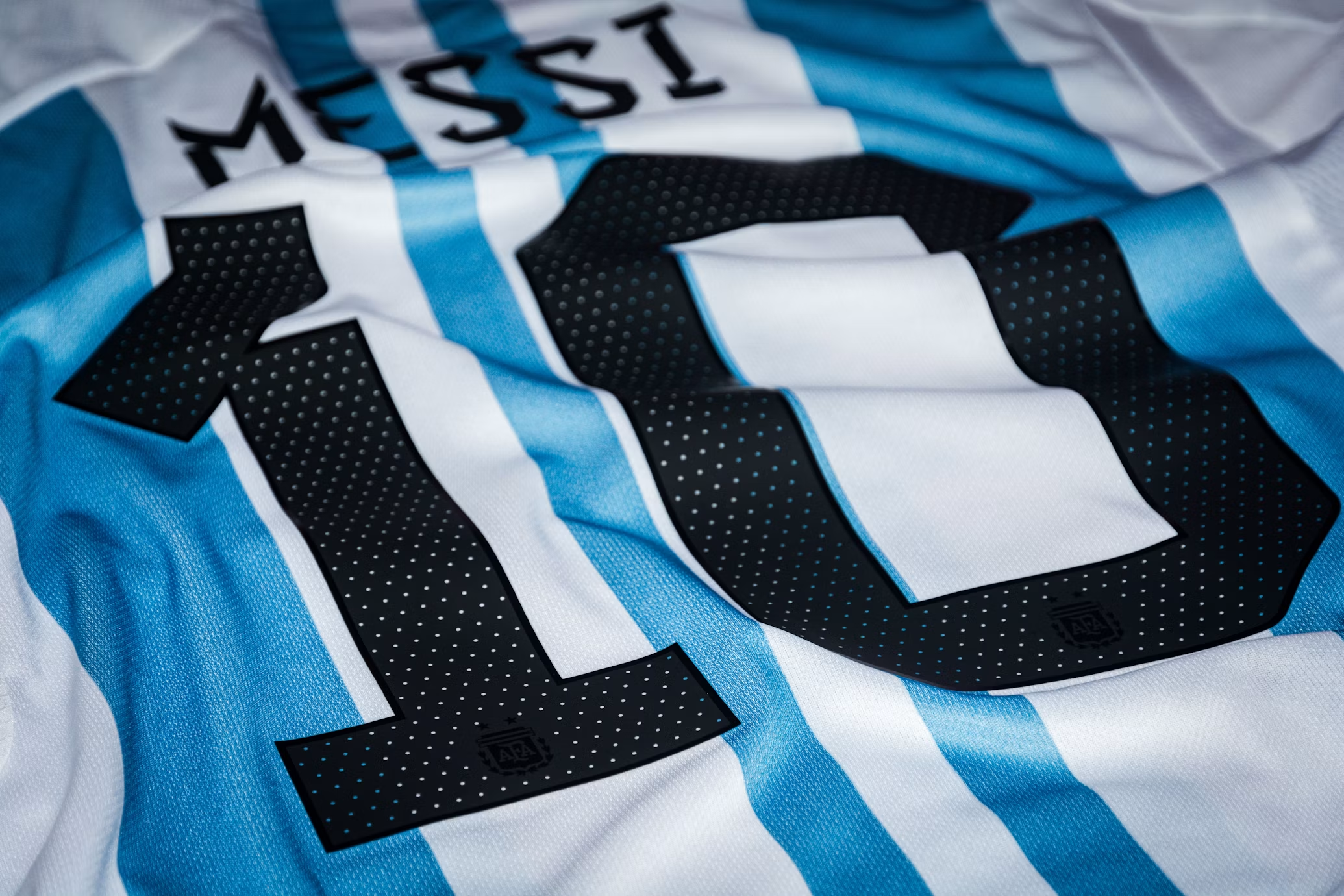
Argentina’s No. 10 delivers another World Cup moment as the scoreboard tells the story against Algeria in 2026.
Messi and Mbappé made the strongest case for individual greatness. Messi’s hat-trick against Algeria did not just win Argentina’s opener; it put him level with Miroslav Klose’s men’s World Cup goals record. Mbappé’s two goals against Senegal pushed him further into France’s record books and reminded everyone that France’s ceiling remains terrifying when he is direct and decisive.
Haaland’s World Cup debut also delivered exactly what Norway had waited years to see: two goals, a heavy win, and the sense that one elite striker can change a country’s expectations almost overnight. Kane scored twice for England and produced the sort of captain’s performance that gives a contender room to breathe.
But the first round also showed the limits of celebrity. Ronaldo’s Portugal had the brand-name storyline and still stumbled against DR Congo. Neymar’s absence left Brazil searching for rhythm against Morocco. Spain had Lamine Yamal and Nico Williams start on the bench against Cape Verde and never found the attacking sharpness expected of them. Belgium needed Romelu Lukaku’s introduction to rescue a point against Egypt.
The trend is not that stars are fading. It is that stars now need a functioning platform. Messi had Argentina’s structure around him. Mbappé had Olise helping France connect the attack. Haaland had Norway willing to play quickly and directly into his strengths. Ronaldo, by contrast, often looked isolated inside a Portugal attack that lacked tempo.
The lesson is old but still true: in a World Cup, talent wins moments. Systems win pressure.
The hosts have avoided the nightmare start
The three host nations all had different opening experiences, but none collapsed under the occasion.
Mexico began the tournament with a 2–0 win over South Africa at the Azteca. It was not a perfect performance. The match was scrappy and shaped by red cards. But for Mexico, after the pain of 2022, the first priority was never elegance. It was release. Julián Quiñones and Raúl Jiménez gave the home crowd what it needed: a win, a celebration and permission to believe again.
The United States produced the most impressive host performance with the 4–1 win over Paraguay. Balogun’s finishing, Pulisic’s influence before his calf issue, and Reyna’s late goal gave the Americans a result that immediately changed the tone of Group D. Their next match against Australia now feels like a meeting of two teams who both think they can win the group.
Canada’s 1–1 draw with Bosnia and Herzegovina was less explosive, but still significant. Cyle Larin’s equaliser gave Canada their first World Cup point, and in a group where all four teams drew their openers, it may matter more than it felt on the night.
The host trend could go either way from here. Home pressure can lift a team, but it can also tighten legs once expectation grows. Mexico and the United States have already banked wins; Canada still need one. The first round, though, avoided the worst-case scenario for North America’s tournament: none of the hosts look like passengers.
Discipline and tournament management are already separating teams
The opening match between Mexico and South Africa brought three red cards, and South Africa are already paying the price. Themba Zwane’s suspension, following his red card against Mexico, leaves Hugo Broos with a problem before the second game. South Africa were beaten, reduced, and left with damage that extends beyond the 90 minutes.
Paraguay’s five yellow cards against the United States told a different version of the same story. It was not just that Paraguay lost 4–1; it was that they looked emotionally stretched by the speed and intensity of the match. In a three-game group phase, that matters. You do not get long to reset, and card pressure can quickly influence selection.
This is a tournament where discipline will not only mean avoiding red cards. It will mean managing heat, hydration breaks, long travel, late-game fatigue and the emotional spikes that come with playing in front of huge crowds. Mexico coach Javier Aguirre even spoke about hydration breaks as tactical windows, which is exactly how managers will use them: not just for recovery, but for instructions.
The teams that can stay calm when games get messy will gain an edge. Ghana did that against Panama. Cape Verde did it against Spain. DR Congo did it after conceding early to Portugal. South Africa and Paraguay, in very different ways, showed how quickly a first match can leave a team with problems that bleed into the second.
The tournament’s emotional centre is shifting quickly
Every World Cup finds its emotional stories. After one round, this one already has several.
Cape Verde’s point against Spain is bigger than the table. It is a country’s first World Cup match becoming a night that people will remember forever. Curaçao lost 7–1 to Germany, but Livano Comenencia’s goal still mattered because it was their first on this stage. DR Congo’s draw with Portugal brought their first World Cup point. Qatar’s late equaliser against Switzerland brought their first World Cup point after the disappointment of 2022.
Then there are the giants writing personal chapters. Messi’s hat-trick was not just another elite performance; it was a record-equalling moment from a player nearing 39. Ronaldo’s draw against DR Congo, on the other hand, felt heavy with time. Kane moved level with Gary Lineker on England’s World Cup scoring list. Mbappé kept building his own argument as the defining tournament player of his generation.
This emotional range is part of why the opening round worked. The 2026 World Cup has already offered routs, shocks, returns, debuts, records and relief. The football has not always been smooth. Some matches have been scrappy. Some favourites have been cautious. But the tournament already feels alive.
The strongest early trend is not one tactic or one region. It is that the old hierarchy is being tested from several angles at once. Some favourites have responded by scoring freely. Others have been dragged into discomfort. The next round will tell us which of these first impressions were real and which were only opening-night noise.
For now, one match has been enough to tell us this: nobody has earned the right to coast.
Saudi Arabia’s 2022 shock once made Lionel Messi’s World Cup dream look fragile, even doomed. Four years later, his hat-trick at the 2026 FIFA World Cup turned that old wound into something very different: not the beginning of the end, but the opening page of one of football’s great late chapters.
Argentina’s No. 10 delivers another World Cup moment as the scoreboard tells the story against Algeria in 2026.
At the final whistle in Lusail, the noise did not arrive all at once.
First came the stillness.
Lionel Messi stood in the pale winter light of Qatar with the look of a man trying to understand how the floor had disappeared beneath him. Around him, Argentina players moved slowly, not only with exhaustion, but with the confusion of people who had walked into a familiar room and found every wall rearranged.
Saudi Arabia had beaten Argentina.
Not survived them. Not merely troubled them. Beaten them.
The scoreboard said 2-1, but scoreboards are often too polite for football’s deeper violence. This was not just a defeat. It was a puncture in the mythology Argentina had carried into the tournament: the long unbeaten run, the Copa América glow, the last great chance, the idea that Messi had finally gathered around him a team shaped by his rhythm rather than crushed by his name.
Now he walked with his head lowered.
In the stands, Saudi supporters celebrated with the delirium of a nation that had seen the impossible stroll casually into view. On phones, in timelines, in comment sections and clipped videos, the mockery began to move faster than the match itself. Where are you, Messi? Messi who? The words changed from place to place, but the feeling behind them was the same. Football, that old theatre of instant judgement, had found its favourite subject.
The little genius had come for his crown and left with a wound.
For a few hours, perhaps longer, it seemed that history had chosen its direction. Messi was 35. The World Cup had not been kind to his deepest longing. A final had already been lost in 2014. Other campaigns had dissolved in frustration, chaos or fatigue. Here, in what many believed would be his last attempt, the opening act had become a public collapse.
People began to speak in endings.
Football had other plans.
Chapter 1: The Day Everything Went Wrong
Argentina had led. That is part of what made the shock so disorienting.
Messi’s penalty in the 10th minute appeared to settle the afternoon into its expected shape. Argentina would control, Saudi Arabia would chase, the tournament favourite would move through the gears. There were disallowed goals, tight offsides, Argentine shirts streaming forward. For a while, the match seemed less like a contest than a delay before the inevitable.
Then came five minutes that ripped open the map.
Saleh Al-Shehri scored. Salem Al-Dawsari scored. The second goal, curling and fierce, felt like someone had thrown a lit match into dry grass. Suddenly Saudi Arabia were not hanging on to a story. They were writing the middle of it in bold green ink.
Argentina lost control of the ball, then of the space, then of themselves. The passes grew impatient. The crosses became hopeful. The faces tightened. Messi drifted into pockets and found bodies around him. Saudi defenders threw themselves across shots as if blocking more than footballs. They were defending a moment that would belong to them forever.
When it ended, Argentina’s 36-match unbeaten run was gone. So too was the comfortable illusion that destiny could be carried into a World Cup like luggage.
The questions came quickly.
Was Argentina too slow? Too dependent? Had the emotional weight of Messi’s final chase become too heavy? Was this another tournament where his brilliance would be trapped inside a national anxiety too large for one man to carry?
There was cruelty in some of it, as there always is when greatness falls in public. But there was also fear. Even those who loved Messi could feel the old shadow returning. World Cups do not wait for sentiment. They do not pause because a player has given the game two decades of beauty. They do not offer extra kindness because time is running out.
For Argentina, Mexico was no longer a second group match.
It was a cliff edge.
Chapter 2: The Refusal to Fall
The story changed with one touch, one shift of weight, one low shot through a forest of pressure.
Against Mexico, Argentina looked trapped for long stretches. The ball moved but did not breathe. The crowd carried tension in waves. Every misplaced pass seemed to ask the same question: what if Saudi Arabia was not an accident? What if it was a warning?
Then Messi received the ball outside the box.
There was no thunder in the movement. No extravagant step-over. Nothing decorative. Just the old economy: the body still, the left foot sudden, the shot skidding low into the corner.
In that moment, the tournament inhaled again.
What followed was not only relief. It was recognition. Argentina had not found a tactical solution so much as an emotional one. They had remembered that their captain was not merely a creator of goals, but a regulator of belief. His presence did not remove fear. It gave fear somewhere to go.
The celebration told its own story. There was release in it, yes, but also command. Messi did not look like a man rescued by a moment. He looked like a man who had pulled his team back toward itself.
Argentina grew from there, not smoothly, not without danger, but with a new hardness. The Saudi defeat did not disappear. It became part of them. A bruise under the shirt. A reminder that nothing would be given, that the road to the trophy would not be paved with admiration.
The team began to change shape around him.
Not tactically alone.
Spiritually.
Chapter 3: Carrying a Nation
Against Poland, Messi missed a penalty and kept playing as if the miss were only weather. That mattered. In earlier years, an Argentine World Cup mistake could become a storm cloud over everything. In Qatar, it passed. The team moved. Alexis Mac Allister scored. Julián Álvarez scored. Argentina topped the group.
The wound had not healed, but it had stopped bleeding.
Against Australia, the match tightened late, and the old nerves returned. Messi scored with the calm of a man opening a locked door with a key he had always kept in his pocket. Yet the night became tense, frantic, human. Argentina survived not as a team floating above pressure, but as one learning to live inside it.
Then came the Netherlands.
That quarter-final was not a football match so much as a fever. It had anger, theatre, late drama, penalties, gestures, collisions of pride. Messi assisted Nahuel Molina with a pass of such disguise that it seemed to travel through a private tunnel only he could see. He scored. Argentina were pulled back. The match became wild. At the end, in the cruelty of the shootout, Argentina stood upright.
Messi was no longer chasing the tournament.
The tournament had begun revolving around him.
Croatia made that even clearer. By then, Argentina had learned how to suffer and how to strike. Messi’s penalty opened the semi-final, but the moment that stayed in the mind came later, near the right touchline, with Joško Gvardiol in front of him. Gvardiol was young, powerful, one of the faces of football’s next age. Messi was smaller, older, slower than the myth of his youth.
Then he turned him.
Not once, but repeatedly, pulling him into a dance with no music, leading him toward the byline and cutting the ball back for Álvarez. It was not simply an assist. It was a message from one football era to another: wait your turn.
Argentina were now Messi’s team in the deepest sense. Not because everything depended on him doing everything, but because everyone seemed to move with the knowledge of what his journey meant. Rodrigo De Paul ran like a man guarding a family heirloom. Álvarez pressed with young lungs. Enzo Fernández gave the midfield a new pulse. Emiliano Martínez carried chaos in his gloves.
And at the centre was Messi, quieter than the noise around him, pulling the country forward by inches.
Chapter 4: The Night the Chase Ended
The final against France felt too large for a single lifetime.
Argentina played for more than a trophy. France refused to surrender theirs. Messi scored. Ángel Di María, fragile and electric, scored. For a while Argentina were not just winning; they were glowing. Then Kylian Mbappé arrived like a storm breaking through a sealed window.
Two goals. Extra time. Messi again. Mbappé again.
By the end, the match had become almost unreasonable. It asked too much of the heart. It asked too much of language. It felt at times like football had gathered all its favourite instruments — beauty, panic, cruelty, nerve, memory — and played them at once until the night shook.
Then came penalties.
When Gonzalo Montiel scored the final kick, Argentina did not merely celebrate. They collapsed into completion. Messi sank into the embrace of teammates, then rose into an image that instantly belonged to football’s permanent gallery: the small man from Rosario holding the World Cup, smiling with the soft disbelief of someone who had reached a place he had imagined for so long that reality seemed almost shy.
It changed the past.
The 2014 final no longer sat alone as a wound. The Copa América heartbreaks lost some of their sting. The Saudi Arabia defeat became a chapter, not a verdict. Messi had the trophy. Argentina had their third star. A nation that had argued, hoped, suffered and waited could finally exhale.
For many, that should have been the closing frame.
The chase had ended.
What else could there be?
Chapter 5: Four Years Later
Time, however, has a strange relationship with Messi.
By 2026, football had moved on in the way football always does. It does not forget, but it turns its head quickly. New faces rise. New arguments gather. Kylian Mbappé was no longer merely the prince of the future; he was already a ruler of the present. Erling Haaland had carried his own force into the global imagination. Younger legs, younger stories, younger storms had begun to claim the spotlight.
Messi arrived in North America at 38, close to 39, already complete in the eyes of history.
That completeness changed the air around him. For most of his career, he had played beneath a demand that greatness required one last missing object. Every tournament, every penalty, every lost final had been weighed against the World Cup. In 2026, that particular burden was gone.
But another question had replaced it.
Why was he still here?
Not as an accusation. As wonder. As curiosity. As a quiet suspicion that time, sooner or later, comes for everyone, even the players who once seemed to bend it.
There had been fitness concerns. There were inevitable doubts about influence, about pace, about whether Argentina could defend a title while still orbiting a star from another football age. And beneath all of it was the most human question of all: after reaching the summit, what does a man do with the mountain?
Messi’s answer did not come in a speech.
It came against Algeria.
Messi’s No. 10 shirt has become more than a jersey; it is a symbol of Argentina’s World Cup memory.
Chapter 6: Then Came the Hat-Trick
The first goal was not delicate.
That mattered.
We remember Messi for the brushstroke, the feathered pass, the dribble through bodies as if gravity had made an exception. But in Kansas City, his first goal was struck with force, a shot from distance that flew beyond Luca Zidane and into the corner. It was a reminder that ageing genius does not always whisper. Sometimes it kicks the door.
The second was different. A spill, a reaction, a poacher’s touch. The kind of goal people once pretended he did not score, because myths are often built by leaving out the ordinary things that make greatness complete. Messi followed the play. Messi waited. Messi finished.
The third was the one that made the night feel symbolic.
A break. A pass. A return. A measured finish placed where the goalkeeper could see it but not reach it. It had the shape of memory. Barcelona years, Argentina years, schoolyard years, all compressed into a few seconds of movement. The body was older. The idea was untouched.
Three goals.
But not merely three goals.
A first World Cup hat-trick. A 200th appearance for Argentina. A sixth World Cup. A share of the all-time World Cup scoring record. The oldest player to score a hat-trick on this stage. Records can sometimes feel cold, like numbers placed behind glass. This did not. This felt alive. It felt like the past reaching forward and touching the present on the shoulder.
The beauty of the hat-trick was not that it erased time. Nothing erases time. His beard carries it. His walk carries it. The way he saves his movements carries it. The miracle is that he has learned how to play with time rather than simply against it.
In 2022, after Saudi Arabia, people looked at Messi and saw a door closing.
In 2026, after Algeria, he made the door look like an entrance.
That is the strange gift of long sporting lives. They rearrange meaning. A defeat that once seemed like an ending becomes the beginning of a deeper arc. A humiliation becomes a shadow that makes the later light more vivid. The mockery remains, but it no longer wounds in the same way. It becomes part of the echo.
“Messi who?”
Four years later, football knew exactly who.
Not because he needed to answer every voice. Not because one hat-trick can define a career already beyond ordinary measurement. But because some players do not simply collect moments. They alter the meaning of the moments that came before.
Final Word
Saudi Arabia’s win will always belong to Saudi Arabia. It was their day, their joy, their thunderclap in the desert. Nothing that happened later should shrink it. But for Messi, it has become something else too: the dark opening to a final movement nobody had the right to expect.
From the silence of Lusail to the roar of Kansas City, from a bowed head to three raised fingers in the imagination, the road has been longer than the scoreboard ever showed.
On the day Saudi Arabia defeated Argentina, many thought they were watching the beginning of the end.
Four years later, a World Cup hat-trick made it feel like the opening page of a much larger story.
Portugal controlled the match for long spells in Houston, but DR Congo found something more valuable than possession: belief. Yoane Wissa’s first-half stoppage-time header earned a 1-1 draw, a first World Cup point for his country, and an early shake-up in the FIFA World Cup 2026 qualification race.
DR Congo players celebrate after their historic equaliser against Portugal in their FIFA World Cup 2026 Group K match.
There was a strange silence around Houston Stadium just after the equaliser went in. Not complete silence — never that, not with Congolese blue bouncing in one corner and Portuguese red wrapped around most of the ground — but a pause, the kind that arrives when a crowd has just been forced to reconsider the story it thought it was watching.
For much of the first half, Portugal vs DR Congo looked like it was drifting toward the expected. Portugal had the ball, the names, the rhythm, the early goal. Cristiano Ronaldo had walked out for another World Cup night, this time at 41, and the stadium had treated his every touch like a small public event. João Neves had already headed Portugal in front after six minutes. The script seemed familiar.
Then Arthur Masuaku took a short corner in first-half stoppage time, bent his delivery into a dangerous crowd, and Yoane Wissa arrived unmarked at the far post. His header flew into the roof of the net. In that instant, DR Congo were no longer guests at Portugal’s occasion. They had taken ownership of it.
The match finished Portugal 1-1 DR Congo, but the scoreline only tells the plain part of the story. For Portugal, this was a warning. For DR Congo, returning to the World Cup stage after 52 years, it was history with a pulse.
Portugal Started Like a Side Ready to Take Control
Portugal’s start had been sharp enough to suggest a comfortable afternoon. Pedro Neto, lively down the left, found space and clipped a measured cross into the box. Neves rose with the timing of a midfielder who understands where forwards want to be and defenders hate to look. His header, directed across goal, gave Portugal a 1-0 lead and seemed to loosen the red half of the stadium.
It was a lovely goal, simple and clean. It was also, as the evening would prove, misleading.
Portugal settled into their familiar possession game, with Vitinha and Neves circulating the ball and Bruno Fernandes searching for pockets between DR Congo’s midfield and defensive line. Nuno Mendes pushed high on the left. João Cancelo tried to offer width and craft from the opposite side. Bernardo Silva drifted inside, looking for the half-space where he usually makes matches feel smaller than they are.
DR Congo refused to panic. Sébastien Desabre had set his side up in a compact 5-3-2, and after the early damage, the shape began to do its work. Chancel Mbemba, Axel Tuanzebe and Steve Kapuadi held the central spaces. Aaron Wan-Bissaka stayed alert to Portugal’s runners. Masuaku, who would later become central to the match’s defining moment, kept his side connected on the left.
It was not a low block built only on desperation. DR Congo had a plan when they escaped. Cédric Bakambu and Wissa were asked to stretch Portugal’s centre-backs, take the first contact, and turn loose balls into territory. Edo Kayembe and Samuel Moutoussamy gave the midfield its bite. The longer the half went on, the more Portugal’s possession began to feel decorative rather than decisive.
DR Congo Refused to Play the Part Assigned to Them
The numbers told the same story in colder language. Portugal had 75 percent of the ball, but DR Congo had more shots. Portugal moved the game around Houston Stadium; DR Congo found ways to make the dangerous moments feel shared.
The first warning came from Wissa, who fired wide not long after Portugal’s opener. Kayembe later tested Diogo Costa with a bouncing effort. These were not waves of pressure, but they were reminders. DR Congo had not come merely to survive the night.
Portugal, meanwhile, began to slow. The ball went sideways more often than forward. Ronaldo, crowded by centre-backs and denied the kind of early service that makes him lethal, became increasingly peripheral. The noise still followed him, but the game did not.
Then came stoppage time.
Moutoussamy’s energy helped force the sequence. DR Congo won the corner, worked it short, and Masuaku shaped the sort of cross defenders dread: curling, dropping, late enough to create uncertainty. Wissa did the rest. He attacked the back post with conviction and buried the header. Portugal’s defenders looked at one another. The Congolese players scattered toward the corner. In the stands, the pockets of blue seemed suddenly much larger than they had been all evening.
It was DR Congo’s first goal at a World Cup. Their previous appearance, as Zaire in 1974, had ended without a goal and without a point. Half a century later, Wissa gave them both a voice.
Portugal Changed Shape, But Not the Mood
Roberto Martínez reacted at half-time. Bernardo Silva did not return after the break, replaced by Francisco Conceição, whose directness immediately changed Portugal’s right side. The ball came quicker. Portugal stretched the pitch more naturally. For a brief spell, it looked as though they had remembered that control without speed can become a comfort blanket.
Portugal thought they had found the second goal 10 minutes into the half. Bruno Fernandes delivered, Neves chested the ball down, and Cancelo’s overhead finish brought a burst of celebration. It did not last. The flag went up. Cancelo had drifted offside.
That moment mattered. It was not just a disallowed goal; it was Portugal’s clearest glimpse of escape. After that, the anxiety returned.
DR Congo nearly punished them. Bakambu bullied his way onto a loose ball and struck the near post, though the move was pulled back for a foul. Later, he had another sight of goal on the counter. Every time Portugal lost structure, DR Congo looked capable of turning the stadium’s mood upside down.
Ronaldo had two second-half openings from Conceição’s service, both poked wide under pressure. Neither was an easy chance, but both carried the weight of his name. This is the burden of Ronaldo at a World Cup now: even half-chances are judged against the memory of all the years when he bent matches to his will.
At 41, he became the oldest outfield player to start a World Cup match. He also walked away without the goal that would have made him the first player to score in six different World Cups. For Portugal, that subplot will not disappear. Martínez can talk of process, growth and patience — and he is right that tournaments are not won in the first group match — but Portugal’s attack looked too often as though it was waiting for a historic moment rather than building a winning one.
Why Portugal Struggled Despite Having So Much of the Ball
The tactical problem was not possession. Portugal had more than enough of that. The issue was where they had it and how slowly they used it. DR Congo were happy for Portugal to play in front of them, shuffle passes across midfield, and send hopeful balls into zones where Mbemba and Tuanzebe could compete.
The spaces behind the wing-backs were not attacked often enough. Bruno Fernandes had flashes but not control. Neto’s early threat faded. Mendes gave Portugal thrust, but not enough final clarity.
DR Congo, by contrast, were honest in their work. Their distances were good. Their midfield rarely allowed Portugal to receive cleanly between the lines. When the first press was beaten, the back five absorbed the next pass. When Portugal tried to speed up, there was usually a blue shirt close enough to make the touch uncomfortable.
It was the kind of defensive performance that does not always look spectacular in real time, because the best parts happen before the ball arrives. A body in the passing lane. A midfielder stepping up just early enough. A centre-back refusing to follow Ronaldo too far and leave space behind. DR Congo’s discipline gave their forwards the chance to make Portugal nervous, and Wissa made sure that one of those moments counted.
Standout Players
Wissa is the natural Man of the Match. João Neves may have been Portugal’s brightest player, scoring the opener and carrying more purpose than many around him, but Wissa gave DR Congo far more than a goal. He ran the channels, pressed when he could, tracked when he had to, and took the one moment that may now live for decades in Congolese football memory.
Portugal’s best performer was Neves. His movement for the goal was excellent, his midfield work tidy, and his willingness to arrive in the box gave Portugal a dimension they otherwise lacked.
DR Congo’s best performer was Wissa, but the unsung hero was Moutoussamy. He did not dominate the television picture, but he helped tilt the emotional balance of the match before half-time. His legs, timing and refusal to let Portugal stroll through midfield gave DR Congo the platform from which belief could grow.
What the Result Means for Group K
The result changes Group K immediately. Portugal expected to begin with three points and move calmly toward tougher assignments against Uzbekistan and Colombia. Instead, they leave Houston with questions.
A draw is not a disaster in a 48-team World Cup, where the top two in each group advance and the best third-placed teams also remain alive, but it narrows the margin for comfort. Portugal still have the squad to recover. They also now have evidence that talent alone will not carry them through this group.
For DR Congo, the meaning is different. One point does not guarantee anything, and Desabre will know that Colombia and Uzbekistan will ask different questions. But emotionally, this was a door opening. DR Congo did not steal a draw through chaos. They earned it through organisation, patience and courage after an awful start. They conceded in six minutes to one of the tournament favourites and refused to shrink.
A Night Bigger Than One Point
That is why the scenes after Wissa’s goal mattered as much as the Group K standings. Congolese supporters had not filled the stadium in the way Portugal’s fans had. They did not need to. When the ball hit the net, their section erupted with the force of a nation that had waited too long to be heard at this level.
Players sprinted toward them. Arms went wide. Faces changed. The match had become bigger than the match.
Portugal will look back at the possession, the early lead, the disallowed goal, and Ronaldo’s late frustrations. They will say they should have won. They may be right.
DR Congo will look back at Wissa’s header, Masuaku’s cross, Bakambu’s running, Moutoussamy’s engine, and a defensive line that refused to crack again. They will say they belonged. They will be right too.
When this World Cup group is finally settled, this 1-1 draw may be remembered in two very different ways: as the evening Portugal left two points behind in Houston, or as the night DR Congo returned to the World Cup and left with proof that history can sometimes arrive at the back post, in first-half stoppage time, wearing blue.
Erling Haaland puts Iraq’s defence under pressure during Norway’s 4-1 win in their 2026 FIFA World Cup Group I opener.
For years, the World Cup had been the one stage Erling Haaland had not touched.
He had scored everywhere else. In England. In Germany. In Europe. In qualifiers. In matches that mattered and matches that felt routine until he made them his own. But the World Cup is different. It does not care about reputation until reputation survives the noise, the nerves and the weight of a nation watching.
On June 16, 2026, at Boston Stadium in Foxborough, Haaland finally stepped into that space.
It did not take him long to make it feel familiar.
Norway beat Iraq 4-1 in their Group I opener, and the scoreline will travel around the world as a clean, emphatic result. Haaland scored twice. Leo Østigård added the third. A late own goal from Aymen Hussein completed the scoring. Norway, back at the World Cup after 28 years, began with three points and a statement.
But this match was more interesting than the final score suggests.
Iraq, playing their first World Cup match in 40 years, did not arrive as passive guests at Norway’s return party. They played with spirit, speed and belief. They equalised through Hussein. They rattled Norway. They made the match feel alive when it might have become a simple Haaland headline.
And then Norway punished them.
That is what good teams do. That is what teams with elite forwards do. They suffer a little, wobble a little, and still walk away with the result looking bigger than the performance.
Norway will take that. Haaland will take that. Group I will take notice.
Haaland Finally Gets His World Cup Moment
There was a strange freshness to watching Haaland at a World Cup.
For a player so famous, so heavily analysed and so globally recognised, this was still a first. His first World Cup appearance. His first World Cup goal. His first chance to turn years of expectation into tournament reality.
That made the opening half-hour feel like a countdown.
Norway had waited 28 years to return to this competition. Haaland had waited his entire senior international career to play in it. Every early touch, every run across the defensive line, every moment of movement in the box seemed to carry the same question: when would it happen?
The answer came in the 29th minute.
David Møller Wolfe drove a low cross into the far-post area, and Haaland did what Haaland has done to defenders for years. He separated himself at the right moment, attacked the space, and stabbed Norway into the lead.
It was not the most spectacular goal he will ever score. It may not even be one of the cleanest. But for Norway, it carried the sound of a door opening.
The country’s modern football dream had finally reached the World Cup scoreboard. Haaland, the player who had powered Norway through qualification, had arrived exactly where everyone expected him to arrive: inside the six-yard drama, one step ahead of the men trying to stop him.
Some goals announce themselves with beauty. Others announce themselves with inevitability.
This was the second kind.
Iraq Refused to Be a Supporting Act
The easy version of this story is Haaland arrives, Norway win, Iraq fade.
That would be unfair.
Iraq had waited even longer than Norway for this stage. Their last World Cup appearance came in 1986. Four decades had passed before they returned, and that history mattered. You could see it in the energy of their play, in the urgency of their attacks, and in the refusal to treat Norway’s star names as an excuse to retreat.
After Haaland’s opener, Iraq could have folded.
Instead, they answered.
In the 39th minute, Aymen Hussein rose above a crowd of Norwegian defenders and headed in Amir Al-Ammari’s cross. It was a superb centre-forward’s goal: brave, direct, physical and full of timing. For a few minutes, Iraq had done more than score. They had changed the emotional temperature of the match.
Suddenly, Norway looked less comfortable. Iraq pressed with belief. Their midfield found runners. Their attacks had purpose. The match had edge, and the crowd had reason to believe the underdog could make this opener far more difficult than Norway wanted.
That spell was important.
It showed Iraq were not just happy to be back. They had enough organisation and attacking quality to trouble opponents in this group. They forced Norway into uncomfortable moments and made Ståle Solbakken’s side defend in ways that will not have gone unnoticed by France or Senegal.
The problem was that good World Cup performances can still be undone by bad World Cup moments.
And Iraq’s bad moment came at the worst possible time.
The Mistake That Changed the Match
Just before halftime, the match turned.
Norway’s second goal did not come from a sweeping passing move or a beautifully constructed attack. It came from a mistake that Iraq will replay with frustration.
A weak back pass put goalkeeper Jalal Hassan under pressure. He hesitated, tried to clear, and Haaland was there. The ball struck the Norwegian striker and bounced into the net.
It was cruel. It was avoidable. It was also exactly the kind of moment Haaland has built a career on.
His greatness is not only in powerful finishes or spectacular runs. It is in the constant pressure he applies to defenders and goalkeepers. He makes routine situations feel unsafe. He turns small errors into goals. He forces opponents to execute perfectly because anything less can become a punishment.
Iraq had worked hard to get back into the match. They had equalised. They had momentum. They had made Norway look uncertain. Then, in one sequence, they handed Haaland a second goal and went into halftime behind.
That is the brutal mathematics of playing against world-class forwards.
You can compete for 44 minutes. You can look brave, intelligent and dangerous. But if you give Haaland one loose ball, one hesitation, one yard too much, he can change the whole story.
Norway led 2-1 at the break, and Iraq’s best spell had still left them chasing the game.
Norway’s Scoreline Was Stronger Than Their Control
The final score makes Norway look dominant. The match itself was less simple.
Iraq had strong periods on both sides of halftime. They moved the ball forward with confidence, attacked Norway’s defensive shape and asked serious questions of a back line that did not always look settled. The Guardian’s live coverage described Iraq as better for a significant spell late in the first half and much of the second, and that reading matched the feel of the game.
Norway, for all their attacking talent, were not flawless.
There were moments when their midfield looked stretched. There were moments when Iraq found space between the lines. There were moments when Norway’s defenders had to deal with more movement and pressure than a 4-1 scoreline usually suggests.
That matters because Group I will become much tougher.
Senegal will bring athleticism and experience. France will bring Kylian Mbappé, Michael Olise, Bradley Barcola and the kind of attacking variety that punishes defensive uncertainty at a different speed. Norway’s opening win gives them breathing space, but it also gives their next opponents plenty to study.
Still, tournament football is not a beauty contest.
Norway scored four. Norway won by three. Norway got Haaland into the tournament immediately. Norway returned to the World Cup with a victory after nearly three decades away.
There are worse problems than winning imperfectly.
Østigård Turns Norway’s Height Into a Weapon
The third goal came in the 76th minute, and it said something important about Norway’s threat beyond Haaland.
Leo Østigård, introduced from the bench, rose to meet a delivery and glanced a header into the net. It was simple, direct and devastating for Iraq.
By then, Iraq had spent large stretches trying to keep Norway’s forwards under control. They had competed well. They had pushed. They had made the game uncomfortable. But the longer the match went on, the more Norway’s physical advantages began to matter.
Set pieces and aerial power are often treated as old-fashioned tools. In tournament football, they remain priceless.
Norway have Haaland, but they are not only Haaland. They have height, structure, delivery, and enough technical quality around him to create different types of danger. Østigård’s goal underlined that. If teams over-focus on stopping Haaland, Norway can still hurt them from other routes.
For Iraq, the third goal was the one that made the mountain too steep.
At 2-1, the match still had tension. At 3-1, the scoreboard began to reflect what Norway wanted the night to become: a convincing opening win, a platform for the group, and a message that their return was not simply sentimental.
Hussein’s Night Captured Iraq’s Cruelty
Aymen Hussein will remember this match with mixed emotions.
He scored Iraq’s first World Cup goal of this campaign, a powerful header that briefly pulled his team level and gave their supporters a moment worthy of the long wait. For a player who had already been central to Iraq’s journey back to the tournament, it was a major personal moment.
But football rarely allows stories to stay clean.
Deep into stoppage time, under pressure in a crowded penalty area, Hussein was credited with an own goal that made it 4-1 to Norway. It was a harsh final note for a player who had done so much to keep Iraq in the match earlier.
That is how quickly tournament narratives can turn.
One moment, Hussein was the symbol of Iraq’s resistance. Later, he was attached to the goal that made the defeat look heavier than the performance deserved.
Iraq should not let that final score define their night too harshly. They competed. They scored. They had Norway under pressure. They gave their fans a World Cup return with moments of real pride.
But they also learned the lesson every team learns at this level: mistakes travel fast, and the scoreboard has no interest in nuance.
Norway’s Return Feels Bigger Because of Haaland
Norway’s absence from the World Cup had lasted since 1998. For a country with proud football memories but limited tournament presence in the modern era, this return already carried emotional weight.
Haaland changes that weight.
Without him, Norway’s return might have been framed as a good story. With him, it becomes something more dangerous. They are not just back. They have one of the most feared forwards in world football leading them.
That changes how opponents prepare. It changes how broadcasters frame their matches. It changes how fans around the world watch them. A Norway game is now also a Haaland event.
Against Iraq, he did not need a perfect performance to score twice. That is part of the fear. He took 11 first-half touches and still produced two goals. He does not always need to dominate every phase of play. He only needs moments.
For Norway, that is a gift.
They can have spells where the game gets messy. They can have spells where possession is imperfect. They can even have spells where the defence looks uncertain. As long as Haaland is on the pitch, they have a way to bend the match back toward themselves.
That is why this win matters beyond three points.
It confirmed that Haaland’s club-level inevitability can survive the World Cup stage.
Group I Now Has a Mbappé-Haaland Storyline
France beat Senegal 3-1 earlier in Group I. Mbappé scored twice. Haaland then scored twice. The group has already found its headline.
France and Norway both have three points. Both have superstar forwards already off the mark. Both have enough attacking quality to believe they can control the group. And both will know that goal difference may matter if the standings tighten later.
That makes Norway’s late fourth goal useful, even if the match was effectively decided by then. In a four-team group, every extra goal can carry value.
Norway’s next match against Senegal will be a serious test of whether this opening win was a launchpad or just a strong start against an opponent they were expected to beat. Senegal’s defeat to France leaves them needing a response. They will not give Norway the same spaces Iraq offered, and they will attack Norway’s defensive weaknesses with different physical tools.
Iraq, meanwhile, face France. It is a difficult assignment, but their first-half performance against Norway gives them something to work with. If they can remove the errors and keep the same attacking conviction, they can still make life uncomfortable.
But the pressure is now immediate.
Norway have the points. Iraq have the regrets.
Why This Win Still Leaves Questions for Norway
A 4-1 victory in a World Cup opener usually invites celebration. Norway deserve theirs.
But Solbakken and his staff will know this was not a complete performance.
The attack looked dangerous, especially when it had space and service. Haaland looked ready. The set-piece threat was real. The bench contributed. The scoreline gave Norway an ideal start.
The defence, though, will be examined.
Iraq found routes forward. Hussein’s equaliser came from a cross that Norway did not defend strongly enough. There were moments when Norway’s midfield protection seemed loose, and Iraq’s runners were able to create disorder. Against stronger finishing, the match could have become more uncomfortable.
That is the balance Norway must manage.
They are dangerous enough to trouble anyone, but they are not yet secure enough to relax. Their ceiling is high because Haaland can make them explosive. Their floor depends on whether they can protect their own box when opponents push back.
That is what makes them interesting.
Norway are not a cautious outsider hoping to survive. They are an attacking team with a superstar striker, a gifted supporting cast and just enough defensive doubt to make their matches compelling.
For neutrals, that is a gift.
Iraq Leave With Hurt, But Not Hopelessness
For Iraq, the pain will be real.
A 4-1 defeat in a World Cup opener is difficult to carry, especially after waiting 40 years to return. The final score will look harsh on paper. It will sit in tables and summaries without explaining the better spells, the equaliser, the pressure, or the way the game briefly felt balanced.
But the performance had value.
Iraq showed they could compete in rhythm and intensity. They did not freeze. They scored a proper goal. They troubled a European side with one of the world’s most famous forwards. They made the match more compelling than many expected.
Now the challenge is emotional as much as tactical.
They must separate the performance from the result. They must learn from the errors without letting them crush belief. They must face France knowing that another defeat could put them close to elimination, but also knowing that their first match proved they belong in the conversation.
World Cups are unforgiving. They are also short enough for one response to change everything.
Iraq still have that chance.
Haaland Arrives, Norway Dream
At full-time, Norway had what they came for.
Three points. Four goals. A winning return to the World Cup. Haaland’s name on the scoresheet twice. A group table that already gives them a platform.
The night was not perfect. It did not need to be.
For Norway, this was about ending the wait and beginning the tournament with authority. For Haaland, it was about crossing the last major threshold of his career so far. The World Cup had finally seen him not as a projection, not as a qualifying machine, not as a name waiting for its moment, but as a scorer on the biggest stage.
Iraq made Norway work harder than the scoreline suggests. That should be remembered. Their return had pride in it, even in defeat.
But the story belonged to Haaland.
The World Cup has a new headline forward in full view now. France have Mbappé firing. Norway have Haaland moving. Group I has already become one of the tournament’s most fascinating early theatres.
Norway waited 28 years to come back.
Haaland needed 29 minutes to make sure everyone noticed.
France players line up before their 2026 FIFA World Cup Group I match against Senegal.
For a while in New Jersey, France looked like a team carrying the weight of expectation rather than wearing it.
Senegal were aggressive. France were loose. The ball did not move quickly enough. The favourites had possession, but not rhythm. The old memories were there too, whether anyone in blue wanted to admit it or not: France and Senegal at a World Cup, the fixture that once produced one of the great opening shocks in tournament history back in 2002.
Then Kylian Mbappé arrived properly.
Not just in the match. In the tournament. In French football history.
By the end of France’s 3-1 win over Senegal at New York New Jersey Stadium on June 16, 2026, the story had changed completely. What began as a difficult Group I opener became a record-breaking night for France’s captain. Mbappé scored twice, moved beyond Olivier Giroud as France’s all-time leading scorer, and reminded the World Cup that Les Bleus remain one of the teams every serious contender will eventually have to measure themselves against.
The scoreline tells one version of the match. France 3, Senegal 1. Mbappé twice, Bradley Barcola once, Ibrahim Mbaye with Senegal’s late response.
The feeling of it was more complicated.
France were not perfect. They were not fluent from the start. They were not always comfortable. But when the game entered the territory where elite players decide elite matches, Mbappé gave it a familiar shape.
A tight match became a French win. A French win became a personal milestone. A personal milestone became a warning.
A First Half That Gave France Plenty to Think About
This was not the smooth opening night France would have imagined.
Senegal began with purpose and refused to let the occasion turn into a French procession. They pressed with bravery, broke with conviction and found enough spaces to make Didier Deschamps’ side uncomfortable.
France had talent everywhere, but for much of the first half they did not have control in the way they wanted. Their passing was occasionally untidy. Their attacking structure felt stretched. Senegal, far from sitting deep and waiting for damage, played with the confidence of a team that believed it could make France remember old scars.
The best Senegalese moments came before the interval.
Sadio Mané forced Mike Maignan into serious work, and Ismaïla Sarr missed a clear chance from close range. It was the kind of opening that can haunt a team against opponents of France’s quality. Senegal had done enough to make the favourites worry. They had not done enough to lead.
That mattered.
Against France, wasted moments rarely stay harmless for long.
Deschamps later suggested the halftime response was not about panic, but correction. France needed better decisions, sharper connections and more influence in the areas where Senegal had denied them comfort. The adjustment that changed the night was Michael Olise moving into more central positions, where he could receive, turn and begin to hurt Senegal between the lines.
The game did not change all at once. But it began to lean.
Michael Olise Gives France the Missing Link
Every great attacking team needs someone who can change the rhythm of a match without making it look dramatic.
For France, that player became Michael Olise.
In the first half, France often looked like a team with too many powerful pieces and not enough connection between them. After the break, Olise began to knit the game together. He drifted into pockets, carried the ball with calm, and played with the sort of disguised timing that unsettles defensive structures.
His influence was not just decorative. It was decisive.
France’s opening goal came after Olise found the kind of pass that separates good possession from meaningful possession. The ball cut through Senegal’s defensive shape, and Mbappé did the rest. The finish was calm, almost understated, but the significance was enormous.
That was the moment Mbappé moved beyond Giroud and became France’s all-time leading scorer.
For any other player, the goal alone would have defined the match. For Mbappé, it felt like another step in a career that has lived in fast-forward since he first exploded onto the World Cup stage as a teenager in 2018.
Yet the goal also changed the match tactically.
Senegal now had to come out. France had more space. Olise had more room to influence. Mbappé had more grass to attack. The game that had looked awkward for France suddenly began to look dangerous for Senegal.
Mbappé’s Record Was More Than a Number
Records can sometimes feel cold. This one did not.
Mbappé had arrived at the tournament under scrutiny, as he so often does now. He is no longer just the dazzling young forward who announced himself to the world in Russia. He is France’s captain, Real Madrid’s superstar, the face of an era, and a player judged not only by what he does, but by what people expect him to do.
That is a heavy place to live.
Against Senegal, he carried it lightly when it mattered most.
His first goal was the record-breaker: France’s captain slipping into space, taking the chance and moving past Olivier Giroud’s national mark. His second, deep into stoppage time, was the exclamation point. After Senegal had pulled one back and briefly introduced uncertainty, Mbappé answered with a fierce long-range strike that ended the argument.
The timing said almost as much as the technique.
Senegal had scored through Ibrahim Mbaye in added time, reducing the deficit and asking one final question of France. For a few moments, the match had a different pulse. A 2-1 scoreline in stoppage time carries its own tension. One loose clearance, one set piece, one mistake, and a comfortable result can become a problem.
Mbappé did not allow the question to linger.
His second goal made it 3-1, secured the win and gave the night a final image worthy of its headline. France had been tested. Mbappé had responded. The record had not arrived in a ceremonial stroll; it had been earned inside a real match against a serious opponent.
That makes it more meaningful.
Barcola’s Goal Shows France’s Depth
Mbappé will dominate the front pages, and rightly so. But France’s second goal told another important part of the story.
Bradley Barcola came on and scored the kind of goal that reminds everyone why France’s squad depth is so frightening. Fresh legs, direct movement, clean execution. He ran beyond Senegal’s defensive line and finished with composure past Édouard Mendy.
For opponents, this is the problem with playing France.
You can contain them for an hour. You can frustrate their starters. You can make the game physical, tense and uncomfortable. Then Deschamps can turn to the bench and bring on another player capable of stretching the pitch and changing the energy.
Barcola’s goal was not just a second goal. It was a squad goal.
It came from France raising the tempo after the break, from better use of central spaces, and from the ability of their substitutes to attack a tiring defence. In tournament football, where three group matches come quickly and knockout rounds punish tired bodies, that depth can be the difference between a good team and a champion.
France have both individual brilliance and options.
That is why this win will concern the rest of Group I.
Senegal Deserved More Than Sympathy
The danger after a 3-1 defeat is that the losing team gets reduced to a paragraph of praise.
Senegal deserve more than that.
For long spells, especially in the first half, they were every bit the difficult opponent France expected. They pressed high enough to disturb France’s rhythm, attacked with pace, and created moments that could have changed the match had they been taken.
Their problem was not courage. It was efficiency.
At this level, the difference between making a favourite nervous and punishing a favourite can be brutally small. Senegal had chances before France led. They had spells of momentum. They had enough technical and athletic quality to suggest they will remain a threat in the group.
But France had Mbappé. France had Olise. France had Barcola from the bench. France had the ruthless edge that separates tournament contenders from teams still chasing the perfect performance.
Ibrahim Mbaye’s late goal mattered, even if Mbappé quickly restored the two-goal margin. It showed Senegal had not disappeared. It showed they could still hurt France. It also gave them something to carry into their next match.
This was not a performance that should break Senegal. It should irritate them.
They were close enough for long enough to know this match did not get away because France were untouchable from the first whistle. It got away because France were more clinical once the game opened.
That is both frustrating and useful.
The 2002 Shadow Was There, But This France Is Different
France against Senegal at a World Cup will always bring history with it.
In 2002, Senegal stunned defending champions France in one of the most famous opening-match shocks the tournament has ever seen. It remains part of Senegal’s football identity and part of France’s World Cup memory. You do not need to mention it every minute for it to exist in the background.
That is why this fixture carried more emotional weight than an ordinary group opener.
For Senegal, it was a chance to reopen an old story. For France, it was a chance to close the door on any romantic repeat before it gathered force.
The first half allowed the memory to breathe. Senegal were sharp enough, direct enough and brave enough to make the match feel uncertain. Every missed chance kept the tension alive. Every French error gave the old narrative a little more oxygen.
But the second half showed how much this French side understands tournament management.
They did not panic. They corrected. They waited for the quality to surface, then accelerated when the chance came. Once Mbappé scored, France did not simply protect the lead; they grew stronger.
That is what serious teams do.
They absorb difficult moments without letting them define the night.
What This Means for Group I
France’s win puts them exactly where they wanted to be after one match: three points on the board, captain scoring, record broken, and the awkward opening test safely handled.
But Group I already looks like one of the more interesting groups of the tournament.
Norway also started with a convincing 4-1 win over Iraq, which means the France-Norway storyline is already building. Mbappé has opened his tournament with two goals. Erling Haaland has done the same. Their eventual meeting now carries the kind of star power that can shape a group and possibly the wider tournament mood.
Before that, France face Iraq in Philadelphia. On paper, they will be expected to win. In tournament reality, Deschamps will know that momentum can vanish quickly if standards drop. France’s first-half issues against Senegal will not be ignored. The second-half improvement will be the model.
For Senegal, the next match against Norway now becomes hugely important. A defeat would leave them in trouble. A win would reopen everything. Their performance against France showed enough to suggest they can compete with anyone in the group, but the margin for missed chances has already narrowed.
That is the cruelty of the World Cup. Good performances do not always buy time.
Points do.
France Look Dangerous Because They Still Have Room to Improve
The most worrying thing for France’s rivals may not be that Les Bleus won 3-1.
It is that they won 3-1 without playing well for 90 minutes.
There were flaws here. The first half lacked precision. Senegal found spaces. France did not always defend transitions cleanly. The attacking rhythm took time to settle. Against a sharper opponent, or on a night when Senegal had taken one of their early chances, this could have become much more uncomfortable.
But tournament winners are rarely perfect in their opening match.
They grow. They solve problems. They find new combinations. They learn which players can change games and which tactical adjustments matter when the plan is not working.
France learned something about Olise. They saw Barcola make an impact. They watched Mbappé turn a difficult night into a historic one. They came through the kind of match that tests a favourite’s patience and left with the only thing that truly matters at this stage: a win.
There will be cleaner performances. There may be bigger nights. But this one had value because it asked France a few questions.
And France had answers.
A Record Night, a Warning Night
When the final whistle went, the headline belonged to Mbappé. There was no avoiding that. Two goals. France’s all-time scoring record. A World Cup opener bent to his will.
But this was not just a night about numbers.
It was about France surviving a difficult start and turning pressure into authority. It was about Senegal showing enough to remain dangerous despite defeat. It was about a group that already has shape, tension and star power. And it was about Mbappé, still only 27, continuing to build a World Cup career that feels increasingly historic.
France did not glide through Senegal. They had to work. They had to adjust. They had to wait for their best player to tilt the match.
That is what made the win feel useful.
The World Cup does not usually reward teams that look perfect in the first week. It rewards teams that can suffer, adapt and still find their edge.
France did that in New Jersey.
Mbappé made history.
And Les Bleus, after a difficult first half and a devastating second, made their first statement of the tournament.
A pencil-style tribute illustration capturing Peter Drury’s voice and the unforgettable football moments his commentary helped define.
Some football moments are remembered first by the picture.
A ball flying into the top corner. A player sliding on his knees. A goalkeeper beaten. A crowd losing itself. A nation, for one impossible second, forgetting everything except the game.
But other moments come back to us through sound.
That is where Peter Drury lives.
For more than three decades, Drury has occupied one of football’s strangest and most delicate roles. He is not the story. He does not score the goal, make the pass, lift the trophy or suffer the defeat. Yet when the moment arrives, when millions of people are trying to understand what they have just seen, his words often become attached to the memory forever.
That is why his commentary travels so far beyond the live broadcast. It gets clipped, shared, replayed, subtitled, remixed and quoted by fans who were not even watching the original feed. Drury’s voice has become part of football’s emotional archive.
His best lines do not simply describe what happened. They give the moment a shape.
This is not a transcript of every famous Drury call. It is a ranking of the moments where his commentary did what great sports broadcasting should do: step into the drama, understand its weight, and then leave just enough words behind for fans to carry with them.
10. Diogo Jota Breaks Tottenham Hearts at Anfield
Liverpool 4-3 Tottenham Hotspur, Premier League, 2023
“Mayhem, Liverpool threw it away and then they won it all over again.”
This was not a final. It did not decide a title. It was not the most important match Peter Drury has ever called.
But it was pure Premier League theatre.
Liverpool raced into a 3-0 lead against Tottenham at Anfield, only for Spurs to drag themselves back from the edge. Richarlison’s stoppage-time equaliser looked like the final twist. Anfield had gone from celebration to disbelief. Tottenham, somehow, had escaped.
Then football changed its mind.
Almost immediately, Lucas Moura made a mistake, Diogo Jota pounced, and Liverpool were 4-3 up. The match had gone from chaos to comedy to cruelty in the space of seconds.
This is the kind of situation where many commentators simply shout. Drury did more than that. He caught the absurdity of it. He understood that the story was not just Jota’s winner, but the emotional whiplash of everyone watching.
That short line works because it sounds like disbelief being processed live. Liverpool had thrown it away. Then, somehow, they had won it all over again.
It was a reminder that some of Drury’s best work comes not only in grand finals, but in those wild domestic matches where the Premier League becomes theatre without warning.
9. Liverpool Hit an Unimaginable Zenith Against Manchester United
Liverpool 7-0 Manchester United, Premier League, 2023
“Liverpool utopia. An unimaginable zenith.”
There are scorelines, and then there are results that seem to detach from logic.
Liverpool’s 7-0 win over Manchester United at Anfield in March 2023 was one of those afternoons. It began as a rivalry match and ended as something closer to a footballing fever dream. Cody Gakpo, Darwin Núñez, Mohamed Salah and Roberto Firmino all played their part as United unravelled in front of a crowd that could hardly believe what it was watching.
For Drury, the challenge was different from calling a last-minute winner. This was not one explosion. It was a slow, stunning collapse for one side and a kind of sporting euphoria for the other.
The phrase “Liverpool utopia” captured that imbalance perfectly. It was not just that Liverpool had beaten their biggest domestic rivals. It was that they had done it by seven. It was that the final score felt almost too extreme to be real.
And that is why the commentary travelled.
Drury found a line that matched the scale of the absurdity. Liverpool were at a height that even their own fans could barely digest. United were at the other end of the emotional spectrum. One club had reached a dream state. The other had hit a historic low.
Great commentary does not need to explain every detail. Sometimes it only needs to name the feeling.
8. Real Madrid Find Another Miracle at the Bernabéu
Real Madrid 3-1 Manchester City, UEFA Champions League, 2022
“They prayed for miracles and miracles arrived.”
Some clubs win matches. Real Madrid, on certain European nights, seems to summon them.
The 2022 Champions League semi-final against Manchester City looked finished. City had control of the tie. The clock was running down. Madrid needed something close to impossible.
Then Rodrygo scored.
Then he scored again.
The Bernabéu changed its shape. A stadium that had been tense and anxious became a storm. City, so composed for so long, suddenly looked like a team trying to hold back history with bare hands.
Drury’s line worked because it understood Real Madrid’s relationship with the Champions League. This was not treated as a normal comeback. It was framed as part of a larger mythology — the idea that Madrid in Europe can stretch the boundaries of what is reasonable.
“They prayed for miracles and miracles have arrived” was not just a poetic flourish. It was the truth of the night as it felt to those watching. Madrid needed something irrational. Football gave it to them.
That is why the moment belongs on this list. Drury did not manufacture the magic. He recognised it while it was happening.
7. Manchester City Come Back From the Edge Against Aston Villa
Manchester City 3-2 Aston Villa, Premier League, 2022
“From the brink of despair… elation! From catastrophe, cacophonic joy!”
The final day of a Premier League season is designed to make calm people irrational.
Manchester City knew victory over Aston Villa would secure the title. Instead, they fell 2-0 down and gave Liverpool hope. For a while, the Etihad felt trapped between panic and disbelief.
Then came the storm.
Ilkay Gündogan scored. Rodri equalised. Gündogan scored again. Three City goals arrived in a burst so sudden that it felt less like a comeback and more like a detonation.
This was a commentator’s nightmare and dream at the same time. Everything happened too quickly. The league table was shifting. The stadium was shaking. Liverpool were playing elsewhere. Every sentence had to carry both the action and the consequences.
Drury’s commentary met the speed of the moment.
The phrase “from the brink of despair” mattered because that was exactly where City had been. Not slightly worried. Not uncomfortable. On the edge. A few minutes from letting the title slip away.
Then, just as quickly, came elation.
City have had many great days under Pep Guardiola. Few have sounded as frantic as that one. The goal did not simply win a match. It rescued a season from disaster and turned it back into celebration.
Drury caught that swing in one breath.
6. Morocco Shake the World Against Belgium
Morocco 2-0 Belgium, FIFA World Cup 2022
“Drink it in, Casablanca. Relish it, Rabat. This is your night.”
The 2022 World Cup gave Morocco a run that grew from surprise into history.
Before the semi-final, before the global celebration, before the full scale of the story became clear, there was Belgium. Morocco’s 2-0 win in the group stage was the result that told everyone this was not just a spirited team enjoying the occasion. This was a serious side with organisation, belief and a crowd that turned every match into a home game.
Drury was at his best when the game moved from result to meaning.
Morocco’s win was not just about beating Belgium. It was about an African and Arab team imposing itself on one of Europe’s most talented squads. It was about the sound inside the stadium, the red shirts in the stands, the emotional force of a team carrying more than eleven players.
The line worked because it moved beyond the stadium and into the places that would feel the result most deeply. Casablanca. Rabat. The cities, the homes, the cafés, the families, the fans watching with flags around their shoulders.
Drury has always had a gift for recognising when football is speaking to identity. In Morocco’s case, that mattered. The win was tactical, but it was also cultural. It belonged to the players, the fans in Qatar, and millions watching across Morocco and the wider diaspora.
The commentary did not need to manufacture drama. Morocco had already done that. Drury simply understood the size of it.
5. Cristiano Ronaldo Returns to Manchester United
Manchester United 4-1 Newcastle United, Premier League, 2021
“Wreathed in red. Restored to this great gallery of the game. A walking work of art.”
Some matches are overloaded before they begin.
Cristiano Ronaldo’s second Manchester United debut was one of them. Old Trafford was not merely waiting for a footballer. It was waiting for a memory to walk back through the door.
Ronaldo had left United as a Ballon d’Or winner, conquered Madrid, gone to Juventus, filled a career with records and returned at 36 wearing No. 7 again. The match against Newcastle was already a spectacle before the first whistle.
Drury’s introduction became part of the occasion because it treated the return not as a transfer story, but as a journey. Madeira, Manchester, Madrid, Turin and back again. A career of different cities, different pressures and different versions of the same global superstar.
Then came that phrase: “A walking work of art.”
It was theatrical, yes. But Ronaldo’s return was theatrical. The whole afternoon was built on nostalgia, celebrity, expectation and memory. The line travelled because it gave supporters the emotion they had already brought into the stadium.
Then Ronaldo scored twice.
That made the call feel prophetic rather than decorative. The story did not collapse under the weight of expectation; it leaned into it. Old Trafford got the homecoming it wanted. Ronaldo got the goals. Drury got the tone right: nostalgic, elevated, but still attached to the match itself.
In hindsight, Ronaldo’s second United spell became complicated. But that afternoon remains frozen in a different light. For one day, football nostalgia delivered exactly what it promised.
4. Messi’s 1,000th Game and the Goal Against Australia
Argentina 2-1 Australia, FIFA World Cup 2022
“A thousand games and still he excels.”
Before Lionel Messi lifted the World Cup, there was pressure.
Argentina’s last-16 match against Australia in Qatar was Messi’s 1,000th senior game, and at that stage the fairytale was still fragile. Argentina had recovered from their opening defeat to Saudi Arabia, but the tournament had not yet become destiny. It still had to be earned, round by round.
Then Messi found the corner.
It was not a thunderbolt. It was not a goal built on violence. It was the kind of Messi finish that looks gentle until you realise nobody else had seen the route. A touch, a gap, a rolled shot through bodies and into the net.
Drury’s call recognised the beauty of the number: 1,000 games, and still the same magic.
That is what made the moment so powerful. Most footballers decline long before their thousandth appearance. Messi was still deciding knockout matches at a World Cup. Still drawing defenders toward him. Still making the extraordinary look calm.
The line mattered because it captured a feeling fans had carried for years: enjoy him while he is here.
By the end of the tournament, that feeling would become even stronger.
3. Tshabalala Scores the Goal of a Continent
South Africa 1-1 Mexico, FIFA World Cup 2010
“Goal for South Africa! Goal for all Africa!”
Every World Cup needs a first roar.
In 2010, it came from Siphiwe Tshabalala’s left foot.
South Africa were hosting the first World Cup on African soil. The opening match against Mexico carried more than footballing pressure. It carried pride, scrutiny, doubt, celebration and the sound of thousands of vuvuzelas turning Soccer City into something alive.
Then, early in the second half, Tshabalala ran onto a pass down the left and smashed the ball into the far top corner.
It remains one of the great opening goals in World Cup history.
Drury’s commentary became attached to it because he understood instantly that this was bigger than South Africa taking a 1-0 lead. It was a goal for a host nation, yes, but also for a continent watching its first World Cup begin with colour, noise and joy.
That is why the line still works. It stretches the moment outward. South Africa scored, but the emotional meaning was continental. A tournament long dreamed about by African football had begun with a goal worthy of the stage.
Great commentary sometimes means getting out of the way. At other times, it means knowing exactly when the moment deserves a larger frame. Drury gave Tshabalala’s strike that frame.
South Africa did not win the match. They did not reach the knockout stage. But that goal survived everything that came after it.
So did the call.
2. Messi Finally Lifts the World Cup
Argentina 3-3 France, Argentina win on penalties, FIFA World Cup Final 2022
“Lionel Messi has conquered his final peak.”
There may never be another final quite like it.
Argentina led. France came back. Messi scored. Mbappé answered. Extra time twisted the story again. Penalties decided what 120 minutes could not. By the end, the match had become almost too much to process.
For Messi, it was the missing piece. For Argentina, it was release. For football, it was one of the greatest endings ever given to one of its greatest players.
This was exactly the kind of moment where commentary can either soar or get crushed by the occasion.
Drury found the emotional centre.
His words around Messi did not treat the trophy as just another honour. They treated it as the closing of a lifelong argument. Messi had lived for years under comparisons, doubts and impossible standards. He had lost a World Cup final in 2014. He had carried Argentina through joy and heartbreak. Now, at last, he was standing on the stage that had always seemed to be waiting for him.
“Final peak” was the right phrase because there was nowhere higher to climb. Messi had already won league titles, Champions Leagues, Ballons d’Or and the Copa América. The World Cup was the last mountain.
What made Drury’s call memorable was not simply the poetry. It was the sense of finality.
Football rarely gives clean endings. Qatar gave Messi one. Drury gave that ending a voice.
1. Roma Rise From Their Ruins Against Barcelona
Roma 3-0 Barcelona, UEFA Champions League, 2018
“Roma have risen from their ruins!”
This is the one.
The Peter Drury commentary moment that fans return to again and again. The one that feels almost too perfectly written to have happened live. The one even Drury himself has played down by saying that commentators are only as good as the moments served up to them.
But what a moment this was.
Roma had lost the first leg of their Champions League quarter-final against Barcelona 4-1. The tie looked finished. Barcelona had Lionel Messi, Luis Suárez, Andrés Iniesta and the weight of modern European power. Roma had hope, a home crowd and the dangerous freedom of a team with nothing sensible left to protect.
Edin Džeko scored. Daniele De Rossi scored. Then, with the tie balanced on away goals, Kostas Manolas attacked a corner and headed Roma into the impossible.
The line became football folklore because it arrived at the exact second disbelief became reality.
Drury did not merely call a goal. He caught the resurrection of a stadium, a club and a night that was not meant to happen. Manolas was not the obvious hero. That made it better. A Greek defender in Rome, a European giant falling, a crowd shaking the Stadio Olimpico — the ingredients were cinematic before Drury even opened his mouth.
But the call elevated it.
This is what separates good commentary from unforgettable commentary. The words did not replace the moment. They revealed what the moment already was.
For many fans, it remains the finest example of Peter Drury’s gift: language meeting football at the point of maximum emotion.
Why Peter Drury’s Commentary Travels So Far
The reason Drury’s best moments live online is not just that he uses beautiful words.
Many commentators can be dramatic. Some can be loud. A few can be poetic. What makes Drury different is timing.
He often knows when to pause. He understands that silence can make a sentence stronger. He can lift a moment without sounding detached from the match. At his best, he does not perform over football; he performs with it.
That is why his commentary works so well in short clips. A Drury call usually has rhythm. It has shape. It begins somewhere, rises naturally, and lands with a phrase fans want to repeat.
There is also something old-fashioned about his style, in the best possible sense. He treats football as sport, but also as theatre, memory and human drama. That is why he can move from a tactical observation to a line that feels almost literary without making the match feel smaller.
Of course, not everyone loves that style. Some viewers prefer commentary that stays plain and minimal. That is fair. Football is personal, and so is the sound people want with it.
But the best Drury moments endure because they serve the occasion. He is not at his strongest when he is trying to decorate a routine passage of play. He is at his strongest when football itself has become extraordinary.
Why These Calls Still Matter
A great commentary line cannot make a bad moment great.
That is important.
Tshabalala’s goal would still be iconic without Drury. Messi lifting the World Cup would still be historic. Roma’s comeback would still be absurd and beautiful. Ronaldo’s return would still have shaken Old Trafford.
But the right words help memory hold its shape.
Years later, fans may forget the minute of a goal, the exact pass before it, or the co-commentator’s reaction. But they remember the feeling. Drury’s best calls protect that feeling. They give it language.
That is why this list matters. It is not only about one commentator. It is about how football is remembered.
The modern game moves fast. Goals are clipped within seconds. Reactions are instant. Attention shifts quickly. But certain moments resist that speed. They stay. They become part of the way fans talk about football years later.
Peter Drury’s greatest commentary moments belong in that category.
They remind us that football is not just watched. It is heard. It is felt. It is retold.
And sometimes, when the ball hits the net and the stadium loses its mind, one voice finds the words everyone else is still searching for.
By the time the final whistle went at Atlanta Stadium on June 15, 2026, the scoreboard still looked plain enough: Spain 0, Cape Verde 0. No goals. No official scorer. No wild comeback line to attach to the match report. But anyone who watched those 96 minutes knew the number told only the smallest part of the story.
Spain had the ball. Spain had the territory. Spain had the reputation, the ranking, the European champion’s aura, the World Cup pedigree, the midfield control, the bench options, the expectation. They had 27 attempts, seven on target, 74% possession and an expected goals figure of 2.29 that underlined the volume of pressure they applied.
They had Vozinha, 40 years old and suddenly standing in the middle of the World Cup like a man refusing to let history pass him by. They had Pico Lopes throwing himself into the line of fire. They had a defensive plan that bent but never snapped. They had a group of players who arrived as debutants and left as one of the early stories of the tournament.
For Spain, this was a warning. For Cape Verde, it was a national memory.
For the World Cup, it was a reminder of why this competition still has the power to make the improbable feel inevitable, if only for one night.
Why This Result Shocked the Football World
Before kickoff, most of the conversation was not about whether Spain would control the game. It was about how long Cape Verde could resist.
That was understandable. Spain entered the tournament as reigning European champions and one of the sides widely expected to go deep in North America. Their identity was clear: possession, patience, technical superiority, midfield command, positional rotation and the ability to wear opponents down until the gaps appeared.
Cape Verde, by contrast, were playing the first World Cup match in their history.
That contrast alone made the fixture feel like one of the great mismatches of the opening round. Spain were not just favourites; they were expected to use the game as a launchpad. With Uruguay and Saudi Arabia also in Group H, the opening match appeared to offer Spain a chance to take control early, manage minutes, build rhythm and avoid drama.
Instead, they walked straight into it.
The shock was not simply that Cape Verde earned a point. It was the manner of it. They did not survive through chaos alone. They did not spend the entire evening hacking clearances into the stands and hoping for mercy. Their performance had structure, restraint and intelligence. They defended deep, yes, but not desperately. They protected the centre, narrowed the passing lanes, refused to overcommit and turned Spain’s dominance into a test of patience that Spain never fully solved.
There was also the emotional scale of it.
Cape Verde are not a traditional World Cup nation. Their football story is shaped by diaspora, by players spread across leagues and continents, by a national team carrying a meaning larger than its squad list. Against Spain, that identity became visible. Every clearance felt like a small act of resistance. Every save became a public declaration. Every minute that passed made the impossible feel more real.
This was not a famous football nation scraping a pragmatic point. This was a debutant nation telling the world it had arrived.
How Cape Verde Executed Their Game Plan
Cape Verde’s plan began with honesty. They knew Spain would have the ball. They knew Rodri, Pedri and Fabián Ruiz would try to dictate rhythm. They knew Spain’s full-backs would push high, that the red shirts would circulate possession from side to side, and that one lapse in concentration could undo an hour of perfect work.
So they gave Spain possession without giving them comfort.
On the team sheet, Cape Verde had Vozinha in goal; Steven Moreira, Diney Borges, Pico Lopes and Sidny Cabral across the back; Kevin Pina, Laros Duarte, Jamiro Monteiro and Jovane Cabral giving the midfield its legs; and Ryan Mendes and Dailon Livramento as the main attacking outlets.
On the pitch, the shape often became something closer to a 5-4-1 or even a compact defensive shell, depending on Spain’s angle of attack. Jovane Cabral frequently dropped into the last line. The midfield two held their positions rather than chasing the ball. The wide players worked back with discipline. Livramento, isolated for long spells, remained a reference point for counters rather than a passenger.
What stood out most was how little Cape Verde panicked.
Teams facing Spain often fall into one of two traps. Some press too eagerly and get played through. Others retreat so deep that the box becomes a shooting gallery. Cape Verde found a narrow line between those extremes. They retreated, but not blindly. They pressed selectively, usually when Spain played into wide areas or took a heavy touch in midfield. They gave up crosses more readily than cutbacks, trusting their centre-backs and goalkeeper to handle balls delivered from less dangerous angles.
That mattered because Spain’s most dangerous football traditionally comes through combinations in the half-spaces, quick third-man runs and cutbacks from the byline. Cape Verde clogged those zones. If Spain wanted to score, they would often have to do it with an extraordinary pass, a perfect header or a moment of individual brilliance.
Spain tried. Cape Verde answered.
The most remarkable statistic of the night may not have been Spain’s 27 attempts. It may have been Cape Verde conceding only one foul. That tells you something about the quality of their defending. They were not reckless. They were not dragged into desperation. They defended with their feet, their positioning and, when required, their bodies.
It was a low block, but not a lazy one. It was a collective performance of concentration.
Spain’s Frustrating Night
For Spain, the frustration began with selection and grew with every wasted attack.
Luis de la Fuente started with Unai Simón in goal; Marcos Llorente, Aymeric Laporte, Pau Cubarsí and Marc Cucurella in defence; Rodri, Pedri and Fabián Ruiz in midfield; Ferran Torres, Mikel Oyarzabal and Gavi across the front line.
The decision to begin without Lamine Yamal and Nico Williams shaped the match. Both players give Spain natural width, acceleration and one-on-one threat. Without them, Spain had control but not enough incision. Ferran and Gavi worked hard, but the attack too often looked like a team trying to unlock a door with the wrong key.
Spain’s possession was not meaningless. They created chances. Pedri found pockets. Cucurella pushed aggressively on the left. Oyarzabal attacked crosses. Ferran threatened in flashes. But the longer the match went on, the more the pattern began to harden: Spain pass, Cape Verde shift; Spain cross, Cape Verde clear; Spain shoot, Vozinha save.
The ball kept coming back. The goal never did.
That is where the psychological pressure changed the game. At 0-0 in the first half, Spain could frame the match as a matter of patience. By the hour mark, patience had started to look like hesitation. By the final 15 minutes, every misplaced pass drew a sharper reaction, every blocked shot seemed heavier, and every Cape Verde clearance fed the belief of the underdog.
Spain’s xG showed they had enough chances to win. Their performance showed why they did not.
Too many shots were rushed. Too many crosses lacked precision. Too many attacks ended with Cape Verde facing the ball rather than being turned toward their own goal. Spain had the numbers, but not enough deception. They had possession, but not enough tempo. They had pressure, but not enough ruthlessness.
And at the back of it all stood Vozinha.
The Defining Moments of the Match
Vozinha’s saves kept Cape Verde alive as Spain pushed for a breakthrough in Atlanta.
The first real warning came in the opening exchanges, when Cape Verde settled more quickly than expected. Spain had the ball from the start, but Cape Verde’s early shape sent a clear message: they were not here for ceremony.
In the 12th minute, Pedri delivered one of those curling balls that usually changes the mood of a match. Oyarzabal was waiting, but Pico Lopes stretched across to make a vital clearing intervention. It was an early sign of what would become the theme of the night: Spain almost finding the gap, Cape Verde closing it at the final second.
By the 36th minute, Vozinha had properly entered the match. Pedri, Spain’s most inventive midfielder, forced a save that lifted the goalkeeper into the centre of the story. Three minutes later, Ferran Torres struck the crossbar, and from the rebound Oyarzabal’s header was somehow clawed away.
That sequence felt like the moment Spain should have broken Cape Verde.
They did not.
Shortly before half-time, Aymeric Laporte powered a header toward goal, only for Vozinha to push it around the post. Spain went into the interval with control, chances and nothing to show for either.
The second half brought more of the same, but with rising tension. Oyarzabal mistimed a close-range header after Pedri had created space down the left. Fabián Ruiz shot from the edge of the area and failed to find the precision Spain needed. The crowd could sense the favourites growing anxious.
Then came the 71st minute.
De la Fuente introduced Lamine Yamal and Mikel Merino, and the rhythm changed. Yamal’s first touches brought electricity. Cape Verde suddenly had to double up on the right. Spaces that had been sealed began to stretch. Spain looked, briefly, as though they had found the missing ingredient.
But Cape Verde adjusted again.
Sidny Cabral, already carrying a yellow and now facing Yamal, was withdrawn. João Paulo came on. The defensive plan remained intact. Spain added Dani Olmo in the 81st minute and Nico Williams in the 87th, but the clock was now part of Cape Verde’s team.
In the 88th minute, Yamal slipped a pass into Oyarzabal. The Spain forward shaped to score. Pico Lopes launched himself into the path of the shot and produced the block of the night.
Then, astonishingly, Cape Verde nearly won it.
In the 90th minute, Kevin Pina’s effort deflected behind for a corner. From the delivery, Diney Borges rose with the chance to become an instant national legend. His header went straight at Unai Simón, but for a second the entire match seemed to tilt toward the impossible.
There was still late Spanish pressure. Yamal crossed. Pedri took a corner. Oyarzabal flicked one across the near post in the 96th minute.
The ball ran through.
Cape Verde had done it.
The Players Who Changed Everything
Vozinha became the emotional face of Cape Verde’s historic World Cup night against Spain.
Vozinha will be the face of this match, and rightly so.
At 40, he delivered the kind of goalkeeping performance that turns a player from a national servant into a global figure. Seven saves, clean handling under pressure, command of a crowded penalty area and the emotional release at full-time — it was all there. He did not simply stop shots. He gave Cape Verde belief every time Spain threatened to take it away.
But this was not a one-man result.
Pico Lopes was immense. His interventions in the 12th and 88th minutes bookended a performance of extraordinary concentration. Against a Spanish attack constantly searching for a half-yard, Lopes defended as though every inch of grass had personal value.
Diney Borges also deserves mention, not only for his late chance but for the work he did inside a crowded defensive structure. Moreira and Sidny Cabral had long, demanding evenings against Spain’s wide rotations. Kevin Pina and Laros Duarte shielded the defence with discipline, rarely getting tempted out of position. Ryan Mendes offered composure and the occasional outlet when Cape Verde needed to breathe.
For Spain, Pedri was the player most likely to find a solution. He created angles others did not see and tried to raise the tempo when the match drifted into sterile possession. Cucurella was aggressive and useful on the left. Yamal, once introduced, immediately changed Cape Verde’s defensive priorities.
But Spain needed someone to finish the story. Nobody did.
Why This Draw Means More Than Just One Point
In the cold language of the table, Cape Verde earned one point.
In reality, they earned something far more durable.
This was Cape Verde’s first match at a World Cup. For many nations, that alone is a historic milestone. To begin that journey by holding Spain — European champions, World Cup contenders, one of the most technically gifted teams in the competition — gives the result a different weight.
It changes how opponents view Cape Verde. It changes how Cape Verde view themselves.
It also matters for African football. The continent has produced famous World Cup nights before, but each new underdog story adds another layer to the tournament’s global identity. Cape Verde did not arrive as a novelty. They arrived with a plan, with organisation and with players capable of meeting the moment.
There is a broader football truth here too.
Modern international football is flatter than it used to be. The biggest nations still have deeper squads and greater resources, but preparation, defensive organisation and tactical education have travelled. A well-coached debutant can now make life miserable for an elite side. A goalkeeper from outside the usual spotlight can own a global stage. A team without superstar branding can still produce a performance that millions remember.
Cape Verde’s draw was not a fluke in the old sense. It was an upset built on detail.
That makes it more impressive.
Reactions and Talking Points
The immediate reaction around the match followed two lines.
For Spain, the tone was frustration. The discussion centred on De la Fuente’s starting choices, the absence of Yamal and Williams from the opening XI, the lack of width, the slow tempo and the familiar question that follows Spain whenever they dominate possession without scoring: how can a team so gifted look so blunt?
There will be criticism, but not panic. Spain still have the players to qualify and the structure to go deep. Tournament football often tests favourites early. The concern is not that Spain drew one game; it is that the draw revived old doubts about whether they can break down a compact, physically committed defensive block when the match becomes tight.
For Cape Verde, the reaction was entirely different.
This was celebration without embarrassment. A draw that felt like a victory. Fans in the stadium and across the Cape Verdean diaspora understood the scale of it. The images of players embracing, collapsing, smiling and staring into the stands told the story better than any statistic. Vozinha’s tears at full-time captured what the night meant: not just relief, but recognition.
The wider football conversation quickly turned Cape Verde into the tournament’s first great underdog romance. That can be dangerous if it becomes sentimental and ignores the football. Cape Verde were not just brave. They were good. They defended with intelligence, managed pressure and understood the match state better than Spain for long stretches.
That is why this result will travel.
What Happens Next
Group H is now far more complicated than Spain wanted.
With Saudi Arabia and Uruguay also drawing 1-1, all four teams finished the first round of group matches on one point. That gives Cape Verde a genuine platform. Their next match against Uruguay will be a different kind of challenge — less possession to defend against, more direct power, more physical transitions, and likely more pressure to offer something with the ball.
But Cape Verde have already changed the terms of their tournament. They no longer enter the second match simply hoping to avoid damage. They enter it knowing they can compete.
Spain face Saudi Arabia next in Atlanta, and the demand will be immediate: win, restore authority, and turn control into goals. Anything less will make the final group match against Uruguay feel dangerous. De la Fuente must decide whether to return Yamal and Williams to the starting XI, whether to adjust the balance of midfield, and how to give Spain more vertical threat without losing their control.
This is the strange beauty of tournament football. One goalless draw can redraw the emotional map of a group.
Spain remain favourites to progress. Cape Verde remain outsiders. But after Atlanta, those labels feel less fixed than they did before kickoff.
Conclusion: The Night Cape Verde Refused to Disappear
Some World Cup matches are remembered for goals. This one will be remembered for resistance.
Cape Verde did not beat Spain on the scoreboard. They did something rarer: they made a draw feel like a national victory and a global event. They turned 0-0 into a story of nerve, pride and shared belief. They reminded everyone that the World Cup is not only a contest of squads and rankings, but of moments — fragile, emotional, improbable moments that belong to those brave enough to seize them.
Spain will move on. They may yet recover, qualify and become the team many expected them to be. Their tournament is not broken.
But Cape Verde have already left a mark.
Years from now, when this World Cup is remembered, people may not recall every shot Spain missed or every pass they completed. They will remember Vozinha in tears. They will remember Pico Lopes throwing himself at the ball. They will remember the blue shirts refusing to crack under wave after wave of pressure.
And they will remember the night Cape Verde arrived at the World Cup, looked Spain in the eye, and refused to disappear.