
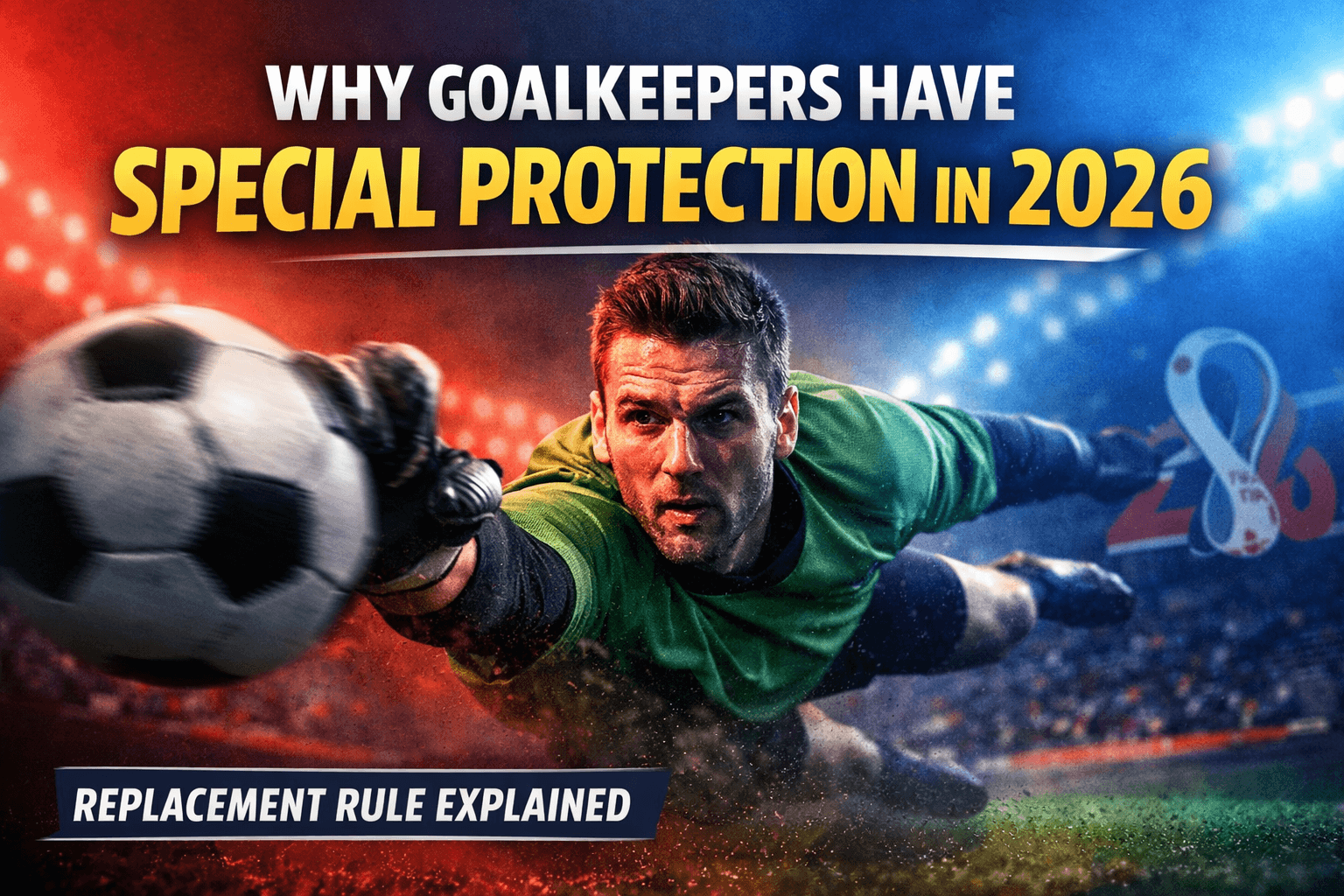
When FIFA confirmed that the 2026 FIFA World Cup would expand to 48 teams, the headlines wrote themselves. A new format. More matches. A broader global footprint. For months, the debate revolved around scheduling, player workload and competitive balance.
Yet tucked away in the tournament regulations is a clause that may influence results just as profoundly as the expanded group stage: goalkeepers and goalkeepers alone are afforded a level of protection no outfield player enjoys.
Once the tournament kicks off in 2026 (teams’ first match to be more precise), defenders, midfielders and forwards are effectively frozen into their squads. Barring truly exceptional administrative circumstances, what you start with is what you finish with. Goalkeepers operate under a different provision altogether. According to the official competition regulations, any goalkeeper who suffers a serious injury or illness during the tournament may be replaced at any stage.
This is not a loophole. It is a deliberate safeguard.
Those who have followed international tournaments closely understand why. The goalkeeper’s position is unlike any other on the pitch. It demands specialist training, a distinct psychological profile and tactical familiarity with the defensive unit that cannot be improvised overnight. An outfield player can often be repositioned in an emergency; a midfielder may fill in at full-back, a forward can drop deeper. But there is no credible substitute for a trained goalkeeper at the highest level.
Modern international football has only sharpened that reality. Keepers today are not merely shot-stoppers. They initiate build-up play, manage defensive lines, command aerial zones and function as the team’s first point of distribution. Losing one mid-tournament particularly to injury can derail not just a match plan, but an entire campaign.
FIFA’s provision recognises that fragility. It ensures that teams are not competitively crippled by circumstances unique to the position. The replacement, however, is tightly regulated: it must be medically justified, formally approved, and applies strictly to the goalkeeper role. It is not an open door to tactical reshuffling.
In a 48-team World Cup, where the margins will be thinner and the schedule denser, this seemingly technical rule could carry real strategic weight. Coaches will travel with three goalkeepers, but the knowledge that an emergency replacement remains possible changes risk calculations particularly deep into the knockout stages.
In tournaments of this magnitude, it is often the small-print regulations, not the grand announcements, that shape defining moments. In 2026, the special protection granted to goalkeepers may prove to be one such detail — quiet on paper, decisive on the pitch.
📋 Understanding The Provisional And Final Squad Lists
Before the World Cup begins, each nation must submit two separate player lists to FIFA: a provisional list and a final list.
The provisional list contains between 35 and 55 players, including at least four goalkeepers. This larger pool acts as the federation’s reserve database for potential call-ups and medical replacements.
From that provisional group, each team then submits its final squad of 23 to 26 players, including at least three goalkeepers. Once this final list is confirmed and the tournament begins, the squad is effectively locked.
Outfield players can only be replaced up to 24 hours before the team’s first match, and only in cases of serious injury or illness — subject to FIFA medical approval.
After that deadline passes, no outfield changes are permitted. This is what makes the goalkeeper exception so significant.
🧤 Goalkeepers Can Be Replaced At Any Stage Of The Tournament
As stated earlier, each team in the 2026 FIFA World Cup is required to submit their final squad of 23–26 players. Importantly, at least three of the declared players must be goalkeepers, a requirement that shows the high regard for the position at the international level.
As to the field players, the room for changing is very limited and strictly regulated. A substitute is only allowed up to 24 hours before a teams first match, and only in the case of a serious injury or illness. When the tournament starts, the window is nearly closed. Except for cases of extraordinary administrative rulings, the defenders, midfielders, and strikers who start the World Cup are the only ones available till the end.
Nevertheless, goalkeepers are a special case in terms of regulations.
If a goalkeeper gets severely injured or ill during any phase of the World Cup (group stage or knockout rounds), the team can still ask for a replacement. The application must be medically and procedurally verified; however, the option remains available until the very end of the competition.
In reality, this policy implies that the goalkeeper is the only field position given the liberty of change during the tournament. It is a small nuance in the regulations; however, it recognises that this role is subjected to unique demands and vulnerabilities. And certainly, this could be a very instrumental factor in a five-and-a-half-week tournament where the margins are very small.
⚖️ Why FIFA Gives Goalkeepers Special Status
FIFA did not carve out an exception for goalkeepers on a whim. The reasoning is rooted in football logic and tournament realities.
1. It is the most specialised position on the pitch
There is no comparable role in the sport. A winger can be asked to track back and operate as a full-back in an emergency. A defensive midfielder can slot into central defence if required. Managers routinely shuffle outfield combinations when injuries strike.
That flexibility ends with the goalkeeper.
The technical demands — positioning, reflex work, aerial command, distribution under pressure — are developed over years of position-specific training. At international level, where the margins are microscopic, improvisation is not a viable strategy. You cannot simply hand gloves to an outfield player and expect structural stability.
FIFA’s allowance reflects that reality.
2. The 48-team format stretches the physical limits
The 2026 FIFA World Cup will be the largest in history. A total of 104 matches will be played across three host nations, with travel spanning vast distances. Teams reaching the final could play as many as eight matches over five-and-a-half-weeks.
Add to that varying climates, recovery demands and the modern expectation that goalkeepers act as auxiliary playmakers, and the physical strain becomes evident. Repetitive diving, aerial collisions and high-intensity build-up involvement increase the risk of knocks turning into tournament-ending injuries.
In such a marathon, attrition is inevitable. The regulation is, in many ways, insurance against that grind.
3. Protecting competitive balance
At its core, the World Cup is about sporting fairness. Without a mid-tournament replacement provision, a side that loses two or three goalkeepers to injury could find itself entering a knockout fixture with an outfield player in goal — a scenario that would undermine competitive integrity at the highest stage of the game.
By permitting goalkeeper replacements under strict medical oversight, FIFA ensures that results are determined by footballing quality rather than administrative rigidity or sheer misfortune.
It is a narrow exception, but an essential one designed less to offer advantage and more to prevent chaos in a tournament where the stakes could not be higher.
📋 How The Goalkeeper Replacement Process Works
The replacement system is tightly controlled and cannot be used as a tactical loophole.
If a goalkeeper is injured or ill:
• The federation must nominate a replacement from its provisional list.
• A detailed medical assessment must be submitted.
• FIFA’s Medical Committee must confirm the severity of the injury.
• The injured goalkeeper must return their accreditation.
• The replacement goalkeeper receives the next available squad number.
Only after FIFA approval can the change be finalized. This ensures the rule is applied strictly for medical reasons.
🏆 Why This Rule Matters More Than It Appears
Modern World Cups are rarely settled by sweeping dominance. More often than not, they turn on moments — a deflection, a lapse in concentration, or the unforgiving theatre of a penalty shoot-out. In that arena, the goalkeeper is no longer a peripheral figure; he is central to the script.
Today’s elite keepers are expected to do far more than repel shots. They initiate attacks, split defensive lines with their passing, command their penalty areas and organise the back four with constant communication. In many systems, the goalkeeper is effectively the first playmaker.
Remove that pillar unexpectedly, and the structural impact can be immediate. Defensive coordination suffers. Build-up patterns break down. Confidence wavers. Relying on an untested or makeshift replacement at that level is not merely inconvenient — it can distort the competitive balance of a match.
By permitting goalkeeper replacements throughout the tournament, FIFA has sought to guard against precisely that scenario at the 2026 FIFA World Cup. The intention is not to hand teams an advantage, but to ensure that contests are decided by preparation and performance, not by avoidable regulatory rigidity.
At a World Cup, where margins are measured in millimetres and nerves, that distinction matters.
🚫 Can Teams Exploit The Rule?
In theory, any regulatory exception invites suspicion. In practice, this one leaves little room for manoeuvre.
The process is neither casual nor discretionary. A team seeking to replace a goalkeeper must submit detailed medical documentation, obtain formal approval from FIFA, and complete the necessary administrative procedures including surrendering the outgoing player’s accreditation. Once replaced, that goalkeeper cannot return to the tournament.
Those layers are not ornamental. They are deliberate safeguards.
The provision exists to address genuine medical emergencies, not to facilitate tactical reshuffles or strategic fine-tuning midway through a campaign. Attempting to manipulate it would require falsifying medical evidence and risking severe disciplinary consequences, a gamble no federation at a World Cup is likely to entertain.
In short, the rule is narrow by design. It protects teams from unforeseen misfortune without opening the door to competitive gamesmanship.
🌍 A Tournament Built Around Structure And Stability
The 2026 World Cup will usher in the most expansive overhaul the tournament has seen in decades — a 48-team field, additional knockout fixtures and a calendar that stretches the physical and logistical limits of the modern game. Within that broader redesign, one relatively understated regulation speaks volumes about how the sport is evolving.
The goalkeeper replacement provision is not a cosmetic tweak. It is part of FIFA’s attempt to balance expansion with competitive integrity at the 2026 FIFA World Cup.
From the moment the competition begins, outfield players are effectively locked into place. Coaches must navigate injuries, suspensions and dips in form with the resources already registered. Goalkeepers stand apart — not by privilege, but by necessity. Their role demands a separate layer of contingency planning, one that acknowledges how exposed a team becomes if that position is suddenly compromised.
In a month-long tournament where margins are microscopic and legacies hinge on moments, that distinction is not trivial. World Cups have been defined by a single save, a fingertip deflection, a penalty stopped under unbearable pressure.
In 2026, the safeguard afforded to goalkeepers may appear technical on paper. On the pitch, it could prove decisive.
