2026 FIFA World Cup: Early Trends Emerging After Every Team Played Once

Cape Verde goalkeeper celebrates as Spain players look frustrated after their World Cup 2026 draw
Cape Verde’s defiant draw against Spain became one of the early stories of World Cup 2026, capturing the tournament’s emerging theme of underdogs refusing to be overwhelmed.

One match is not enough to decide a World Cup. It is barely enough to decide whether a team has solved its nerves, read the room, or adjusted to the weather, the pitch, the crowd and the size of the occasion.

But one match is enough to leave fingerprints.

After every team had played once at the 2026 FIFA World Cup, the tournament already had shape. Not a final shape, of course. Group-stage football is slippery. A team that looks broken on opening night can win twice and suddenly look reborn. A side praised for its discipline can be pulled apart four days later. Still, the first 24 games have given us something more useful than predictions: they have given us clues.

Germany hit seven. Spain could not hit one. Messi produced a hat-trick that felt like a private conversation with football history. Cape Verde held firm against a European champion. Portugal had Cristiano Ronaldo on the pitch and still looked short of ideas. The United States and Mexico gave the hosts a strong start, while Canada had to fight for its first World Cup point.

The expanded 48-team tournament has not produced one simple story. It has produced several at once: more goals, more firsts, more brave defending, more late swings, and more evidence that reputation is not much use once the whistle goes.

Here are the early trends that matter after the opening round of group matches.

The smaller nations are not here as decoration

The first round’s most important message may be this: the gap between football’s old powers and its supposed outsiders is not as comfortable as some expected.

Cape Verde’s 0–0 draw with Spain was the headline result of that theme. Spain had the ball, the territory and the volume of chances. Cape Verde had the nerve, the structure and Vozinha, their 40-year-old goalkeeper, who turned a World Cup debut into a national memory. The numbers told one story — Spain’s dominance — but the result told another. Cape Verde did not play like a team waiting to be overwhelmed. They defended the box, stayed calm, avoided panic fouls and made Spain look strangely blunt.

DR Congo did something similar against Portugal, though in a different register. Portugal scored early through João Neves, then drifted into a performance that became slower and narrower as the night went on. DR Congo grew into the match, equalised through Yoane Wissa and nearly stole it when Cédric Bakambu hit the post. That was not luck dressed up as romance. It was a team refusing to disappear after conceding early.

Morocco’s 1–1 draw with Brazil was less of a shock if you have been paying attention to African football, but it still mattered. Morocco looked organized, brave on the ball and dangerous enough to make Brazil uncomfortable. Brazil needed Vinícius Júnior to rescue a draw after Ismael Saibari had exposed familiar weaknesses.

There were more examples. Egypt took a point from Belgium. Saudi Arabia drew with Uruguay. New Zealand twice led Iran before finishing 2–2. Qatar, beaten three times at home in 2022, claimed their first World Cup point by finding a stoppage-time equaliser against Switzerland.

The trend may not survive every second match. Depth still matters. Recovery still matters. But the opening round has already challenged one easy assumption about expansion: more teams has not simply meant more soft games. It has meant more styles, more tension and more opponents capable of making favourites uncomfortable.

Possession without incision is becoming a trap

Spain’s draw with Cape Verde will be studied because it was so clean as a warning. You can dominate the ball, move it from side to side, build patiently and still spend 90 minutes slowly walking into a wall.

Spain had the numbers that usually make a post-match report look one-sided. They had possession. They had attempts. They had enough territory to make the game feel like it was being played almost exclusively in Cape Verde’s half. Yet the clearest story was not Spain’s control. It was Cape Verde’s control of the danger zones.

That distinction matters. In tournament football, sterile possession is not just unproductive; it can become emotionally draining. Every blocked shot adds weight. Every overhit cross makes the next one more anxious. The underdog starts to believe. The favourite starts to force.

Portugal felt the same problem against DR Congo. After scoring in the sixth minute, they did not build a performance around that advantage. They became predictable. Ronaldo’s presence gave the match its global frame, but Portugal’s bigger problem was structural: not enough speed in the final third, not enough movement around the box, not enough threat after the first blow.

Brazil, too, had stretches against Morocco where possession did not automatically mean control. Morocco’s transitions and midfield pressure made Brazil look like a team still searching for its rhythm under Carlo Ancelotti. Vinícius Júnior’s equaliser was brilliant, but brilliance is not the same as coherence.

The teams that should be concerned are obvious: Spain, Portugal, Brazil and Belgium all have enough individual quality to escape these early issues. But the first round showed that ball dominance alone is not going to bully opponents at this World Cup. The best low-block teams are more athletic, more organised and more comfortable suffering than ever.

When the favourites clicked, they were ruthless

For all the talk of underdog resistance, the opening round was not short of punishment. When the stronger teams found rhythm, games disappeared quickly.

Germany’s 7–1 win over Curaçao was the clearest example. Felix Nmecha scored early, and Germany never allowed the match to settle into a sentimental debut story. Kai Havertz scored twice, Jamal Musiala was on the scoresheet, and the Germans looked like a team determined to make an opening statement rather than merely collect three points.

Sweden’s 5–1 win over Tunisia carried a similar feeling. Yasin Ayari scored twice, Alexander Isak and Viktor Gyökeres also scored, and Sweden produced their first five-goal World Cup match since 1938. That matters not just because of the scoreline, but because Sweden arrived with questions after a difficult qualification route. One game later, the mood around them changed.

The United States were another side who used the opener to shift perception. The 4–1 win over Paraguay had an early own goal, a Folarin Balogun brace and a stoppage-time finish from Giovanni Reyna. More important, it had pace and aggression. This did not look like a host trying to survive the pressure. It looked like a team comfortable making the occasion uncomfortable for someone else.

France beat Senegal 3–1, with Kylian Mbappé scoring twice and Michael Olise giving the attack a different kind of balance. Norway, back on the World Cup stage after a long absence, beat Iraq 4–1 with Erling Haaland scoring twice on his tournament debut. Argentina beat Algeria 3–0 because Lionel Messi decided the opening night of his sixth World Cup was a good time to score three.

This is the other side of the expanded format. Yes, more teams are capable of resisting. But if the elite teams score first and keep accelerating, the scoreboard can still get ugly. The sides that benefit are those with multiple finishers rather than one obvious route to goal. Germany, France, Argentina, Sweden, Norway and the United States all showed that once the first line breaks, they have enough runners to make the second line panic.

Late goals and second-half swings are already shaping the groups

The first round was full of matches that changed late or lived on the edge deep into the second half.

Qatar’s point against Switzerland came through a stoppage-time equaliser, after Switzerland had dominated chances but failed to kill the game. Ghana beat Panama 1–0 through Caleb Yirenkyi in the fifth minute of added time, a classic tournament gut-punch: one counter, one finish, three points. Colombia were pulled back by Uzbekistan after the break, then immediately retook control through Luis Díaz before Jaminton Campaz added a stoppage-time third.

Japan’s 2–2 draw with the Netherlands was one of the round’s best examples of emotional momentum. The game burst open after halftime, with three goals arriving in a frantic 13-minute spell before Japan levelled late through a header that went in off Daichi Kamada. Japan did not treat the draw as a miracle. Their coach and players sounded like a team that believed it could have taken more.

England’s 4–2 win over Croatia was another reminder that no lead feels entirely safe. Croatia twice pulled themselves back into the game before England eventually found separation through Harry Kane, Jude Bellingham and Marcus Rashford.

This is likely to continue. The 2026 format changes the psychology of the group stage. With third-place routes available, teams trailing by one goal have strong incentive to chase, but teams protecting a draw may also value that point more than usual. Add heat, travel and squad rotation, and the final 20 minutes could become the tournament’s most revealing period.

Teams with strong benches and calm game management will benefit. Teams that dominate without scoring a second — Switzerland against Qatar, Portugal against DR Congo, Spain against Cape Verde — have already seen how quickly control can turn into regret.

Goalkeepers are having a louder tournament than expected

Modern football analysis often starts with pressing structures, rest defence and build-up patterns. Fine. But sometimes a World Cup trend is simpler: goalkeepers are already stealing scenes.

Vozinha’s performance against Spain was the obvious masterpiece. At 40, on Cape Verde’s World Cup debut, he became the face of one of the tournament’s first great stories. But he was not alone.

Australia’s Patrick Beach made the saves that kept Türkiye out in Vancouver, giving the Socceroos the platform for a 2–0 win built on defensive discipline and counterattacking timing. Saudi Arabia’s draw with Uruguay also had a strong goalkeeping element, with Mohammed Al Owais helping Saudi Arabia withstand long spells of Uruguayan pressure. Ghana needed Lawrence Ati Zigi in the first half against Panama before his injury forced a change.

There is a reason this keeps happening. The first game of a World Cup can make attacking players tight. Chances are snatched at. Final passes are forced. That gives goalkeepers the chance to become the emotional centre of the match.

The teams that benefit are not only the defensive underdogs. A reliable goalkeeper lets a team survive its worst spell and still keep the match alive. Cape Verde, Australia, Saudi Arabia and Ghana all left their openers with something because they had someone capable of turning pressure into frustration.

Star power still matters, but it is no longer enough by itself

Argentina number 10 scores during 2026 World Cup match against Algeria
Argentina’s No. 10 delivers another World Cup moment as the scoreboard tells the story against Algeria in 2026.

Messi and Mbappé made the strongest case for individual greatness. Messi’s hat-trick against Algeria did not just win Argentina’s opener; it put him level with Miroslav Klose’s men’s World Cup goals record. Mbappé’s two goals against Senegal pushed him further into France’s record books and reminded everyone that France’s ceiling remains terrifying when he is direct and decisive.

Haaland’s World Cup debut also delivered exactly what Norway had waited years to see: two goals, a heavy win, and the sense that one elite striker can change a country’s expectations almost overnight. Kane scored twice for England and produced the sort of captain’s performance that gives a contender room to breathe.

But the first round also showed the limits of celebrity. Ronaldo’s Portugal had the brand-name storyline and still stumbled against DR Congo. Neymar’s absence left Brazil searching for rhythm against Morocco. Spain had Lamine Yamal and Nico Williams start on the bench against Cape Verde and never found the attacking sharpness expected of them. Belgium needed Romelu Lukaku’s introduction to rescue a point against Egypt.

The trend is not that stars are fading. It is that stars now need a functioning platform. Messi had Argentina’s structure around him. Mbappé had Olise helping France connect the attack. Haaland had Norway willing to play quickly and directly into his strengths. Ronaldo, by contrast, often looked isolated inside a Portugal attack that lacked tempo.

The lesson is old but still true: in a World Cup, talent wins moments. Systems win pressure.

The hosts have avoided the nightmare start

The three host nations all had different opening experiences, but none collapsed under the occasion.

Mexico began the tournament with a 2–0 win over South Africa at the Azteca. It was not a perfect performance. The match was scrappy and shaped by red cards. But for Mexico, after the pain of 2022, the first priority was never elegance. It was release. Julián Quiñones and Raúl Jiménez gave the home crowd what it needed: a win, a celebration and permission to believe again.

The United States produced the most impressive host performance with the 4–1 win over Paraguay. Balogun’s finishing, Pulisic’s influence before his calf issue, and Reyna’s late goal gave the Americans a result that immediately changed the tone of Group D. Their next match against Australia now feels like a meeting of two teams who both think they can win the group.

Canada’s 1–1 draw with Bosnia and Herzegovina was less explosive, but still significant. Cyle Larin’s equaliser gave Canada their first World Cup point, and in a group where all four teams drew their openers, it may matter more than it felt on the night.

The host trend could go either way from here. Home pressure can lift a team, but it can also tighten legs once expectation grows. Mexico and the United States have already banked wins; Canada still need one. The first round, though, avoided the worst-case scenario for North America’s tournament: none of the hosts look like passengers.

Discipline and tournament management are already separating teams

The opening match between Mexico and South Africa brought three red cards, and South Africa are already paying the price. Themba Zwane’s suspension, following his red card against Mexico, leaves Hugo Broos with a problem before the second game. South Africa were beaten, reduced, and left with damage that extends beyond the 90 minutes.

Paraguay’s five yellow cards against the United States told a different version of the same story. It was not just that Paraguay lost 4–1; it was that they looked emotionally stretched by the speed and intensity of the match. In a three-game group phase, that matters. You do not get long to reset, and card pressure can quickly influence selection.

This is a tournament where discipline will not only mean avoiding red cards. It will mean managing heat, hydration breaks, long travel, late-game fatigue and the emotional spikes that come with playing in front of huge crowds. Mexico coach Javier Aguirre even spoke about hydration breaks as tactical windows, which is exactly how managers will use them: not just for recovery, but for instructions.

The teams that can stay calm when games get messy will gain an edge. Ghana did that against Panama. Cape Verde did it against Spain. DR Congo did it after conceding early to Portugal. South Africa and Paraguay, in very different ways, showed how quickly a first match can leave a team with problems that bleed into the second.

The tournament’s emotional centre is shifting quickly

Every World Cup finds its emotional stories. After one round, this one already has several.

Cape Verde’s point against Spain is bigger than the table. It is a country’s first World Cup match becoming a night that people will remember forever. Curaçao lost 7–1 to Germany, but Livano Comenencia’s goal still mattered because it was their first on this stage. DR Congo’s draw with Portugal brought their first World Cup point. Qatar’s late equaliser against Switzerland brought their first World Cup point after the disappointment of 2022.

Then there are the giants writing personal chapters. Messi’s hat-trick was not just another elite performance; it was a record-equalling moment from a player nearing 39. Ronaldo’s draw against DR Congo, on the other hand, felt heavy with time. Kane moved level with Gary Lineker on England’s World Cup scoring list. Mbappé kept building his own argument as the defining tournament player of his generation.

This emotional range is part of why the opening round worked. The 2026 World Cup has already offered routs, shocks, returns, debuts, records and relief. The football has not always been smooth. Some matches have been scrappy. Some favourites have been cautious. But the tournament already feels alive.

The strongest early trend is not one tactic or one region. It is that the old hierarchy is being tested from several angles at once. Some favourites have responded by scoring freely. Others have been dragged into discomfort. The next round will tell us which of these first impressions were real and which were only opening-night noise.

For now, one match has been enough to tell us this: nobody has earned the right to coast.

The World Cup Is Only Just Starting — But These 7 Early Trends Already Matter

Football players in action inside a packed World Cup stadium during the opening phase of the 2026 FIFA World Cup
The opening matches of the FIFA World Cup 2026 have already revealed early trends in tactics, momentum, discipline and emerging stars. Illustration: worldcuplocaltime.com

This analysis is based on the FIFA World Cup 2026 matches completed as of June 13, 2026, including Mexico vs South Africa, South Korea vs Czechia, Canada vs Bosnia and Herzegovina, and USA vs Paraguay.

The FIFA World Cup 2026 is still in its first act, and that matters. Four completed matches are not enough to define a tournament, expose every contender, or declare which teams are built for the long road. World Cups are famous for misleading first impressions: a slow starter can become a finalist, a brilliant opening performance can fade quickly, and one emotional night can distort the wider picture.

But opening matches do leave fingerprints.

They show which teams are carrying pressure well, which tactical ideas are already working, which weaknesses opponents may target, and which players look ready for the stage rather than overwhelmed by it. The early World Cup group stage is not just about points; it is about tone. The first 90 minutes often shape the next five days of conversation around a team. Confidence grows faster. Doubt spreads even faster.

After Mexico’s win over South Africa, South Korea’s comeback against Czechia, Canada’s draw with Bosnia and Herzegovina, and the United States’ emphatic victory over Paraguay, several World Cup trends are already worth watching. Some may disappear once the bigger nations enter the tournament. Others may become central to how the 2026 World Cup is remembered.

That is the value of reading the first few games together: not to declare winners, but to spot the first clues — the habits, pressures and turning points that may shape the weeks ahead.

1. The Host Nations Are Not Just Hosting — They Are Feeding Off the Occasion

The first major trend of the FIFA World Cup 2026 is impossible to separate from the geography of the tournament. The host nations are not background characters. They are already central to the emotional rhythm of the competition.

Mexico set the tone in the opening match at the Azteca, beating South Africa 2-0 in a game that mixed celebration, nerves, dominance and chaos. Julián Quiñones scored early, Raúl Jiménez added the second, and the crowd helped turn the match into something larger than a routine Group A win. Mexico were not flawless — South Africa’s disciplinary collapse made the second half easier — but the bigger point was the way Mexico carried the burden of opening the tournament. For a host nation, the first match is never just another fixture. It is a national release valve.

Canada’s 1-1 draw with Bosnia and Herzegovina told a different version of the same story. Canada did not start well enough, conceded from a set piece, and missed chances through Jonathan David and others. Yet the atmosphere in Toronto mattered. Cyle Larin’s equaliser, almost immediately after coming on, felt less like a statistical event and more like a moment the stadium had dragged out of the match. Canada did not win, but they avoided the emotional damage of losing their first World Cup match on home soil.

Then came the United States, who delivered the most convincing host performance so far with a 4-1 win over Paraguay. Folarin Balogun’s first-half brace, Christian Pulisic’s involvement, and Gio Reyna’s late goal turned the U.S. opener in the Los Angeles area into a statement rather than a survival act.

The trend matters because host energy can be a genuine competitive force. It does not guarantee tactical control or protect teams from injury, fatigue or poor decisions. But in a tournament spread across three countries, the home advantage may arrive in waves — Mexico City, Toronto, Los Angeles, Vancouver, Seattle and beyond. The question now is whether the hosts can keep turning emotion into performance once the novelty of the opening night fades.

2. Teams Are Being Punished Before They Have Time to Settle

One clear lesson from the FIFA World Cup opening matches is that teams cannot afford a slow emotional entry into games. The tournament has barely begun, yet several matches have already turned on early mistakes, early pressure, or a failure to manage the first phase.

Mexico’s opener against South Africa began with exactly the kind of moment coaches fear in a World Cup. South Africa tried to play under pressure, lost the ball in a dangerous area, and Quiñones punished them in the ninth minute. It was not an elaborate attacking move built through long possession. It was a World Cup mistake: one loose moment, one sharp reaction, one stadium suddenly exploding.

The United States did something similar to Paraguay. Their seventh-minute opener came through pressure, movement and a forced own goal. From there, Paraguay were chasing the match emotionally as much as tactically. Once the U.S. added two more before half-time, the game had already moved into a different category. Paraguay were not simply behind; they were being dragged into a match rhythm they did not want.

Canada also learned the cost of early vulnerability. Bosnia and Herzegovina’s first-half goal came from a corner routine, but the bigger issue was Canada’s inability to convert their early energy into control. When a host team starts with adrenaline but lacks precision, the opponent only needs one structured moment to change the mood.

South Korea’s 2-1 win over Czechia offered the counterpoint. They fell behind in the second half, but they did not panic. Within eight minutes, Hwang In-beom had equalised, and Oh Hyeon-gyu later completed the comeback. That response may prove more valuable than the result itself because it showed emotional control after conceding.

This trend may continue because opening matches are uniquely volatile. Teams are adjusting to travel, stadiums, nerves, heat, noise and unfamiliar opponents. The sides that settle quickest — not necessarily the most talented sides — are gaining immediate control of the narrative.

3. Set Pieces and Aerial Moments Are Already Acting Like Tactical Equalisers

In tournament football, set pieces are often described as marginal details. That is misleading. In the early 2026 World Cup, they already look like a central theme.

Czechia’s goal against South Korea came from a direct, physical route: Vladimir Coufal’s long throw, Ladislav Krejci’s movement, and a powerful header. It was a classic example of how a team can struggle to create consistently in open play but still manufacture danger through height, timing and delivery. South Korea had more possession and more imagination, yet one aerial sequence forced them into a comeback.

Bosnia and Herzegovina took the same route against Canada. Jovo Lukic’s header came after a corner sequence involving Sead Kolasinac’s flick-on, and it silenced a crowd that had arrived expecting a national celebration. Bosnia did not need to dominate the game to score. They needed one well-rehearsed delivery, one physical duel, and one attacker arriving in the right zone.

Even Mexico’s second goal against South Africa reinforced the value of aerial execution. Raúl Jiménez’s far-post header was not just a sentimental moment for a veteran striker; it was the goal that settled Mexican nerves. In a match where South Africa were already reduced, Mexico still needed a direct penalty-box action to turn control into comfort.

This is why fans should pay attention. The expanded 2026 World Cup brings together teams with very different tactical profiles. Some will press. Some will sit deep. Some will build through midfield. Others will rely heavily on dead balls, long throws and second-phase deliveries. In that environment, set pieces become a leveller.

The broader implication is clear: teams with technical superiority still need to defend ugly moments. A World Cup team can control possession for long spells and still be exposed by one corner, one long throw, or one mismatch at the back post. Early evidence suggests that defensive organisation on restarts may be just as important as attacking fluency in the group stage.

4. The Bench Is Already Changing Matches, Not Just Protecting Legs

One of the most interesting early World Cup trends is the impact of substitutes. Managers are not simply using the bench to close games or rest tired starters. They are using it to alter the emotional and tactical direction of matches.

Canada’s draw with Bosnia and Herzegovina is the clearest example. Cyle Larin began on the bench, entered in the second half, and scored almost immediately. The goal did more than rescue a point. It changed the meaning of Canada’s opening match. Without it, the story would have been about missed chances, pressure and a painful defeat on home soil. With it, the story became resilience, crowd energy and a first World Cup point.

South Korea also benefited from bench impact. Oh Hyeon-gyu’s 80th-minute winner against Czechia arrived after South Korea had already shown technical control but needed a decisive penalty-box presence. His goal underlined the value of having a forward who can enter a match with clarity: attack the right space, finish the chance, and turn superiority into a result.

The United States had already done the major damage before Gio Reyna came on, but his stoppage-time goal still mattered. In group-stage football, late goals can shape goal difference, confidence and selection conversations. Reyna’s finish added a final layer to the U.S. performance and reminded opponents that the American threat is not limited to the starting XI.

This trend is likely to become more important as the tournament grows. The 2026 World Cup is longer, larger and more physically demanding than any previous edition. Coaches will have to manage minutes, injuries, travel and emotional peaks. That means the best World Cup teams may not simply be the ones with the strongest first eleven. They may be the ones with the clearest second-half plans.

Early on, the substitutes are already writing headlines. That is rarely a small thing in tournament football.

5. Discipline May Be the First Tactical Separator of the Tournament

It would be too simplistic to say the 2026 World Cup has a discipline problem after only a few matches. But it is fair to say discipline has already shaped the tournament.

Mexico’s 2-0 win over South Africa was the obvious warning. Three red cards in the opening match instantly turned discipline into a major talking point. South Africa finished with nine men after Sphephelo Sithole and Themba Zwane were sent off, while Mexico’s César Montes was also dismissed late. The match had already tilted toward Mexico, but the red cards removed any realistic path back for South Africa and introduced an early question for every coach in the tournament: how much emotional control does your team have when the game begins to run away?

This matters because World Cup matches are rarely played in neutral emotional conditions. Players are carrying national expectation, personal ambition, refereeing uncertainty, crowd noise and the knowledge that one mistake can define a tournament. Once a team falls behind, physical frustration can become tactical damage. South Africa’s opener was a brutal case study in how quickly a difficult match can become an impossible one.

There is also a strategic layer. With VAR active and referees under global scrutiny, teams must understand that actions which might be debated in domestic football can become decisive after review. The threshold for risk changes when every incident is slowed down, replayed and judged in isolation.

The United States-Paraguay match did not descend into the same card chaos, but it did show how quickly physicality rises once a team is chasing. Paraguay had to respond after conceding early, and the match became more confrontational as the U.S. built control.

The trend may not continue at the same dramatic level. Three red cards in one match is unusual. But the underlying lesson will remain throughout the World Cup group stage: discipline is not just a moral quality. It is a tactical tool. Teams that keep eleven players on the pitch, avoid needless suspensions, and manage emotional pressure will give themselves a far better chance of surviving the group.

6. This World Cup Feels Like a Stadium-by-Stadium Event

The FIFA World Cup 2026 is being played across three countries, and the opening matches have already made that scale feel real. This does not feel like a tournament with one central mood. It feels like a moving festival, changing personality from city to city.

Mexico City delivered the old World Cup theatre: history, noise, national pressure, and a stadium that seemed to understand the weight of the moment. Mexico’s win over South Africa was not just about the scoreline. It was about the Azteca becoming the first emotional landmark of the tournament.

Guadalajara gave South Korea and Czechia a different kind of stage. The match itself was a clash of styles — Czech directness against Korean movement and possession — but the atmosphere had its own rhythm. The sight of a Mexican wave during a non-Mexico match was a reminder that neutral venues can still develop a strong local identity.

Toronto gave the tournament its Canadian arrival. Canada’s first World Cup match on home soil came with red shirts, national music, celebrity presence and a crowd that stayed emotionally invested even when Bosnia led. Larin’s equaliser felt powerful partly because it was scored in front of people who were desperate not just for a result, but for a memory.

Los Angeles, meanwhile, gave the U.S. opener a different texture: spectacle, celebrity, performance and a confident American sporting production. The United States then matched that off-field energy with the most complete performance of the opening matches.

This wider trend matters because the 2026 World Cup will not be experienced only through goals, points and group tables. It will also be shaped by travel, culture, identity, crowd theatre and national mood. Host cities are going to become part of the tournament’s narrative. A match in Mexico City may carry a very different energy from one in Seattle, Vancouver, New Jersey or Miami.

For World Cup teams, that matters too. Atmosphere changes pressure. Pressure changes decisions. Decisions change matches.

7. The Early Stars Are Not Always the Biggest Names

The opening matches have already challenged the idea that the most famous World Cup players will automatically own the biggest moments.

Christian Pulisic was influential for the United States, especially in the first half against Paraguay, but the headline belonged to Folarin Balogun. His two goals gave the U.S. a cutting edge that has not always been guaranteed in previous tournament cycles. That matters because the U.S. do not need Pulisic to carry every attacking moment if Balogun, Gio Reyna, Malik Tillman and others are contributing decisive actions.

South Korea offered another version of the same pattern. Son Heung-min remains the face of the team and still shaped the attention of Czechia’s defenders. But the decisive attacking quality came through Hwang In-beom, Kang-in Lee and substitute Oh Hyeon-gyu. South Korea’s win looked healthier because it was not dependent on one superstar producing one perfect moment.

Canada’s rescue act also came from a player who began the game outside the starting XI. Cyle Larin is not an unknown figure, but his role against Bosnia showed that World Cup players do not have to start to become central to the story. One substitution, one touch, one finish — and Canada’s entire opening narrative changed.

Mexico’s second goal came from Raúl Jiménez, a familiar name but a player whose emotional journey gave the moment extra weight. Quiñones scored the first goal of the tournament, but Jiménez’s header felt like the kind of veteran contribution that can steady a squad.

This trend could become increasingly important as the 2026 World Cup progresses. The tournament is too long and too demanding for star dependency alone. Injuries, suspensions, rotation and fatigue will force teams to find different match-winners. The sides that look most dangerous may not be the ones with one global icon, but the ones with several players capable of taking ownership of a moment.

That is an early warning to every opponent: stop the headline name, and the game may still find another hero.

Conclusion

It is too early to make sweeping claims about the 2026 World Cup, but it is not too early to notice patterns. The opening matches have already shown the power of host-nation emotion, the danger of slow starts, the continuing value of set pieces, the importance of substitutes, and the cost of poor discipline.

They have also reminded us that World Cups are shaped by more than tactics. Crowds matter. Cities matter. Timing matters. A goal in the seventh minute can change a match; a substitute in the 76th minute can change a country’s mood; a red card can turn a difficult afternoon into a tournament problem.

The most important takeaway is that the FIFA World Cup 2026 already feels alive. Not settled, not fully formed, but alive with storylines that could grow quickly over the coming days.

As more World Cup teams enter the competition, some of these early trends will be tested. Others will be replaced. But after the opening matches, one thing is clear: this tournament is already giving us more than results. It is giving us clues.

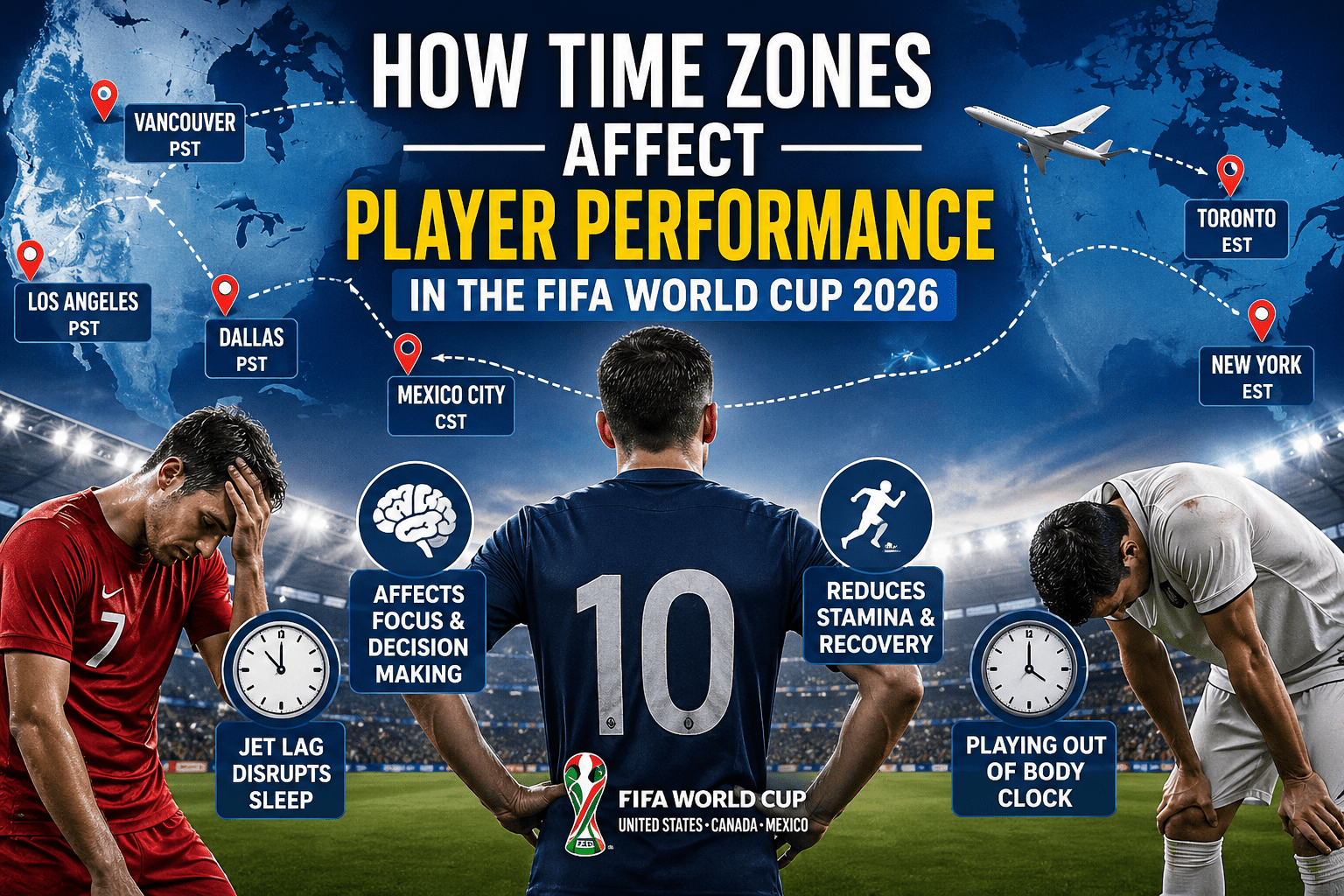
How Time Zones Affect Player Performance in the FIFA World Cup 2026

The 2026 FIFA World Cup is being sold as the biggest tournament in football history — more teams, more cities, more matches. But beneath the scale and spectacle lies a quieter storyline, one that won’t show up in highlight reels or post-match graphics: time itself.

For players, this World Cup won’t just be about opponents or tactics. It will be about clocks, recovery windows, and the invisible strain of crossing continents in the middle of a tournament. From the Pacific coast to the eastern edge of North America, the game will be played across shifting time zones that challenge not just the body, but the rhythm that drives it.

The question isn’t whether time zones matter. It’s how much they might shape what we see on the pitch.

🌍 A Tournament Spread Across Time

The geography of the 2026 World Cup changes the conversation entirely. Matches will be played across multiple time zones, stretching from cities like Los Angeles and Vancouver in the west to New York and Toronto in the east.

That span creates a gap of several hours between venues. On paper, it’s just a scheduling detail. In practice, it means a team can finish one match on the West Coast and find itself preparing for the next with its body still operating on a different clock.

In a tournament where recovery time is already limited, that mismatch becomes impossible to ignore.

✈️ The Reality of Jet Lag in Elite Football

Jet lag tends to get brushed off as a minor inconvenience, but at the elite level, it’s a genuine performance factor. It interferes with the body’s circadian rhythm—the internal clock that governs sleep, focus, and physical sharpness.

Top-level football is built on precision. Training loads, recovery routines, and even pre-match preparation are timed to ensure players peak at the right moment. When that timing slips, even slightly, the consequences aren’t subtle.

Sleep patterns break down, energy comes in waves rather than consistency, and the body struggles to sync itself quickly enough. The response is there, but it rarely arrives exactly when it’s needed.

🗺️ Distance Becomes a Competitive Factor

Travel has always been part of the World Cup, but never at this scale. In 2026, distances between host cities will regularly stretch into thousands of kilometres.

A team could move from the West Coast to the East between matches, or travel South into different climates and altitudes. These aren’t minor adjustments. They demand physical and mental recalibration in the middle of a tightly packed schedule.

The challenge isn’t just the journey itself; it’s what comes after. Matches don’t wait for players to fully adjust.

⚡ Margins Measured in Milliseconds

At the highest level, football is decided in moments that pass almost instantly. A goalkeeper reacts, a defender steps forward, a striker makes a run. These actions rely on timing that feels instinctive but is rooted in sharp neurological response.

Disrupt that timing, even slightly, and the game changes. Reaction speeds dip just enough to turn a save into a goal, or a clearance into a chance. These are not dramatic failures, they are fractions, but fractions are often decisive.

🏃 Fatigue That Builds, Not Breaks

What makes travel fatigue particularly dangerous is its subtlety. It rarely shows up as complete exhaustion. Instead, it accumulates — a slight drop in stamina here, a slower recovery there.

Over the course of a tournament, those small declines can add up. A team that looks sharp in its opening match may struggle to maintain the same intensity as the schedule tightens and the travel continues.

In that sense, endurance in 2026 may be less about fitness and more about how well teams manage the spaces between matches.

🧠 Decision-Making Under Pressure

Football intelligence — the ability to read the game, anticipate movement, and make the right choice under pressure is often what separates good teams from great ones.

But cognitive sharpness is closely tied to rest and rhythm. When players are not fully synchronized with their environment, decision-making becomes just a fraction slower, just a touch less precise.

Across 90 minutes, those marginal differences can shape entire matches.

😴 Playing Against the Body Clock

Kick-off times are fixed. The body’s internal clock is not.

A match that feels like mid-afternoon locally may register very differently for a player who has recently crossed time zones. In some cases, teams will effectively be playing at what their bodies perceive as early morning or late night.

The result isn’t always visible, but it lingers in performance, in the tempo of play, in the sharpness of movement, in the energy that defines the game.

📊 Lessons from the Past, Scaled Up

Previous World Cups have already shown what travel can do to a team, especially when the host country is spread out. You hear it in post-match interviews—players talking about long flights, broken routines, and the difficulty of finding any sense of normalcy from one game to the next.

What changes in 2026 isn’t the nature of the problem, but the extent of it. The tournament is bigger in every sense—more teams, more fixtures, more miles to cover. And when everything expands like that, the margin for error doesn’t. It shrinks.

🌎 An Uneven Playing Field?

Not all teams will experience these challenges equally. Some will be more familiar with the conditions, others better prepared for long-haul travel.

But familiarity alone doesn’t guarantee success. Adaptation, planning, and squad depth will all play a role in determining who handles the demands of the tournament most effectively.

If there is an advantage, it may belong not to the strongest team on paper, but to the one that manages the tournament best as a whole.

🔧 Managing the Invisible Challenge

Modern teams are not unprepared for these conditions. Sports science has evolved to address travel fatigue, with strategies designed to minimize disruption and accelerate recovery.

Still, no system can fully eliminate the effects of constant movement across time zones. At best, teams can manage the impact — not remove it.

That reality ensures time remains a factor, even if it operates in the background.

⏱️ What It Means for the Tournament

For fans, these dynamics add another layer to the tournament. Matches may unfold differently than expected. Favorites may look less dominant. Underdogs may find opportunities in moments where fatigue shifts the balance.

The 2026 World Cup won’t just test skill and tactics. It will test endurance, adaptability, and the ability to perform when the body is slightly out of sync.

🏁 The Game Beyond the Game

Time zones won’t be listed in match statistics. They won’t appear in post-match analysis or highlight packages. But they will be there, shaping performance in ways that are easy to miss and difficult to measure.

In a tournament defined by fine margins, those unseen influences can make all the difference. And in 2026, as the World Cup stretches across a continent, time itself may become one of the most important opponents any team faces.

The 495 Scenarios: How FIFA Pre-Plans the Round of 32 at World Cup 2026

At the 2026 FIFA World Cup, progressing from the group stage will not be limited to just first and second place. The two best teams from each group will qualify, but they will be accompanied by 8 out of the 12 third-place finishers from the groups, which will totally change the play of the qualification.

In order to avoid any luck factor in the knockout bracket, FIFA has identified 495 different qualification scenarios, each representing the possible pairings in the Round of 32 depending on the group results. The competition regulations provide for these routes even before the tournament starts, and they are automatically implemented once the final standings are known.

Below is an explanation of how these scenarios work, why FIFA uses them, and how they decide the path from the group stage to the knockout rounds.

🔢 Why Are There 495 Different Scenarios?

The number 495 is not just any random number; there is mathematics behind it.

At the 2026 World Cup:

• There are 12 groups (Group A to Group L)
• Each group produces one third-placed team
• Only eight of those 12 third-placed teams qualify for the knockout stage

There are 495 possible combinations to select 8 teams out of 12. Each combination represents a unique tournament pathway that must be accounted for in advance and keeping the same in view, FIFA has created a predefined knockout mapping for every one of these combinations.

📋 Where Are These Scenarios Defined?

The full list of scenarios is laid out in Annex C of FIFA’s official World Cup 2026 Competition Regulations.

For each possible set of eight third-placed teams, FIFA has already specified:

• Which group winner they can face
• Which runner-up they can face
• Which match number they are assigned to
• Which side of the bracket they occupy

This removes any need for additional draws or discretionary decisions after the group stage.

⚖️ Why FIFA Uses Pre-Planned Scenarios

FIFA’s decision to lock the bracket in advance isn’t cosmetic. It serves several practical needs.

First, competitive balance. With the matchups predefined, no team gains an edge from late adjustments or subjective pairing once the group stage ends. The path is the path.

Second, clarity. Every team arrives knowing exactly how qualification works and what finishing positions could mean. There’s no mystery and no improvisation once the standings are final.

And third, logistics. In a tournament spread across three countries and 16 venues, certainty matters. Stadium availability, team travel, broadcast schedules, and security planning all rely on fixed match numbers and dates. At that scale, flexibility gives way to precision by design.

🔁 Why Teams Cannot Face Group Opponents Again Immediately

One of the cornerstones of the 495-scenario system is opponent separation.

Teams are protected from immediate rematches. No side can face another team from its own group in the Round of 32, a safeguard that’s built directly into FIFA’s predefined mappings rather than left to chance.

The aim is simple. It keeps the knockout stage fresh, broadens competitive exposure, and avoids situations where a strong group effectively turns into a closed loop.

📊 How Group Performance Shapes the Knockout Path

Finishing position still matters greatly.

Group winners are protected from facing other group winners in the Round of 32
Runners-up face a mix of winners and third-placed teams
Third-placed teams are assigned based on their group origin and ranking

The predefined scenarios ensure that higher-ranked teams retain structural advantages without eliminating the possibility of surprise matchups.

🧪 Example: How One Third-Placed Team Is Assigned a Round of 32 Match

To understand how the 495 scenarios work in practice, consider the example below.

Imagine that the eight best third-placed teams come from the following groups:
A, B, C, D, E, F, G and H.

FIFA’s predefined table for this exact combination already specifies:

• Which third-placed team faces a group winner
• Which third-placed team faces a runner-up
• Which match number each team is assigned to

For example, the third-placed team from Group C might be assigned to face the winner of Group A in Match 49, while the third-placed team from Group F could face the runner-up of Group D.

These pairings are not decided by a draw after the group stage. They are triggered automatically once the identity of the eight qualifying third-placed teams is confirmed.

If a different combination of groups qualifies, for example, if a third-placed team from Group J replaces one from Group C, then a different predefined scenario will get activated.

🧠 Strategic Implications for Teams

Third place won’t be an afterthought in this format.

Coaches and analysts will be tracking third-place tables across all 12 groups, often in real time. Goal difference, goals scored, and even disciplinary records can shape not just who advances, but who they end up facing next.

In certain scenarios, finishing third in a demanding group can actually produce a cleaner path into the Round of 32 than finishing second elsewhere. That’s one of the quiet quirks of the expanded format and one that teams will be well aware of as the group stage unfolds.

🌍 Why This System Is New to the World Cup

In the 32-team era, finishing third usually meant the end of the road, and the Round of 16 followed a familiar, predictable pattern. Expanding the tournament to 48 teams rewrote that logic entirely, forcing FIFA to plan for combinations and consequences that simply didn’t exist in previous World Cups.

The 495-scenario framework is the solution to that problem — a system built to absorb the scale of the tournament without letting the bracket unravel once the group stage ends.

📌 What Fans Should Know

There won’t be a second draw once the group stage wraps up. As soon as the final group matches are complete and the eight best third-placed teams are identified, the Round of 32 bracket will lock into place automatically. The pairings follow predefined pathways, not last-minute decisions.

Every matchup is governed by regulations written well before the opening kickoff, which is a necessary safeguard in a tournament this large and this tightly choreographed.

The 495 scenarios highlight just how deliberately the 2026 FIFA World Cup has been built. What can look chaotic from the outside is, in fact, tightly controlled beneath the surface. In the largest World Cup ever staged, uncertainty hasn’t been left to chance. It’s been organized with structure replacing randomness to preserve balance across continents, groups, and qualification routes.

Why World Cup Upsets Are More Common Than Club Football Surprises

Upsets are woven into football’s DNA. They’re the matches where a favorite loses its footing, an outsider refuses to follow the script, or a result lands well outside expectation. Those moments exist everywhere in the sport, but they arrive with far greater frequency and force at the FIFA World Cup than they do in domestic club football.

Every edition delivers its share. Established powers bow out early. Teams written off before kickoff push deep into the knockout rounds. These outcomes aren’t flukes or one-off shocks. They’re the consequence of how international tournaments are built and how they are played — compressed schedules, limited preparation time, emotional pressure, and razor-thin margins that leave no room for slow starts or recovery.

In this post, we will look at why the World Cup continues to generate more surprises than league football, and why that unpredictability remains one of the tournament’s defining strengths, not a flaw, but a feature that makes the world wait for the tournament to come back every four years.

⚽ Short Tournaments Leave No Room for Recovery

Club football is a marathon by design. Leagues stretch across months, sometimes an entire year, giving the strongest teams time to absorb mistakes, rotate through slumps, and let depth and quality eventually tell. Over that many matches, the table usually reflects the truth.

The World Cup works in the opposite direction. It’s a sprint. With only a few games separating progress from elimination, there’s no cushion for an off night or a momentary lapse. One bad half, one missed chance, one mistake, and a tournament can be over. That compression sharpens every moment and it’s why surprises are not only possible, but inevitable.

🎯 Limited Preparation Levels the Playing Field

Club sides live on continuity. They train together week after week, refine systems over entire seasons, and develop an almost automatic understanding of roles and spacing. By the time pressure moments arrive, most decisions are second nature.

International football doesn’t offer that luxury. National teams come together in short bursts, often with just a handful of sessions to prepare. Coaches have limited scope for intricate tactical work, which shifts the emphasis toward structure, work rate, and moments of individual quality. Those constraints narrow the gap, making it easier for disciplined, well-organized teams to compete with opponents that might look stronger on paper.

🌍 Diverse Styles Create Tactical Uncertainty

The World Cup throws together teams shaped by very different footballing worlds. Every confederation brings its own habits, rhythms, and assumptions about how the game should be played, forged through distinct leagues, climates, and development systems.

When those styles collide in a one-off setting, certainty fades quickly. A disciplined low block, a direct counter-attacking plan, or a team comfortable in conditions its opponent rarely faces can strip away technical superiority. Over 90 minutes, those contrasts matter and they’re often enough to tilt a match in unexpected directions.

🔄 Knockout Football Amplifies Randomness

In league play, a loss is usually just a setback. In the World Cup knockout rounds, it’s final.

Single-elimination football changes everything. Extra time stretches legs and nerves. Penalty shootouts flatten any remaining gap between teams. Even the best sides grow cautious, aware that one mistake can undo months of preparation. As the margins shrink, control gives way to tension, and matches are often decided by isolated moments rather than sustained superiority.

That environment doesn’t reward the best team over time. It rewards the one that survives the night.

🔥 Emotional Weight Alters Performance

Pulling on a national shirt carries a weight that club football rarely matches. Players talk about World Cup games differently the noise, the attention, the sense that every touch is being judged not just by teammates, but by an entire country. Careers are remembered, fairly or not, through moments that unfold on this stage.

That emotional load doesn’t land evenly. Underdogs often feed off it, playing with freedom and urgency, while favorites can tighten as expectation builds. When the balance tips too far in either direction, quality alone isn’t always enough to restore it. More often than not, that emotional swing is sitting quietly behind the World Cup’s most surprising results.

📜 History Shows Upsets Are Not Anomalies

Over the course of World Cup history, surprise results have been more routine than rare. Games that once felt seismic now read as part of a familiar cycle, shaped by the way the tournament is built and how closely matched the field has become.

Those moments last not because they defy explanation, but because the World Cup consistently puts teams into situations where the unexpected is always within reach.

⚖️ Why Club Football Appears More Predictable

Club football is built to reward stability. Depth matters. Continuity matters. Over a long season, teams have the time and margin to tweak systems, rotate players, and absorb setbacks without lasting damage.

That structure smooths out volatility. Quality tends to assert itself eventually. The World Cup strips those safeguards away. By design, it compresses everything — time, tolerance for error, and recovery. Creating a competition where control is fragile and outcomes are far less predictable.

The World Cup’s unpredictability isn’t a problem to be solved. It’s the point. Short timelines, knockout stakes, emotional weight, and a collision of playing styles create a competition where control is fleeting and certainty rare. Over a few weeks, momentum can swing on a single moment, and reputation offers only limited protection. Those surprises sit at the heart of the FIFA World Cup’s appeal. Every edition produces new stories, new reference points, and fresh reminders that football, at its highest level, still resists complete order. That tension between preparation and chaos is what keeps the tournament compelling, generation after generation.