How Time Zones Affect Player Performance in the FIFA World Cup 2026

The 2026 FIFA World Cup is being sold as the biggest tournament in football history — more teams, more cities, more matches. But beneath the scale and spectacle lies a quieter storyline, one that won’t show up in highlight reels or post-match graphics: time itself.

For players, this World Cup won’t just be about opponents or tactics. It will be about clocks, recovery windows, and the invisible strain of crossing continents in the middle of a tournament. From the Pacific coast to the eastern edge of North America, the game will be played across shifting time zones that challenge not just the body, but the rhythm that drives it.

The question isn’t whether time zones matter. It’s how much they might shape what we see on the pitch.

🌍 A Tournament Spread Across Time

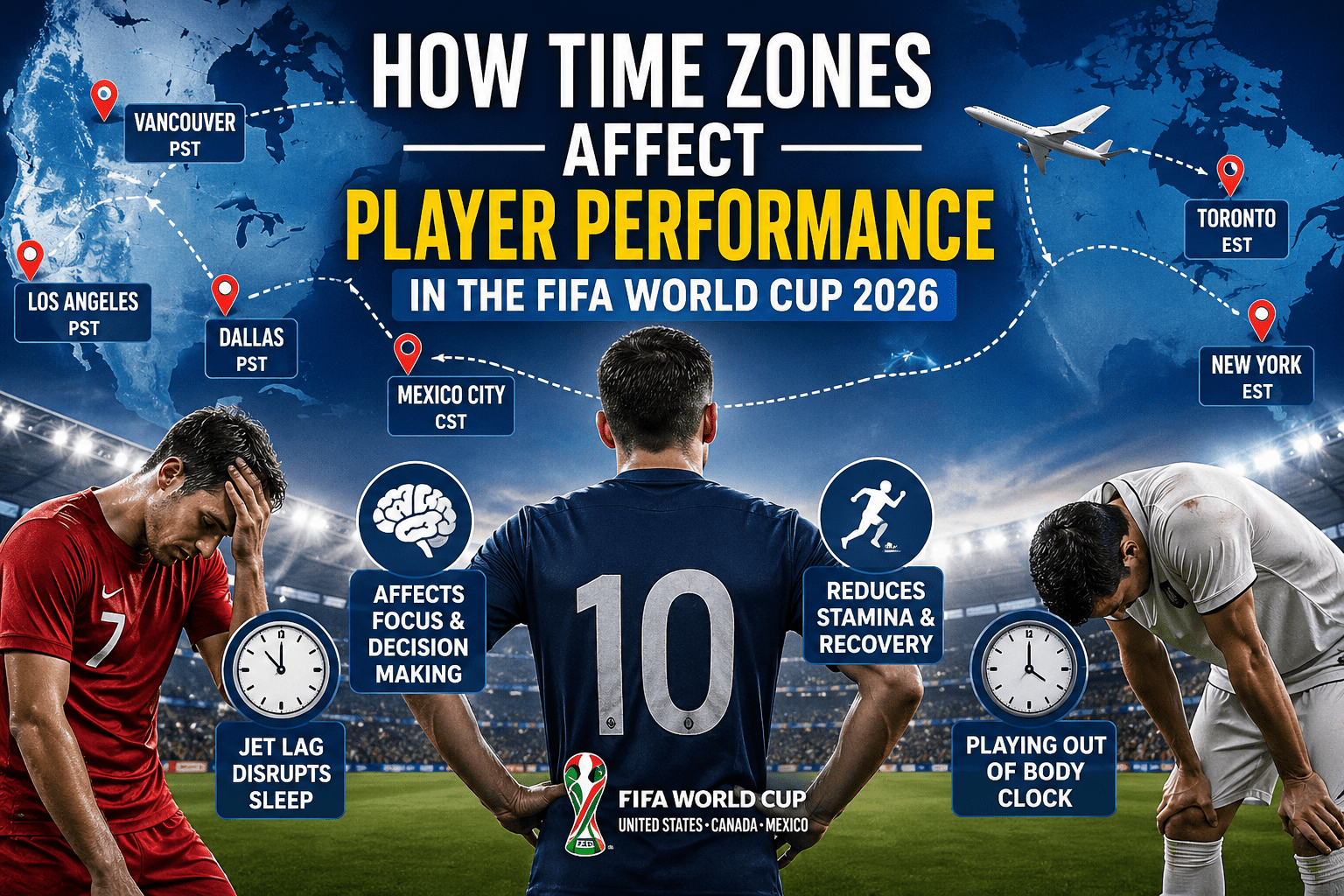
The geography of the 2026 World Cup changes the conversation entirely. Matches will be played across multiple time zones, stretching from cities like Los Angeles and Vancouver in the west to New York and Toronto in the east.

That span creates a gap of several hours between venues. On paper, it’s just a scheduling detail. In practice, it means a team can finish one match on the West Coast and find itself preparing for the next with its body still operating on a different clock.

In a tournament where recovery time is already limited, that mismatch becomes impossible to ignore.

✈️ The Reality of Jet Lag in Elite Football

Jet lag tends to get brushed off as a minor inconvenience, but at the elite level, it’s a genuine performance factor. It interferes with the body’s circadian rhythm—the internal clock that governs sleep, focus, and physical sharpness.

Top-level football is built on precision. Training loads, recovery routines, and even pre-match preparation are timed to ensure players peak at the right moment. When that timing slips, even slightly, the consequences aren’t subtle.

Sleep patterns break down, energy comes in waves rather than consistency, and the body struggles to sync itself quickly enough. The response is there, but it rarely arrives exactly when it’s needed.

🗺️ Distance Becomes a Competitive Factor

Travel has always been part of the World Cup, but never at this scale. In 2026, distances between host cities will regularly stretch into thousands of kilometres.

A team could move from the West Coast to the East between matches, or travel South into different climates and altitudes. These aren’t minor adjustments. They demand physical and mental recalibration in the middle of a tightly packed schedule.

The challenge isn’t just the journey itself; it’s what comes after. Matches don’t wait for players to fully adjust.

⚡ Margins Measured in Milliseconds

At the highest level, football is decided in moments that pass almost instantly. A goalkeeper reacts, a defender steps forward, a striker makes a run. These actions rely on timing that feels instinctive but is rooted in sharp neurological response.

Disrupt that timing, even slightly, and the game changes. Reaction speeds dip just enough to turn a save into a goal, or a clearance into a chance. These are not dramatic failures, they are fractions, but fractions are often decisive.

🏃 Fatigue That Builds, Not Breaks

What makes travel fatigue particularly dangerous is its subtlety. It rarely shows up as complete exhaustion. Instead, it accumulates — a slight drop in stamina here, a slower recovery there.

Over the course of a tournament, those small declines can add up. A team that looks sharp in its opening match may struggle to maintain the same intensity as the schedule tightens and the travel continues.

In that sense, endurance in 2026 may be less about fitness and more about how well teams manage the spaces between matches.

🧠 Decision-Making Under Pressure

Football intelligence — the ability to read the game, anticipate movement, and make the right choice under pressure is often what separates good teams from great ones.

But cognitive sharpness is closely tied to rest and rhythm. When players are not fully synchronized with their environment, decision-making becomes just a fraction slower, just a touch less precise.

Across 90 minutes, those marginal differences can shape entire matches.

😴 Playing Against the Body Clock

Kick-off times are fixed. The body’s internal clock is not.

A match that feels like mid-afternoon locally may register very differently for a player who has recently crossed time zones. In some cases, teams will effectively be playing at what their bodies perceive as early morning or late night.

The result isn’t always visible, but it lingers in performance, in the tempo of play, in the sharpness of movement, in the energy that defines the game.

📊 Lessons from the Past, Scaled Up

Previous World Cups have already shown what travel can do to a team, especially when the host country is spread out. You hear it in post-match interviews—players talking about long flights, broken routines, and the difficulty of finding any sense of normalcy from one game to the next.

What changes in 2026 isn’t the nature of the problem, but the extent of it. The tournament is bigger in every sense—more teams, more fixtures, more miles to cover. And when everything expands like that, the margin for error doesn’t. It shrinks.

🌎 An Uneven Playing Field?

Not all teams will experience these challenges equally. Some will be more familiar with the conditions, others better prepared for long-haul travel.

But familiarity alone doesn’t guarantee success. Adaptation, planning, and squad depth will all play a role in determining who handles the demands of the tournament most effectively.

If there is an advantage, it may belong not to the strongest team on paper, but to the one that manages the tournament best as a whole.

🔧 Managing the Invisible Challenge

Modern teams are not unprepared for these conditions. Sports science has evolved to address travel fatigue, with strategies designed to minimize disruption and accelerate recovery.

Still, no system can fully eliminate the effects of constant movement across time zones. At best, teams can manage the impact — not remove it.

That reality ensures time remains a factor, even if it operates in the background.

⏱️ What It Means for the Tournament

For fans, these dynamics add another layer to the tournament. Matches may unfold differently than expected. Favorites may look less dominant. Underdogs may find opportunities in moments where fatigue shifts the balance.

The 2026 World Cup won’t just test skill and tactics. It will test endurance, adaptability, and the ability to perform when the body is slightly out of sync.

🏁 The Game Beyond the Game

Time zones won’t be listed in match statistics. They won’t appear in post-match analysis or highlight packages. But they will be there, shaping performance in ways that are easy to miss and difficult to measure.

In a tournament defined by fine margins, those unseen influences can make all the difference. And in 2026, as the World Cup stretches across a continent, time itself may become one of the most important opponents any team faces.

Top 10 Underdog Teams That Could Surprise in FIFA World Cup 2026

While each World Cup unfolds its own unique story, it is typically those unexpected narratives that resonate the most with fans. Low-profile teams quietly arriving and often turn out to have the most dramatic outcomes.

The 2026 FIFA World Cup, by expanding the field to 48 teams, will definitely raise the chances for such scenarios. More teams equate to more factors, and with the nature of football tournaments, this usually culminates in a level of unpredictability.

Although not every underdog advances far, the record demonstrates that at least a few always manage to do so. Here are 10 teams from underdog categories that have the capabilities to overturn predictions at the 2026 World Cup.

Morocco

Morocco’s run in 2022 changed how they are perceived, but they still operate outside the traditional elite. That makes them dangerous.

Their success wasn’t built on a moment of brilliance, but on defensive structure and clarity in approach. Teams that understand their identity in tournament football are often the hardest to break.

Japan

The power of Japan is in their capability to adapt. They don’t stick to a single style, so they have the freedom to change according to the opponent.

Japan is well drilled technically as well as being tactically alert. They have even demonstrated their ability to mix it with the best sides. In the knockout stage of the game, that ability to change really counts as a bonus.

United States

Hosting the tournament changes the equation for the United States. Familiar conditions and crowd support can shift momentum in subtle but important ways.

The squad itself is young and energetic, with players gaining experience at top clubs. The key question is not ability, but composure under pressure.

Senegal

Senegal has moved beyond being unpredictable. They now combine physical presence with a clearer tactical identity.

Teams that can maintain structure across multiple matches tend to go further in tournaments, and Senegal has shown signs of that consistency.

Mexico

Mexico enters 2026 with mixed recent form, but playing on home soil changes expectations entirely.

Support, familiarity, and comfort in conditions can elevate performance. If they find early momentum, they could become difficult to stop.

Switzerland

Switzerland usually doesn’t grab the spotlight, but they always manage to be competitive. Their strong defense is what makes them one of the most difficult sides to tackle.

Since matches at that level of competition are mostly determined by tiny differences, such constant performance might be sufficient for them to reach an advanced stage unexpectedly.

South Korea

South Korea plays with intensity that few teams can match. Their pressing and energy can disrupt rhythm and force mistakes.

If they add efficiency in front of the goal, they become more than just competitive — they become dangerous.

Canada

Canada’s profile is built on pace and direct attacking play. They are not overly complicated, but they are effective when space opens up.

As co-hosts, they will play with a sense of freedom, and that unpredictability can unsettle more structured teams.

Ecuador

Ecuador tends to operate under the radar, but they are tactically disciplined and difficult to break down.

Their strength lies in staying compact and capitalizing on key moments rather than controlling entire matches.

Australia

Australia’s style of play relies on organization and effort. They seldom let their opponents have easy openings in the games.

In knock-out situations, when the matches get more tense, these features of the team usually turn out to be more important than the individual skills.

⚽ Why the 2026 Format Favors Underdogs

The expanded structure changes the dynamics of qualification. With more teams progressing from the group stage, perfection is no longer required.

That gives underdogs room to recover from early setbacks and build momentum as the tournament progresses.

Once they reach the knockout rounds, the gap between favorites and outsiders often becomes smaller than expected.

🏁 The Role of the Unexpected

Underdogs not always raise the trophy, but they influence the tournament to a large extent. They create suspense, knock out the better teams and change people’s minds about the team they tip.

In a sporting event as volatile as the World Cup, such occurrences are not rare – they are one of the things that make it what it is.

This year 2026, with the increased number of teams and more opportunities, the conditions are ripe for yet another episode of unexpectedness.

Complete Guide to FIFA World Cup 2026 Format: New Rules Explained Simply

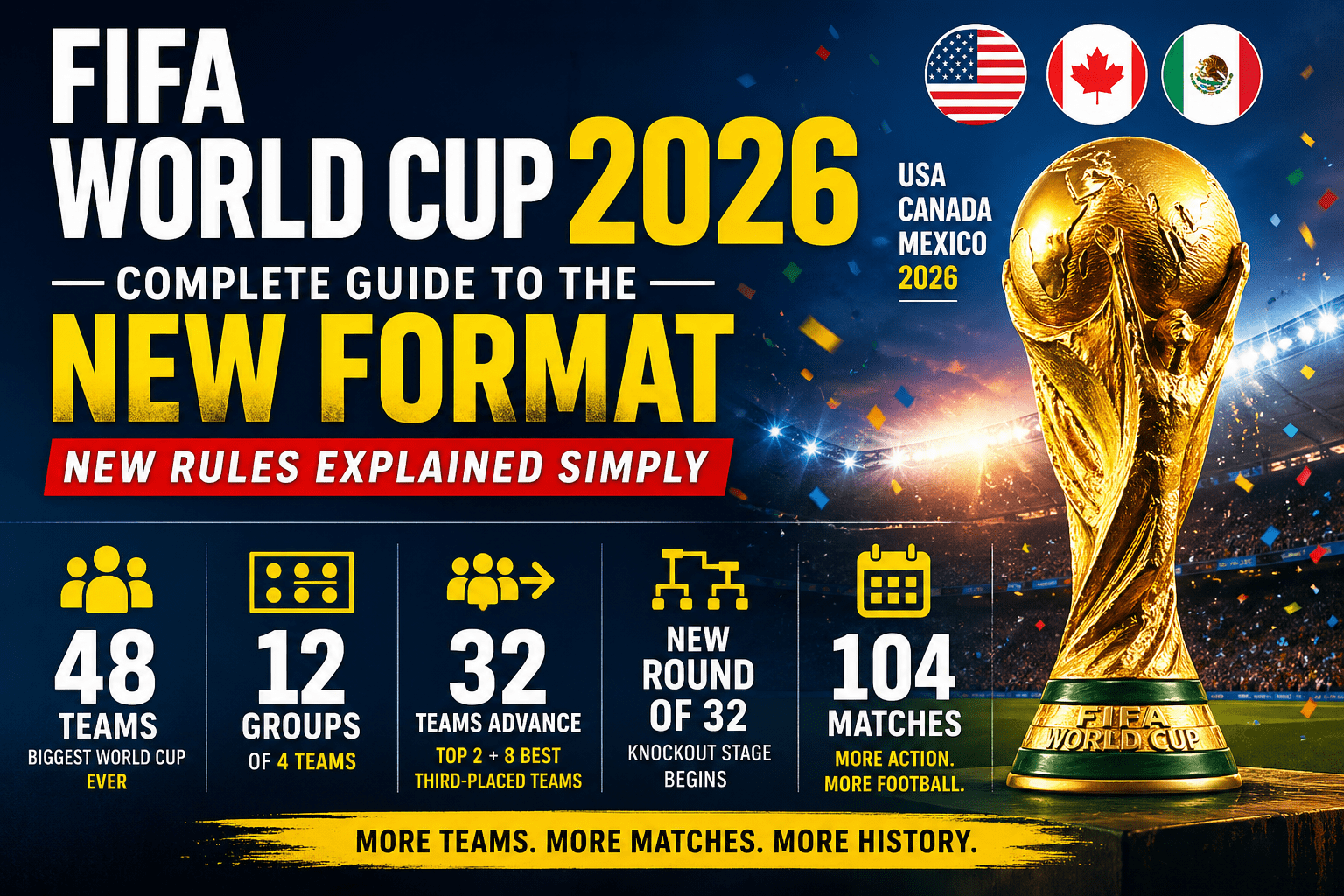
The 2026 FIFA World Cup is going to see an unprecedented growth in international football. For the first time we will see 48 teams take part which brings in new nations to the stage and we see a very different format from what we are used to in past editions.

With more games, a longer competition, and a restructured format it is easy for the average fan to get confused. This guide breaks down the 2026 World Cup format in a simple and easy way.

🌍 Expansion to 48 Teams

The big change we see is the increase from 32 teams to 48 teams. That is the highest increase in the tournament’s history and this has truly made the tournament inclusive.

With more teams in the mix we see greater representation from different continents which in turn gives countries that had trouble qualifying a chance to compete on football’s biggest stage.

Also as a result the total number of matches will go up to 104 from 64 in the past tournaments.

⚽ Group Stage Format Explained

There will be 12 groups and each group will have 4 teams making a total of 48 teams divided into groups. Each team will have three Group-stage games in the form of a round-robin.

Each team will play against the other three teams in their group only once. Points allocation will be based on the usual system: 3 points for the winner, 1 point to each in case of a draw, and 0 for the loser.

This system is quite fair and avoids the problems that could arise with smaller groups.

✅ Who Qualifies for the Knockout Stage?

The qualification system has been altered given that there are more teams.

The top two teams from each group get direct qualification to the knockout round. Besides that, other eight best third-ranked teams from all groups will also qualify.

So altogether 32 teams will be in the second round, which allows the first round to be less strict yet highly competitive.

🏆 Introduction of the Round of 32

Having 32 teams qualify, the knockout phase is kicking off at the Round of 32, meaning that instead of the conventional Round of 16 as the first elimination round, there will be the Round of 32.

Then the competition goes on with the usual sequence: Round of 16, quarterfinals, semifinals, and the final.

The result of each knockout game is determined on that day only. If after regular 90 minutes the scores are tied, then extra time is played and if there is still no winner, penalties are taken.

📊 More Matches, Longer Tournament

Hence, an enlargement results in a considerable rise in the count of matches. A team getting to the final will have 8 encounters on their way rather than 7.

One more game won’t be very noticeable but at the top level that means more physical and tactical input from players and teams.

Keeping up with tiredness, team changes, and getting better will be of a greater concern than even before.

🧠 Why FIFA Changed the Format

The new format is designed to achieve several goals. First, it increases global participation by allowing more teams from different regions to qualify.

Second, it expands the commercial and global reach of the tournament, with more matches and more engagement opportunities for fans worldwide.

Finally, FIFA chose the 12 groups of four teams structure to maintain competitive balance and avoid issues like collusion that could arise in smaller groups.

🟨 Rule Adjustments and Fair Play

As the number of matches increases, a few rules will have to be changed to keep the competition fair throughout the tournament.

One of the main aspects is regulating the yellow cards that can lead to a suspension. Such suspensions are designed in a way so that in most cases, a player who receives a suspension due to yellow cards would not miss a crucial knockout game.

These changes are made to guarantee that the longer format does not over-penalize the teams that advance.

🎯 What It Means for Teams

Regarding teams, the new format alters the strategic thinking of the teams. Since there will be more games and even the chance to qualify as a third-placed team, the group stage will be less about doing everything perfectly and more about being able to keep up the level of performance.

Having a deep squad will become extremely important. Teams having strong substitutes and able to rotate players efficiently will be distinctly ahead of others.

In fact, it will be the longest and hardest journey to the title than at any other time.

👥 What It Means for Fans

For fans, the bigger tournament implies more football games to watch, more countries for the fans to root for. It gives more opportunities for different teams to rise and reveal their game on the world platform.

Allowing third-placed teams to advance means that more games throughout the group stage remain crucial and the atmosphere will be charged with excitement and uncertainty.

On the whole, the experience extends in time, range, and inclusiveness.

🏁 A New Era for the World Cup

There has been no major structural modification to the FIFA World Cup as profound as that of 2026 in the last few decades. It merges the extension of the competition with a recognizable format, thus producing a competition that is not only bigger but also more complicated.

Although issues of quality and competitiveness will still be raised, it is indisputable that the World Cup is stepping into a new era.

And globally, for football fans, it implies that there will be additional games, expanded narratives, and intensified moments that characterize the sport.

No Broadcaster, 40 Days to Go: Why FIFA World Cup 2026 Is Still in Limbo in India

As of May 1, 2026, India still has no confirmed broadcaster for the 2026 FIFA World Cup, with just over 40 days left.

For a tournament of this scale, that is highly unusual. And with the clock ticking, what started as a delay is now turning into a real last-minute problem for fans and broadcasters alike.

🚨 40 Days to Go, Still No Broadcaster

The 2026 FIFA World Cup kicks off on June 11, 2026 (on the early morning of June 12, 2026, for Indian Fans), yet India still does not have an official TV or digital partner.

Broadcast deals for tournaments of this scale are typically finalized years in advance. Networks build marketing campaigns, sell advertising inventory, and prepare coverage well ahead of time.

In this case, none of that has happened — and with the countdown underway, the delay has now turned into a genuine last-minute scramble.

😟 Why Fans Should Be Worried

For fans, the biggest concern is not just where to watch — but whether clarity will come in time.

Last-minute deals often mean rushed coverage, limited promotion, and confusion around streaming platforms.

For a tournament that only comes once every four years, that uncertainty feels out of place.

💰 Why the Deal Is Stuck

At the center of the issue is the gap between FIFA’s expectations and what Indian broadcasters believe the tournament is worth.

Even after reported price reductions, networks remain cautious. The core concern is simple: can they recover the investment?

Advertising revenue, which drives most sports deals in India, may not be strong enough this time — especially given the unique challenges of this tournament.

🕒 Midnight Matches, Lower Revenue

The 2026 World Cup is going to be hosted by North America, which gives rise to a substantial problem for Indian audience in terms of timing.

Nearly all the games are likely to be scheduled between midnight and early morning (IST).

Even though devoted fans can stay up late to watch, a large number of casual viewers will not be there at those hours which adversely affects advertising value.

In terms of broadcasters, the timing issue is one of the major reasons why the agreement is still pending.

🏏 Cricket Still Dominates the Market

Indian sports broadcasting is still heavily driven by cricket.

Major networks and streaming platforms have already invested billions in IPL and ICC rights — properties that guarantee consistent viewership and strong returns.

Compared to that, the World Cup — despite its global appeal — is seen as a riskier investment, especially with difficult match timings.

📉 A More Cautious Broadcasting Industry

The Indian media landscape has changed significantly in recent years.

There are fewer major players due to consolidation, and companies are now far more focused on return on investment rather than prestige.

Even global events like the FIFA World Cup are no longer guaranteed buyers if the financial model doesn’t make sense.

⚽ Does the 48-Team Format Help?

The 2026 tournament is set to include 48 teams and 104 matches in total, so it will be the largest World Cup by far.

This not only adds more matches, but also poses a problem – not all of the games will be appealing enough for large Indian audiences.

Speaking from the TV rights holder’s point of view, an increased number of games is not necessarily equal to higher worth, particularly if the majority of them take place at odd hours.

🔮 What Happens Next?

Despite the uncertainty, it is still highly unlikely that the World Cup will go untelevised in India.

Several outcomes are possible:

• A last-minute deal with a private broadcaster
• A streaming-first approach by a digital platform
• Possible involvement of public broadcasting

If a deal doesn’t happen soon, this could turn into one of the most chaotic World Cup broadcasts India has seen.

🧠 What This Situation Really Means

This is not just about one tournament — it reflects a larger shift in how sports media works in India today.

Broadcasters are no longer chasing global events blindly. Every deal is measured, calculated, and evaluated for profitability.

The 2026 FIFA World Cup has become a real-time example of that change.

⏳ The Clock Is Ticking

The clock is no longer just ticking — it’s becoming the story.

And with time running out, the question is no longer if India will watch the World Cup…

but how late that answer will come.