
The 2026 FIFA World Cup is being sold as the biggest tournament in football history — more teams, more cities, more matches. But beneath the scale and spectacle lies a quieter storyline, one that won’t show up in highlight reels or post-match graphics: time itself.
For players, this World Cup won’t just be about opponents or tactics. It will be about clocks, recovery windows, and the invisible strain of crossing continents in the middle of a tournament. From the Pacific coast to the eastern edge of North America, the game will be played across shifting time zones that challenge not just the body, but the rhythm that drives it.
The question isn’t whether time zones matter. It’s how much they might shape what we see on the pitch.
🌍 A Tournament Spread Across Time
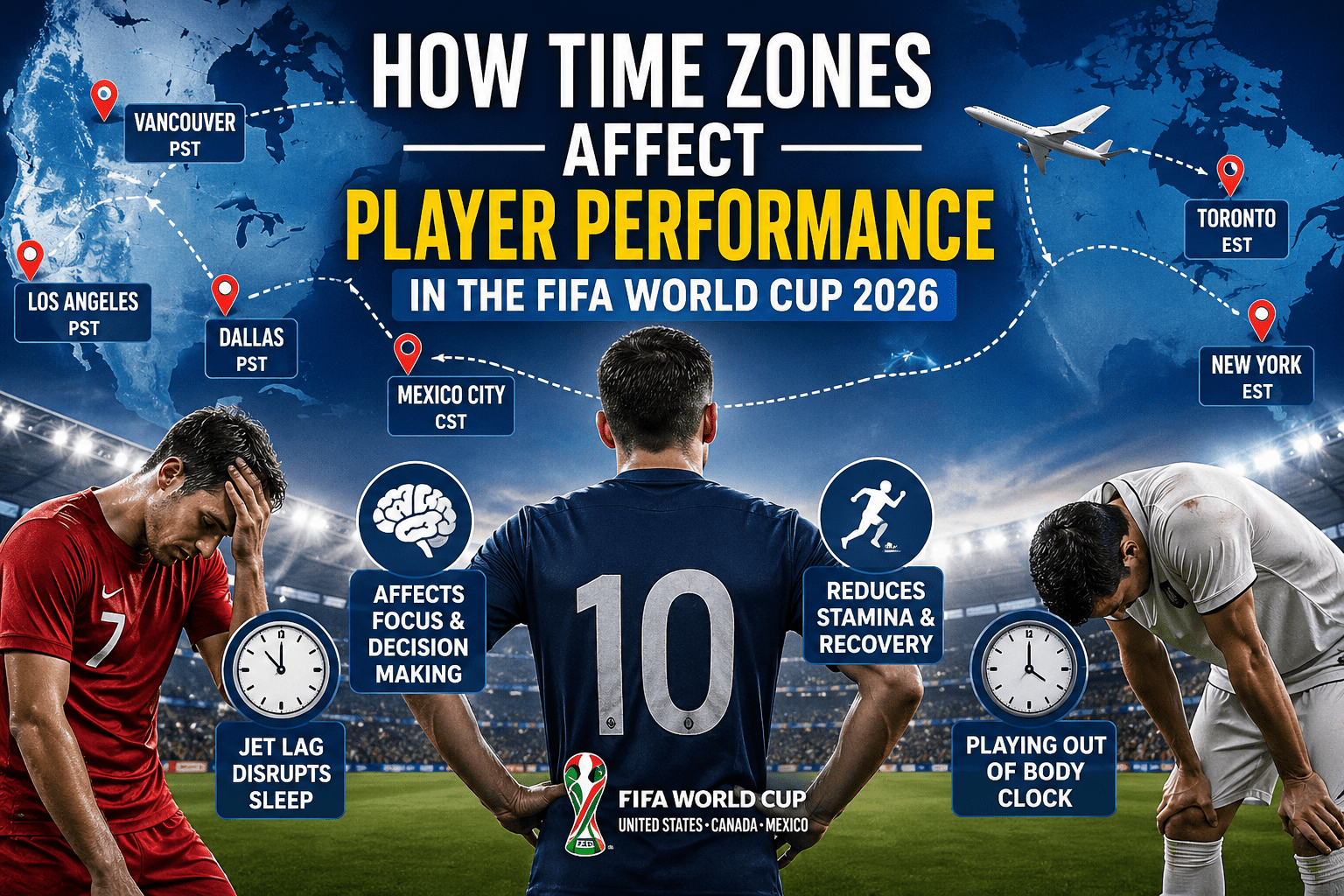
The geography of the 2026 World Cup changes the conversation entirely. Matches will be played across multiple time zones, stretching from cities like Los Angeles and Vancouver in the west to New York and Toronto in the east.
That span creates a gap of several hours between venues. On paper, it’s just a scheduling detail. In practice, it means a team can finish one match on the West Coast and find itself preparing for the next with its body still operating on a different clock.
In a tournament where recovery time is already limited, that mismatch becomes impossible to ignore.
✈️ The Reality of Jet Lag in Elite Football
Jet lag tends to get brushed off as a minor inconvenience, but at the elite level, it’s a genuine performance factor. It interferes with the body’s circadian rhythm—the internal clock that governs sleep, focus, and physical sharpness.
Top-level football is built on precision. Training loads, recovery routines, and even pre-match preparation are timed to ensure players peak at the right moment. When that timing slips, even slightly, the consequences aren’t subtle.
Sleep patterns break down, energy comes in waves rather than consistency, and the body struggles to sync itself quickly enough. The response is there, but it rarely arrives exactly when it’s needed.
🗺️ Distance Becomes a Competitive Factor
Travel has always been part of the World Cup, but never at this scale. In 2026, distances between host cities will regularly stretch into thousands of kilometres.
A team could move from the West Coast to the East between matches, or travel South into different climates and altitudes. These aren’t minor adjustments. They demand physical and mental recalibration in the middle of a tightly packed schedule.
The challenge isn’t just the journey itself; it’s what comes after. Matches don’t wait for players to fully adjust.
⚡ Margins Measured in Milliseconds
At the highest level, football is decided in moments that pass almost instantly. A goalkeeper reacts, a defender steps forward, a striker makes a run. These actions rely on timing that feels instinctive but is rooted in sharp neurological response.
Disrupt that timing, even slightly, and the game changes. Reaction speeds dip just enough to turn a save into a goal, or a clearance into a chance. These are not dramatic failures, they are fractions, but fractions are often decisive.
🏃 Fatigue That Builds, Not Breaks
What makes travel fatigue particularly dangerous is its subtlety. It rarely shows up as complete exhaustion. Instead, it accumulates — a slight drop in stamina here, a slower recovery there.
Over the course of a tournament, those small declines can add up. A team that looks sharp in its opening match may struggle to maintain the same intensity as the schedule tightens and the travel continues.
In that sense, endurance in 2026 may be less about fitness and more about how well teams manage the spaces between matches.
🧠 Decision-Making Under Pressure
Football intelligence — the ability to read the game, anticipate movement, and make the right choice under pressure is often what separates good teams from great ones.
But cognitive sharpness is closely tied to rest and rhythm. When players are not fully synchronized with their environment, decision-making becomes just a fraction slower, just a touch less precise.
Across 90 minutes, those marginal differences can shape entire matches.
😴 Playing Against the Body Clock
Kick-off times are fixed. The body’s internal clock is not.
A match that feels like mid-afternoon locally may register very differently for a player who has recently crossed time zones. In some cases, teams will effectively be playing at what their bodies perceive as early morning or late night.
The result isn’t always visible, but it lingers in performance, in the tempo of play, in the sharpness of movement, in the energy that defines the game.
📊 Lessons from the Past, Scaled Up
Previous World Cups have already shown what travel can do to a team, especially when the host country is spread out. You hear it in post-match interviews—players talking about long flights, broken routines, and the difficulty of finding any sense of normalcy from one game to the next.
What changes in 2026 isn’t the nature of the problem, but the extent of it. The tournament is bigger in every sense—more teams, more fixtures, more miles to cover. And when everything expands like that, the margin for error doesn’t. It shrinks.
🌎 An Uneven Playing Field?
Not all teams will experience these challenges equally. Some will be more familiar with the conditions, others better prepared for long-haul travel.
But familiarity alone doesn’t guarantee success. Adaptation, planning, and squad depth will all play a role in determining who handles the demands of the tournament most effectively.
If there is an advantage, it may belong not to the strongest team on paper, but to the one that manages the tournament best as a whole.
🔧 Managing the Invisible Challenge
Modern teams are not unprepared for these conditions. Sports science has evolved to address travel fatigue, with strategies designed to minimize disruption and accelerate recovery.
Still, no system can fully eliminate the effects of constant movement across time zones. At best, teams can manage the impact — not remove it.
That reality ensures time remains a factor, even if it operates in the background.
⏱️ What It Means for the Tournament
For fans, these dynamics add another layer to the tournament. Matches may unfold differently than expected. Favorites may look less dominant. Underdogs may find opportunities in moments where fatigue shifts the balance.
The 2026 World Cup won’t just test skill and tactics. It will test endurance, adaptability, and the ability to perform when the body is slightly out of sync.
🏁 The Game Beyond the Game
Time zones won’t be listed in match statistics. They won’t appear in post-match analysis or highlight packages. But they will be there, shaping performance in ways that are easy to miss and difficult to measure.
In a tournament defined by fine margins, those unseen influences can make all the difference. And in 2026, as the World Cup stretches across a continent, time itself may become one of the most important opponents any team faces.

